The collapse of the Tacoma Narrows Bridge on November 7, 1940, remains one of the most important structural failures in engineering history. Often referred to as “Galloping Gertie,” the bridge dramatically twisted and oscillated in strong winds before ultimately tearing itself apart and plunging into Puget Sound in Washington State, USA.
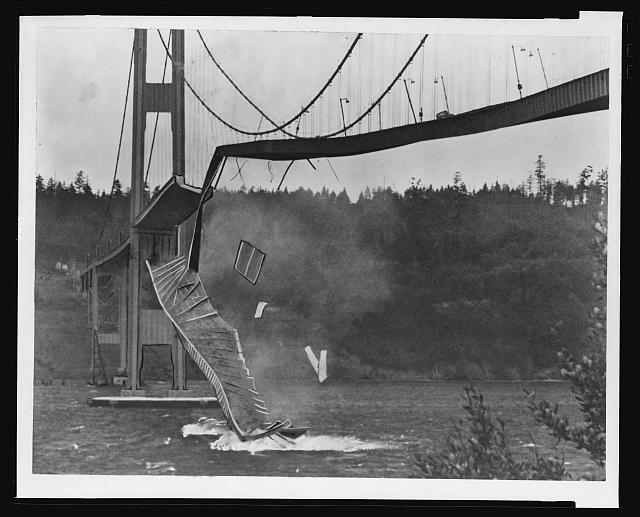
Although no human lives were lost in the disaster, the event profoundly transformed civil engineering, bridge design, aerodynamics, and structural analysis. The collapse demonstrated that engineers could no longer focus solely on static loads such as the weight of vehicles and the bridge itself. Dynamic forces—especially wind—had to become a central consideration in structural design.
Today, the Tacoma Narrows Bridge serves as a case study taught in civil engineering, architecture, construction management, and structural design programs worldwide. The lessons learned from its failure influenced the development of modern suspension bridges and led to major advancements in wind engineering and aerodynamic testing.
This article explores the history, engineering principles, location, economics, geography, architecture, innovative methods, design decisions, and lasting lessons behind one of the most famous engineering failures ever recorded.
Historical Background
During the 1930s, transportation across Puget Sound in Washington State relied heavily on ferries. As automobile ownership increased, local communities demanded a permanent crossing between Tacoma and the Kitsap Peninsula.
Construction of the Tacoma Narrows Bridge began in 1938 and was completed in July 1940. At the time, it was the third-longest suspension bridge in the world, featuring a main span of approximately 2,800 feet (853 meters).
From the moment the bridge opened, motorists noticed unusual movements. Even under moderate winds, the roadway exhibited significant vertical undulations. Drivers reported feeling as though they were riding ocean waves while crossing the structure.
These movements quickly earned the bridge its famous nickname, “Galloping Gertie.”
Although engineers attempted to reduce the oscillations through various modifications, including hydraulic dampers and cable tie-down systems, the underlying aerodynamic problem remained unresolved.
Only four months after opening, the bridge collapsed in spectacular fashion.
Location and Geographic Factors
The Tacoma Narrows Bridge crossed a narrow section of Puget Sound known as “The Narrows,” connecting Tacoma to Gig Harbor in Washington State.
Geographic Characteristics
Several geographical factors contributed to the challenging environment:
- Narrow water passage
- Steep surrounding terrain
- Strong tidal currents
- Frequent wind activity
- Funnel-shaped landscape
The Narrows acts as a natural wind corridor. Air moving through the constricted passage accelerates similarly to water flowing through a nozzle.
This geographic phenomenon regularly produces sustained winds capable of interacting with large structures.
On the morning of November 7, 1940, winds reached approximately 40 miles per hour (64 km/h). While significant, these winds were not considered extreme for the region. The fact that such moderate winds caused catastrophic failure highlighted serious flaws in the bridge’s aerodynamic design.
Economic Pressures and Cost-Cutting Decisions
One of the most important factors behind the collapse was economics.
The Great Depression had placed enormous financial pressure on infrastructure projects across the United States. Funding was limited, and engineers were encouraged to reduce costs wherever possible.
The Quest for a Cheaper Bridge
To save money, designers pursued a more streamlined structure than previous suspension bridges.
Several cost-saving measures included:
- Narrow deck width
- Reduced structural depth
- Use of solid plate girders instead of open trusses
- Lower overall material usage
These decisions significantly reduced construction costs and allowed the project to move forward.
However, they also created an exceptionally flexible structure.
The bridge became lighter and more elegant, but it sacrificed critical stiffness that would have helped resist aerodynamic forces.
The economic benefits achieved during construction ultimately led to much greater costs following the collapse, including reconstruction expenses, engineering investigations, and lost public confidence.
The Tacoma Narrows disaster remains a powerful reminder that short-term cost savings can create long-term risks when structural performance is compromised.
Architectural Design and Aesthetic Innovation
From an architectural perspective, the Tacoma Narrows Bridge was considered revolutionary.
During the early twentieth century, suspension bridges typically used deep open trusses beneath the roadway. These trusses provided substantial stiffness but often appeared bulky and industrial.
A Modern Appearance
The Tacoma Narrows Bridge adopted a sleek and elegant profile.
Architects and engineers sought a cleaner visual appearance featuring:
- Thin deck sections
- Smooth lines
- Minimal structural depth
- Streamlined proportions
The bridge represented a modernist approach to infrastructure design.
Its appearance was widely praised because it seemed lighter and more graceful than earlier suspension bridges.
Unfortunately, the same features that made the bridge aesthetically appealing also reduced its resistance to wind-induced movement.
This tension between aesthetics and structural performance continues to challenge architects and engineers today.
Modern projects strive to balance visual elegance with safety, functionality, and resilience.
Engineering Principles Behind the Collapse
The Tacoma Narrows Bridge collapse is fundamentally a story about engineering principles and the interaction between structures and wind.
Traditional bridge design focused primarily on:
- Dead loads (self-weight)
- Live loads (traffic)
- Temperature effects
- Earthquake forces
However, the bridge revealed the importance of aerodynamic forces.
Understanding Structural Dynamics
Every structure has natural frequencies at which it prefers to vibrate.
When external forces interact with these frequencies, motion can become amplified.
Engineers now study:
- Resonance
- Vibration modes
- Dynamic loading
- Aeroelasticity
- Fluid-structure interaction
The Tacoma Narrows Bridge demonstrated that wind can act not merely as a static pressure but as a dynamic force capable of continuously feeding energy into a structure.
Aerodynamic Instability
One of the primary causes of the collapse was aerodynamic instability.
Unlike modern suspension bridges, which often use open trusses or aerodynamic deck sections, the Tacoma Narrows Bridge used solid steel plate girders along the sides of the roadway.
How the Wind Affected the Structure
When wind struck the bridge:
- Airflow could not easily pass through the deck.
- Vortices formed behind the girders.
- Pressure differences developed above and below the deck.
- Oscillations began to grow.
These aerodynamic effects generated vertical and twisting motions.
Instead of dissipating energy, the bridge continuously absorbed additional energy from the wind.
The result was increasing movement rather than stabilization.
Torsional Flutter: The True Cause of Failure
For many years, the collapse was incorrectly described as a simple resonance problem.
Modern research has shown that the primary mechanism was aeroelastic torsional flutter.
What Is Torsional Flutter?
Torsional flutter occurs when aerodynamic forces interact with a structure’s twisting motion.
The process unfolds as follows:
- Wind causes the deck to twist slightly.
- The twisted deck alters airflow patterns.
- New aerodynamic forces increase the twisting.
- Additional energy enters the system.
- Oscillations become larger.
- Structural components begin failing.
Unlike ordinary vibration, flutter is self-exciting.
Once it begins, it can grow even without stronger winds.
This phenomenon is particularly dangerous because the structure effectively creates the conditions that worsen its own motion.
By the morning of November 7, the bridge was twisting dramatically, with one side rising while the opposite side fell.
The rotational movements became so severe that structural failure became inevitable.
The Role of Extreme Flexibility
Another major factor was the bridge’s unusual flexibility.
The deck was exceptionally slender relative to its span length.
Lack of Torsional Stiffness
Torsional stiffness refers to a structure’s resistance to twisting.
Because the bridge was:
- Narrow
- Shallow
- Lightweight
it possessed limited torsional resistance.
As aerodynamic forces increased, the structure lacked the strength and rigidity necessary to prevent large rotational movements.
The bridge essentially behaved like a flexible ribbon suspended across the water.
While flexibility is not inherently bad, excessive flexibility without adequate damping or aerodynamic stability can be catastrophic.
Cable Slippage and Final Failure
As oscillations intensified, the bridge experienced additional structural problems.
Investigations revealed that a cable band on the north suspension cable slipped shortly before collapse.
Structural Imbalance
This slippage divided the bridge into unequal sections and disrupted load distribution.
The resulting imbalance increased stress throughout the structure.
Violent twisting motions then caused suspenders and connections to fail progressively.
Once critical members fractured, the bridge rapidly disintegrated.
Large sections of the roadway broke apart and fell into Puget Sound.
Within hours, one of the world’s longest suspension bridges had been destroyed.
Innovative Methods Emerging from the Disaster
Although the collapse was tragic from an engineering standpoint, it sparked extraordinary innovation.
The disaster forced engineers to rethink bridge design fundamentally.
Wind Tunnel Testing
One of the most important developments was the widespread adoption of wind tunnel testing.
Today, engineers routinely build scale models and expose them to simulated wind conditions.
Testing evaluates:
- Aerodynamic behavior
- Vortex formation
- Flutter potential
- Structural response
- Wind-induced vibrations
Virtually every major long-span bridge now undergoes extensive aerodynamic analysis before construction.
Computational Modeling
Advances in computer technology later enabled:
- Finite element analysis
- Computational fluid dynamics
- Aeroelastic simulations
- Dynamic structural modeling
These tools help engineers predict behavior that would have been impossible to analyze accurately in 1940.
Design Improvements in Modern Bridges
Modern suspension bridges incorporate numerous features developed directly from lessons learned at Tacoma Narrows.
Aerodynamic Deck Sections
Today’s bridges often use streamlined deck shapes that allow air to flow smoothly around the structure.
Examples include:
- Box girders
- Open truss systems
- Ventilated deck designs
Increased Stiffness
Modern bridges include stronger structural systems to resist twisting.
Damping Systems
Specialized dampers help absorb vibrational energy before it becomes dangerous.
Continuous Monitoring
Sensors now monitor:
- Wind speeds
- Vibrations
- Structural stresses
- Cable movements
These technologies provide early warning of potential problems.
Impact on Civil Engineering
The collapse transformed the engineering profession.
Before Tacoma Narrows, wind effects were often considered secondary concerns.
After Tacoma Narrows, aerodynamic performance became a core aspect of structural design.
Educational Significance
Today, the bridge is studied in courses involving:
- Structural engineering
- Bridge engineering
- Architecture
- Construction management
- Fluid mechanics
- Aerodynamics
Students learn how design decisions, economics, aesthetics, and environmental conditions interact within complex infrastructure projects.
The event remains one of the most valuable educational examples of engineering failure analysis.
Impact on Architecture and Construction
The collapse also influenced architecture and construction practices.
Architects learned that visual elegance must always be balanced against structural performance.
Construction professionals recognized the importance of:
- Comprehensive testing
- Interdisciplinary collaboration
- Risk assessment
- Quality control
- Performance-based design
The disaster demonstrated that successful infrastructure requires cooperation among architects, engineers, contractors, and researchers.
The Replacement Bridge
A replacement Tacoma Narrows Bridge opened in 1950.
Unlike its predecessor, the new structure incorporated lessons from the collapse.
Improvements included:
- Deep open trusses
- Greater stiffness
- Improved aerodynamic behavior
- Enhanced structural redundancy
The replacement bridge has operated successfully for decades.
A second parallel span opened in 2007 to accommodate growing traffic demands.
Together, these bridges demonstrate how engineering knowledge evolves through experience and continuous improvement.
Lessons Learned
The Tacoma Narrows Bridge collapse remains one of the most influential engineering failures ever studied.
Several enduring lessons emerged:
1. Wind Matters
Aerodynamic forces can be as important as gravity loads in long-span structures.
2. Testing Is Essential
Complex structures require extensive analysis and physical testing before construction.
3. Cost Savings Have Limits
Economic efficiency should never compromise structural safety.
4. Aesthetics Must Support Performance
Beautiful designs must also satisfy engineering requirements.
5. Flexibility Requires Control
Flexible structures need sufficient stiffness, damping, and aerodynamic stability.
6. Engineering Is Continually Evolving
Failures provide valuable opportunities for learning and innovation.
Conclusion
The collapse of the Tacoma Narrows Bridge was far more than a dramatic structural failure. It represented a turning point in the history of engineering, architecture, and construction.
Driven by aerodynamic instability, torsional flutter, extreme flexibility, and structural imbalance, the bridge failed under wind conditions that should not have threatened a properly designed structure. Economic pressures, innovative yet unproven design choices, and limited understanding of aerodynamic behavior all contributed to the disaster.
Yet from this failure emerged some of the most important advancements in modern engineering. Wind tunnel testing, aerodynamic bridge design, computational analysis, and improved structural monitoring all trace part of their development to the lessons learned from “Galloping Gertie.”
More than eighty years later, the Tacoma Narrows Bridge remains a powerful reminder that successful infrastructure depends on the careful integration of engineering science, architectural vision, economic realities, and environmental understanding. Its legacy continues to shape the design of bridges around the world, ensuring that future generations benefit from the hard-earned lessons of one of history’s most famous engineering failures.
No responses yet