Few structures in human history have achieved the enduring influence of the Roman Colosseum. Nearly two millennia after its construction, the amphitheater remains one of the most recognizable architectural works ever built and continues to shape modern thinking about stadium design, public infrastructure, urban planning, and the relationship between architecture and political authority.
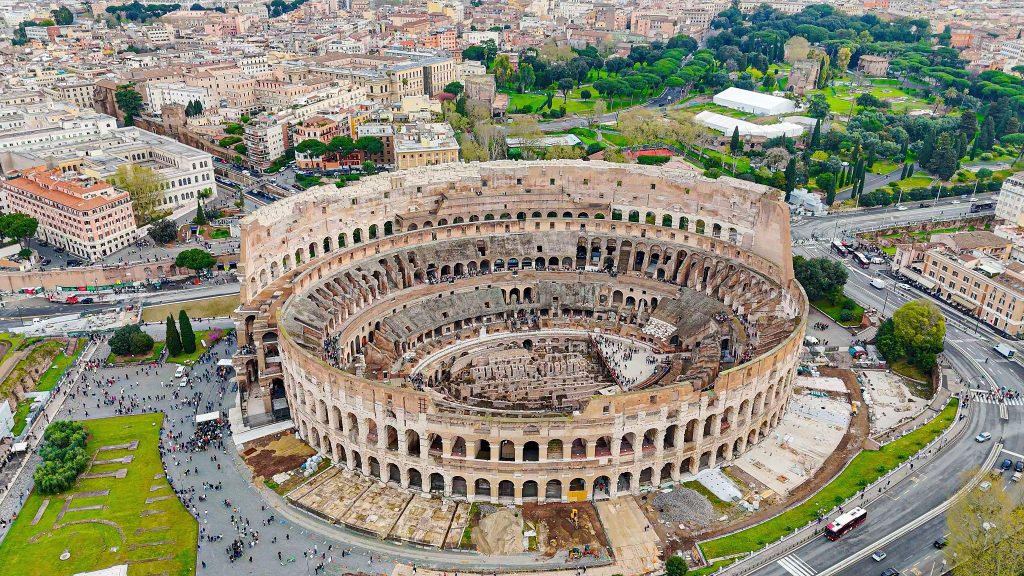
While commonly remembered as a venue for gladiatorial combat and public spectacles, the Colosseum was far more than an entertainment facility. It represented a sophisticated integration of engineering, construction management, social organization, urban planning, and statecraft. In many ways, it functioned as a machine designed to shape public perception, reinforce social hierarchy, and project the power of the Roman Empire.
For civil engineers, architects, urban planners, and construction professionals, the Colosseum offers valuable lessons about large-scale project delivery, infrastructure systems, crowd management, structural innovation, and the strategic use of architecture to influence society. Its construction demonstrates how the built environment can simultaneously solve political problems, create civic identity, and establish a lasting cultural legacy.
This article examines the Colosseum not merely as an ancient monument but as one of history’s most influential engineering achievements and explores how its design principles continue to resonate in contemporary architecture and urban development.
The Political Context Behind the Project
Every major construction project emerges from a specific social and political context, and the Colosseum is no exception.
The site upon which the Colosseum stands was once occupied by a private lake belonging to Emperor Nero’s vast palace complex, the Domus Aurea, or “Golden House.” Following the devastating Great Fire of Rome in 64 CE, Nero appropriated significant portions of the city to construct his extravagant residence. While architecturally impressive, the palace became a powerful symbol of imperial excess and detachment from ordinary citizens.
After Nero’s downfall and death, the new emperor Vespasian faced a critical challenge: restoring public trust in the imperial government. His solution was both symbolic and practical. Rather than preserving Nero’s private pleasure grounds, he drained the artificial lake and replaced it with a public amphitheater capable of accommodating approximately 50,000 spectators.
This decision transformed a space associated with elite privilege into one dedicated to public use. From an urban design perspective, it represents one of history’s most significant examples of adaptive land repurposing. A landscape that once communicated exclusivity and authoritarian control was reimagined as a civic gathering space intended to serve the broader population.
Construction began around 72 CE and was completed in less than a decade—an extraordinary achievement considering the scale, complexity, and technological limitations of the era.
The project was reportedly financed through wealth acquired during the Roman conquest of Judea and utilized labor from captured prisoners. Beyond its practical function, the building itself became a visible demonstration of Rome’s military and economic power. It embodied a clear message: the empire possessed the resources, labor force, and organizational capability to transform conquered territories into monumental public works.
Construction and Engineering at an Unprecedented Scale
The Colosseum was among the largest construction projects of the ancient world.
Measuring approximately 189 meters in length, 156 meters in width, and nearly 50 meters in height, the structure occupied an immense footprint within the urban fabric of Rome. The scale alone required engineering solutions rarely attempted before.
The building utilized a combination of materials including travertine limestone, volcanic tuff, brick-faced concrete, and iron clamps. Roman concrete, one of the empire’s greatest technological innovations, played a particularly important role. Its durability allowed engineers to create large vaulted spaces and structural forms that would have been difficult or impossible using traditional stone construction alone.
The amphitheater’s structural system relied heavily on arches and vaults, which efficiently distributed loads throughout the building. Rather than depending on massive solid walls, Roman engineers developed a network of interconnected arches capable of supporting enormous weight while minimizing material consumption.
This approach reflects principles still employed in modern structural engineering. Efficient load transfer, redundancy, and material optimization remain fundamental objectives in contemporary design.
The Colosseum’s construction also required sophisticated project management. Coordinating thousands of workers, sourcing construction materials, transporting stone, and maintaining schedules over several years demanded organizational capabilities comparable to those required for modern megaprojects.
In many respects, the Colosseum can be viewed as one of history’s earliest examples of large-scale integrated project delivery.
Urban Planning and Strategic Site Selection
One of the most remarkable aspects of the Colosseum is its relationship with the surrounding city.
The amphitheater was strategically positioned between important districts of Rome, including elite residential areas, commercial zones, religious centers, and major transportation routes. This placement ensured that citizens from diverse social backgrounds would encounter the structure regularly during their daily activities.
Urban planners today understand that landmark buildings can influence movement patterns and shape perceptions of place. The Romans demonstrated this principle with exceptional sophistication.
The site itself occupied a natural depression between several hills. As visitors approached, the structure gradually emerged into view, creating a dramatic visual experience. This manipulation of topography amplified the building’s perceived scale and monumentality.
Modern architects frequently employ similar techniques. Museums, civic buildings, and cultural institutions are often positioned to maximize visual impact through carefully orchestrated approaches and sightlines.
The Colosseum demonstrates that successful urban design extends beyond the building itself. The surrounding environment, circulation patterns, and visual sequences all contribute to the overall experience.
Architecture as a Language of Social Order
The Colosseum offers a fascinating case study in how architecture can communicate social values.
Although the amphitheater welcomed tens of thousands of spectators, access and seating arrangements were carefully controlled according to social class. The spatial organization of the building physically reinforced Roman hierarchy.
The emperor occupied privileged seating. Senators and aristocrats sat closest to the arena floor. Wealthier citizens occupied intermediate sections, while women, slaves, and lower-status groups were assigned seats farther from the action.
This hierarchy was not hidden; it was celebrated and embedded directly into the architecture.
The exterior façade further reinforced these ideas through the use of classical orders. The lower level employed the sturdy Doric order, the middle levels featured Ionic columns, and the upper levels incorporated the more elaborate Corinthian style.
This vertical progression created a symbolic representation of Roman society. Strength formed the foundation, refinement occupied the middle, and grandeur crowned the top.
For architects, this demonstrates how formal design elements can communicate abstract concepts such as authority, order, and cultural identity. Buildings are never neutral objects; they carry meanings that influence how users interpret their environment.
Crowd Management and Circulation Engineering
Perhaps one of the Colosseum’s most impressive achievements was its circulation system.
Accommodating approximately 50,000 spectators required careful attention to crowd movement, safety, and accessibility. Roman engineers developed an extensive network of corridors, stairways, ramps, and entrances that allowed large numbers of people to enter and exit efficiently.
The structure incorporated approximately 80 entrances distributed around its perimeter. This decentralized approach minimized congestion and reduced evacuation times.
The famous vomitoria—passageways designed to rapidly disperse crowds—enabled spectators to reach their assigned seating sections with remarkable efficiency.
Modern stadium designers continue to employ many of the same principles. Contemporary sports venues rely on distributed entrances, hierarchical circulation systems, clear wayfinding strategies, and carefully calculated egress capacities.
The Colosseum demonstrates that crowd engineering is not a modern invention. Roman architects understood that user experience depends not only on the destination but also on the journey through the building.
Environmental Design and Spectator Comfort
The Romans also addressed environmental challenges in innovative ways.
One of the most notable features was the velarium, a massive retractable awning system that provided shade for spectators. Operated by sailors and supported by a complex network of ropes and masts, the canopy reduced solar exposure and improved comfort during events.
This represents an early example of climate-responsive architecture.
Today, architects employ advanced technologies such as tensile membranes, kinetic façades, and retractable roofs to achieve similar objectives. Although separated by nearly two thousand years, both approaches reflect the same fundamental concern: creating comfortable environments for large populations.
The incorporation of environmental controls demonstrates that Roman engineers understood the relationship between thermal comfort and user satisfaction long before modern building science emerged.
The Hypogeum: Hidden Infrastructure Beneath the Arena
While the Colosseum’s exterior captured public attention, much of its engineering brilliance remained hidden below ground.
Approximately a decade after the amphitheater opened, a massive underground complex known as the hypogeum was added beneath the arena floor.
This two-level system functioned as a backstage infrastructure network supporting performances and spectacles. It contained holding areas for animals, storage rooms, mechanical equipment, staging zones, and circulation corridors.
More than 80 lifts connected the underground spaces to the arena above. Operated through a combination of pulleys, capstans, and human labor, these mechanisms enabled animals, scenery, and performers to appear dramatically on the arena floor.
From an engineering perspective, the hypogeum resembles modern building service infrastructure. Like contemporary mechanical rooms, service tunnels, and logistics networks, it supported visible operations while remaining largely invisible to users.
The lesson is clear: successful architecture depends not only on what occupants see but also on the hidden systems that enable functionality.
Water Infrastructure and Roman Engineering Excellence
The Colosseum cannot be fully understood without considering Rome’s broader infrastructure network.
Ancient sources describe occasions when the amphitheater hosted simulated naval battles involving large quantities of water. Whether such events occurred frequently remains debated among historians, but their possibility highlights the sophistication of Roman hydraulic engineering.
Rome’s aqueduct system transported enormous volumes of water across challenging terrain using gravity alone. Carefully controlled gradients allowed water to travel for tens of kilometers while maintaining reliable flow.
This infrastructure supplied public baths, fountains, industrial operations, and potentially special events within the Colosseum.
For civil engineers, the Roman water system remains one of history’s greatest achievements. It illustrates how large-scale infrastructure networks can support urban growth, public health, economic development, and cultural activities simultaneously.
Architecture, Identity, and Civic Memory
One reason the Colosseum remains culturally significant today is that it succeeded in shaping collective identity.
The structure transformed Rome’s military victories, economic power, and social hierarchy into physical form. Citizens who entered the amphitheater experienced not merely entertainment but a carefully constructed narrative about what it meant to be Roman.
The building reinforced civic pride, loyalty, and a sense of belonging to something larger than oneself.
Modern governments and institutions continue to use architecture for similar purposes. National museums, memorials, stadiums, and civic centers often serve as symbols of shared identity and collective values.
The Colosseum demonstrates how architecture can outlive the political systems that created it. Although the Roman Empire eventually collapsed, the building continues to influence how subsequent generations perceive Roman civilization.
Lessons for Modern Construction and Urban Development
The Colosseum remains relevant because it addresses challenges that contemporary professionals still face.
First, it illustrates the importance of integrating architecture, engineering, and urban planning into a unified vision. The project succeeded not because of any single innovation but because multiple disciplines worked together toward common objectives.
Second, it highlights the value of infrastructure. Hidden systems—including transportation networks, water supply, logistics corridors, and service spaces—often determine whether public projects succeed or fail.
Third, it demonstrates the power of user experience. Circulation, comfort, accessibility, and visual impact were treated as essential design considerations rather than afterthoughts.
Finally, it reminds us that architecture is never purely technical. Buildings shape behavior, communicate values, and influence how societies understand themselves.
Conclusion
The Colosseum stands as one of the most extraordinary achievements in the history of architecture, engineering, and construction. Its significance extends far beyond its role as an ancient entertainment venue.
The amphitheater represents a masterclass in structural engineering, project delivery, urban planning, crowd management, environmental design, and infrastructure integration. It demonstrates how architecture can simultaneously serve practical needs, communicate political messages, and create lasting cultural identity.
For today’s civil engineers, architects, and construction professionals, the Colosseum offers a powerful reminder that great projects are not measured solely by their technical specifications. Their true success lies in how effectively they connect people, shape cities, and endure across generations.
Nearly two thousand years after its completion, the Colosseum remains more than a monument. It is a testament to the enduring power of engineering and design to transform society and leave a legacy that outlasts empires themselves.
No responses yet