What does it take to manufacture a concrete structure longer than two football pitches, weighing more than 73,000 tonnes, and designed to spend the next 120 years beneath the sea?
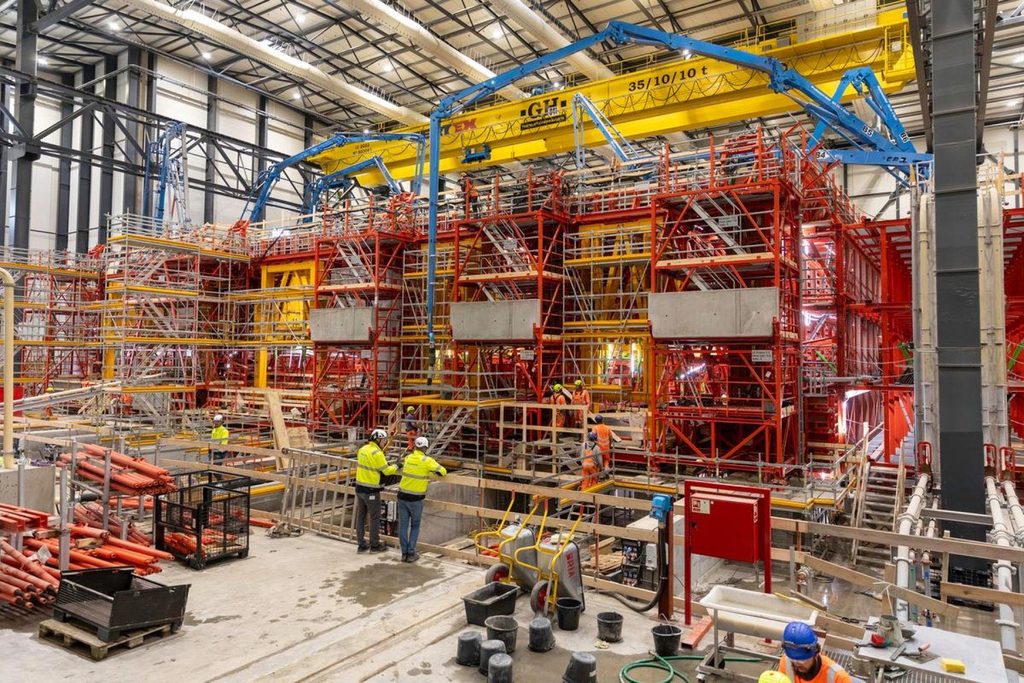
On the Danish island of Lolland, near the town of Rødbyhavn, engineers have constructed an extraordinary factory.
It does not manufacture cars, ships, or conventional building components.
Instead, it produces enormous reinforced-concrete tunnel sections that will eventually form part of an 18-kilometre underwater road and railway connection between Denmark and Germany.
The project is the Fehmarnbelt Tunnel, one of the most ambitious infrastructure developments in Europe.
When completed, the tunnel will contain four motorway lanes and two electrified railway tracks, providing a permanent connection beneath the Baltic Sea.
But the most remarkable engineering achievement may be taking place before the tunnel elements even reach the water.
Each standard tunnel element measures approximately 217 metres long, 42 metres wide, and 9 metres high.
It weighs approximately 73,500 tonnes.
And rather than constructing each section individually at the installation site, engineers are manufacturing these giant concrete structures using a highly organized production system.
The process brings together reinforced-concrete technology, automated steel fabrication, specialized formwork, concrete chemistry, precision surveying, and industrial production management.
So how exactly are these extraordinary structures made?
Let’s follow the manufacturing process from raw materials to a completed tunnel element ready for installation.
1. Why Build an Underwater Tunnel in a Factory?
Most people associate concrete construction with activity taking place directly at a building site.
Workers assemble reinforcement, install formwork, pour concrete, and allow the material to harden where the final structure will remain.
This is known as cast-in-place construction.
For enormous underwater infrastructure, however, constructing every component at its final position can be extremely difficult.
Working beneath water introduces problems involving visibility, currents, access, equipment positioning, and quality control.
The Fehmarnbelt Tunnel uses a different strategy.
Its main concrete elements are manufactured on land and later transported to their permanent underwater locations.
This is a form of precast concrete construction, although the components are vastly larger than conventional precast beams, slabs, or wall panels.
The advantages of industrialized construction
A factory environment offers several benefits.
Concrete can be placed under more controlled conditions, reinforcement can be inspected before casting, and formwork can be reused across multiple production cycles.
Workers also have better access to equipment and materials than they would during underwater construction.
Most importantly, the production process can be standardized.
Instead of treating every tunnel element as a separate construction project, engineers repeat a carefully designed manufacturing sequence.
That repetition is important because the Fehmarnbelt Tunnel requires 79 standard elements and ten special elements.
The challenge is not simply manufacturing one enormous concrete structure.
It is manufacturing dozens of them consistently.
2. Inside the Fehmarnbelt Tunnel Factory
The tunnel factory is located near Rødbyhavn on Denmark’s southern coast.
It was constructed specifically to manufacture the elements required for the Fehmarnbelt crossing.
The facility contains three production halls, designated A, B, and C.
Five production lines are used for standard tunnel elements, while a sixth manufactures the smaller special elements.
Each standard tunnel element consists of nine reinforced-concrete segments.
This means that producing the 79 standard elements requires 711 individual segment castings.
The manufacturing operation is therefore comparable to a large industrial production facility rather than a conventional construction site.
Concrete production on demand
Two large concrete batching plants are located beside the production halls.
Together, they are capable of producing more than 600 cubic metres of concrete per hour.
This capacity is important because individual casting operations require thousands of cubic metres of concrete.
Concrete supply must be coordinated with the placement schedule to maintain consistency and avoid unwanted interruptions.
A prolonged interruption during a major pour can create construction joints or other quality concerns if it is not properly managed.
Consequently, concrete production, transportation, placing equipment, and workforce scheduling must operate as an integrated system.
The factory also includes dedicated areas for reinforcement fabrication, material handling, element preparation, and movement toward the work harbour.
Every part of the facility supports the larger objective: producing enormous tunnel elements safely, efficiently, and to demanding quality standards.
3. Step One: Manufacturing the Steel Reinforcement
Before concrete can be poured, engineers must prepare the steel reinforcement.
Concrete is exceptionally useful for resisting compression, but its tensile strength is relatively low.
Steel reinforcement allows reinforced-concrete structures to resist tensile stresses and helps control cracking.
For an underwater tunnel, these requirements are particularly important.
The structure must resist water pressure, soil loads, construction forces, and traffic loads throughout its service life.
Prefabricating reinforcement cages
At Fehmarnbelt, much of the reinforcement is prepared in a dedicated panel factory.
Steel reinforcement bars are assembled into large grid-like structures that form part of the tunnel’s internal reinforcement system.
The facility uses automated equipment, including welding robots, to help manufacture these assemblies.
The completed reinforcement structures are transported to the main production halls.
There, workers position and connect them into the required three-dimensional arrangements.
This approach reduces the amount of individual reinforcement assembly required at the casting stations.
It also allows repetitive manufacturing tasks to be carried out using controlled production methods.
Why reinforcement placement matters
Steel bars must be positioned according to the structural design.
Their diameter, spacing, anchorage, and concrete cover influence the element’s strength and durability.
Concrete cover is especially important in marine structures because it helps protect embedded steel against environmental exposure.
If reinforcement is positioned too close to a surface, the intended protective cover may be reduced.
This can increase the risk of deterioration over time.
Engineers therefore use inspection procedures to verify reinforcement placement before the concrete is cast.
4. Step Two: Assembling the Giant Formwork
Once the reinforcement has been prepared, the next major challenge is creating the shape of the tunnel segment.
Formwork is the temporary or reusable structure that holds fresh concrete in its required position until it has developed sufficient strength.
For conventional buildings, formwork might create columns, beams, slabs, or walls.
At Fehmarnbelt, the formwork must create an enormous tunnel cross-section with multiple internal compartments.
The tunnel cross-section
Each standard element contains separate spaces for road traffic, railway traffic, and a central service passage.
These openings must be formed with sufficient accuracy to accommodate future installations and structural requirements.
The formwork therefore consists of complex assemblies of steel components, supports, platforms, and adjustment mechanisms.
Specialist formwork supplier PERI developed customized systems for the production lines.
These systems are designed to support repeated concrete casting operations at an extraordinary scale.
Each segment casting involves approximately 3,300 cubic metres of concrete.
That is far beyond the quantity required for many conventional building components.
Managing formwork pressure
Fresh concrete behaves approximately like a fluid before it begins to stiffen.
As concrete is placed, it applies lateral pressure to the formwork.
The magnitude of that pressure depends on factors including placement rate, concrete properties, temperature, and setting behavior.
If the formwork is inadequately designed, excessive pressure can cause deformation or failure.
For this reason, engineers must carefully coordinate the formwork design with the concrete placement procedure.
The equipment must also be sufficiently rigid to maintain the required geometry.
Even small dimensional errors can become significant when repeated across hundreds of large concrete segments.
5. Step Three: Producing the Concrete Mix
The next stage begins at the batching plants.
Concrete is manufactured by combining cementitious materials, aggregates, water, and selected admixtures.
The proportions of these ingredients influence fresh-concrete workability, strength development, durability, shrinkage, and heat generation.
For marine infrastructure, durability is particularly important.
The completed tunnel must function within a demanding environment for a design service life of at least 120 years.
Why ordinary concrete is not enough
Concrete specifications for major infrastructure must consider more than compressive strength.
Engineers also evaluate permeability, resistance to environmental exposure, and the potential for cracking.
Water and aggressive substances can enter concrete through pores or cracks.
Over time, these processes may affect embedded reinforcement and the structure’s durability.
The concrete mixture must therefore satisfy strict performance requirements.
Admixtures may be used to control workability, setting behavior, and other characteristics.
However, a concrete mixture that performs well in laboratory testing must also remain practical to manufacture and place at full scale.
This is especially challenging when thousands of cubic metres are needed for a single segment.
Consistency becomes one of the most important requirements.
6. Step Four: Casting Thousands of Cubic Metres of Concrete
Once the formwork and reinforcement are ready, concrete placement can begin.
At Fehmarnbelt, a typical segment casting requires approximately 3,300 cubic metres of concrete.
According to the construction contractor, the first segment casting operation took approximately 36 hours.
Concrete placement on this scale requires precise coordination.
The batching plants must maintain production, delivery equipment must operate reliably, and workers must ensure that concrete reaches the required locations within the formwork.
Preventing defects during placement
One major concern is inadequate compaction.
Fresh concrete can contain entrapped air, particularly around congested reinforcement.
If the material is not properly placed and consolidated, voids or honeycombing may develop.
These defects can reduce structural performance and durability.
Engineers therefore use suitable concrete placement techniques and, where required, vibration or other consolidation methods.
The objective is to produce dense concrete that properly surrounds the reinforcement and fills the formwork.
Another concern is segregation.
If coarse aggregate separates excessively from the cement paste and smaller particles, the resulting concrete may become nonuniform.
Proper mix design and controlled handling help reduce this risk.
Why continuous coordination is essential
During a large casting operation, the production teams must manage concrete supply, placement rates, equipment reliability, and quality testing.
A problem at the batching plant can affect the entire operation.
Similarly, unexpected equipment failure may interrupt placement.
This is why industrial-scale concrete manufacturing requires contingency planning as well as technical expertise.
The Fehmarnbelt Tunnel demonstrates that successfully casting a massive element is not simply a matter of producing enough concrete.
It requires ensuring that the material is delivered and placed consistently across an extremely large and complex structure.
7. Step Five: Controlling Heat and Cracking
Concrete generates heat as cement reacts with water.
This chemical process is called hydration.
Hydration allows the concrete to develop strength, but it can also create temperature differences within large structural elements.
The temperature inside a thick concrete section may rise more than the temperature near its exposed surfaces.
As the concrete cools, different parts of the structure can contract at different rates.
If that movement is restrained, tensile stresses may develop.
When these stresses exceed the concrete’s tensile capacity, cracking can occur.
Why this matters for underwater tunnels
Cracking is a particularly important issue for structures exposed to water pressure and demanding durability conditions.
Not every crack represents a structural failure.
However, crack widths and locations must remain within acceptable design limits.
Engineers can manage thermal cracking through a combination of concrete mix design, temperature control, construction sequencing, reinforcement, and curing procedures.
For example, reducing excessive heat generation can help limit temperature differences.
Careful curing also reduces undesirable moisture loss and supports strength development.
The exact temperature-control procedures depend on the concrete design and construction specifications.
The underlying lesson is that concrete does not become a reliable structural material simply because it has been poured into the correct shape.
Its behavior during the hours, days, and weeks after casting is equally important.
8. Step Six: Curing the Concrete
After placement, concrete needs time to develop its required properties.
This process is often described as curing.
During curing, suitable moisture and temperature conditions are maintained to support cement hydration and reduce the risk of early-age damage.
Concrete does not become fully hardened the moment its surface appears solid.
Strength development continues as hydration progresses.
A controlled factory environment
The Fehmarnbelt segments are manufactured inside climate-controlled production halls.
This allows workers to reduce the influence of outdoor weather variations on the casting process.
Once an individual segment has reached the required condition, it can be advanced along the production line.
The formwork is then prepared for another casting operation.
The project developer reported that the first complete standard element, cast in May 2024, required approximately three additional weeks of curing before the next preparation stage.
This curing period is part of a carefully organized production sequence.
The factory must allow enough time for concrete quality and strength development while maintaining production across multiple lines.
9. Step Seven: Moving a Concrete Segment Through the Factory
One of the most unusual aspects of the Fehmarnbelt manufacturing process is that the enormous concrete segments move through the factory.
Instead of relocating the entire formwork system for each new segment, the production arrangement uses large hydraulic jacks to push completed sections forward.
This allows the formwork to be prepared for the next casting cycle.
The process is repeated until nine segments have been produced.
Together, they form one approximately 217-metre-long standard tunnel element.
Why this resembles an assembly line
In conventional manufacturing, a product often moves between workstations.
Different processes are performed at each location.
The Fehmarnbelt factory applies a similar concept to reinforced-concrete construction.
Reinforcement preparation, formwork, casting, curing, inspection, and element movement are organized as stages in a production system.
The main difference is the extraordinary size and weight of the product.
Moving such enormous sections requires careful control.
The structures must be adequately supported, and movement must occur without introducing unacceptable stresses.
The mechanical systems must also operate with sufficient accuracy to maintain the production alignment.
As a result, temporary works and movement systems become major engineering components in their own right.
10. Step Eight: Quality Control and Concrete Testing
Producing a structure intended to remain beneath the Baltic Sea for more than a century requires extensive quality control.
The project cannot rely on visual inspection alone.
Concrete is tested to verify that its properties meet the required specifications.
One common method is the compressive strength test.
Concrete samples are cast into standardized cubes or cylinders, cured, and then loaded in a testing machine until failure.
The compressive strength is calculated by dividing the maximum applied load by the loaded cross-sectional area.
For example, if a concrete cube with a loaded area of 22,500 square millimetres fails under a load of 900 kilonewtons:
Compressive strength = Failure load ÷ Loaded area
= 900,000 N ÷ 22,500 mm²
= 40 N/mm², or 40 MPa
This is a simplified educational example, not the specified strength of the Fehmarnbelt concrete.
Testing at the Fehmarnbelt factory
The contractor operates concrete testing laboratories near the batching plants.
These laboratories conduct regular strength tests on concrete samples.
In May 2024, the contractor reported that more than 1,000 cubes from one standard-element concrete mix had been tested within a 28-day period.
Testing on this scale helps engineers monitor production consistency.
However, compressive strength is only one aspect of quality assurance.
Other inspections can include concrete workability, reinforcement positioning, dimensional checks, surface defects, and relevant durability requirements.
The purpose is to identify problems before elements reach the final underwater installation stage.
Once an element has been immersed, major repairs are significantly more difficult.
That makes factory quality assurance especially valuable.
11. Step Nine: Preparing the Finished Element for Transportation
After all nine segments have been manufactured and the complete element has undergone the required inspections and curing, preparation for marine transportation begins.
Although the tunnel element is made primarily from concrete, it must temporarily function as a floating structure.
This requires several additional systems.
Installing watertight bulkheads
Temporary steel bulkheads are fitted at the ends of the element.
These prevent water from entering the internal compartments during flotation and transportation.
The enclosed air spaces allow the structure to displace sufficient water to float.
Installing ballast systems
The element’s different internal compartments do not necessarily have identical structural weights.
In the Fehmarnbelt standard elements, the motorway portion is heavier than the railway portion.
Temporary ballast tanks are therefore installed to help balance the structure and control its orientation.
Additional ballast concrete is also installed during preparation for immersion.
The goal is to provide the correct balance between flotation stability and controlled descent.
This illustrates a major engineering challenge.
The structure must be manufactured to withstand permanent underwater service, but it must also be capable of surviving an entirely different temporary condition while floating.
12. Manufacturing the Special Tunnel Elements
Not every tunnel element has the same design.
In addition to 79 standard elements, the Fehmarnbelt Tunnel includes ten special elements.
These have an additional basement level that accommodates electrical and other technical installations.
The extra space improves access to infrastructure needed for tunnel operation and maintenance.
Because the special elements have a different geometry from standard elements, they require a separate manufacturing arrangement.
The additional basement also changes the structural configuration and handling requirements.
The first special element was completed in 2024.
This demonstrates another advantage of the project factory.
Different structural components can be manufactured using dedicated production lines while remaining part of the same overall construction programme.
However, the special elements must still integrate with the standard tunnel sections.
That requires consistent interfaces, precise geometry, and carefully coordinated installation planning.
13. What Engineers Can Learn From the Production Process
The Fehmarnbelt factory is more than a construction facility.
It is a valuable case study in how modern civil engineering increasingly incorporates industrial manufacturing principles.
Several lessons apply to other major construction projects.
Standardization improves repeatability
Producing similar structural elements allows teams to refine methods, reduce variation, and develop more predictable workflows.
Quality control should be built into production
Inspection is most effective when performed throughout the manufacturing process, rather than only after a structure is complete.
Temporary conditions influence permanent design
Elements must resist forces during casting, movement, floating, and installation—not just after the tunnel opens.
Logistics can govern productivity
Even excellent structural designs can be delayed by inefficient material deliveries, equipment breakdowns, or poor scheduling.
Prefabrication does not eliminate construction complexity
It relocates many activities to a more controlled environment, where they can be managed through industrial production methods.
These principles are relevant to bridge segments, precast building systems, modular construction, offshore structures, and large infrastructure programmes.
14. The Factory’s Role in the Project’s Progress
The production factory began casting tunnel segments in 2023.
The first complete standard element was cast in May 2024.
Following further preparation and testing, the first element was successfully immersed in the Baltic Sea in May 2026.
Additional installations followed.
By the end of September 2026, four standard tunnel elements had been placed on the seabed, creating almost 900 metres of the future crossing.
As of autumn 2026, the factory remains central to the ongoing project.
The manufacturing programme must continue supplying elements while marine construction teams transport and install completed sections.
This creates an important relationship between factory production and offshore operations.
If manufacturing is delayed, future installation work may be affected.
If marine operations are delayed by weather or other conditions, finished elements must be managed within the available preparation and harbour facilities.
Efficient project delivery therefore depends on coordinating two major operations: industrial production on land and specialized construction at sea.
Conclusion: Turning Megaproject Construction Into Industrial Manufacturing
The Fehmarnbelt Tunnel demonstrates how far precast concrete technology has developed.
Manufacturing a reinforced-concrete structure weighing more than 73,000 tonnes is already an extraordinary undertaking.
Producing dozens of these structures through a coordinated factory system adds another level of engineering complexity.
Every stage requires careful planning.
Steel reinforcement must be fabricated and positioned accurately.
Formwork must resist enormous concrete pressures while maintaining the required dimensions.
Concrete must be manufactured consistently, placed correctly, and cured under suitable conditions.
Quality-control teams must verify that the completed structure satisfies demanding standards.
Finally, the element must be prepared to float, transported to sea, and installed beneath the Baltic seabed.
The project is an important reminder that civil engineering involves much more than calculating structural loads or designing concrete sections.
It also involves developing construction systems capable of transforming those designs into reliable infrastructure.
For students, the factory provides an excellent practical example of reinforced-concrete design, material science, temporary works, and construction management.
For professionals, it demonstrates the potential of prefabrication, automation, standardized production, and integrated project planning.
And for anyone fascinated by engineering, it reveals something extraordinary.
One of the world’s longest underwater tunnels is being manufactured, section by section, inside a giant factory on land.
That is what makes the Fehmarnbelt Tunnel such a remarkable example of modern engineering.
Explore More Engineering With VCE Build
At VCE Build, we explain the engineering, construction methods, and technical decisions behind the world’s most ambitious infrastructure projects.
Watch our YouTube videos for visual engineering explanations, construction documentaries, and megaproject breakdowns.
For deeper learning, join VCE Build on Patreon to access illustrated engineering case studies, downloadable tutorials, construction drawing guides, and professional project analysis.
Looking for engineering research, educational content development, technical illustrations, or infrastructure-related project support? Explore VCE Build’s professional services through our website.
VCE Build — Understand the Engineering. Learn the Construction. Explore the Megaprojects.
No responses yet