An underwater tunnel can have millions of tonnes of water above it. Yet cars and trains travel through these structures without water pouring through the walls. How is that possible?
The answer involves far more than thick concrete.
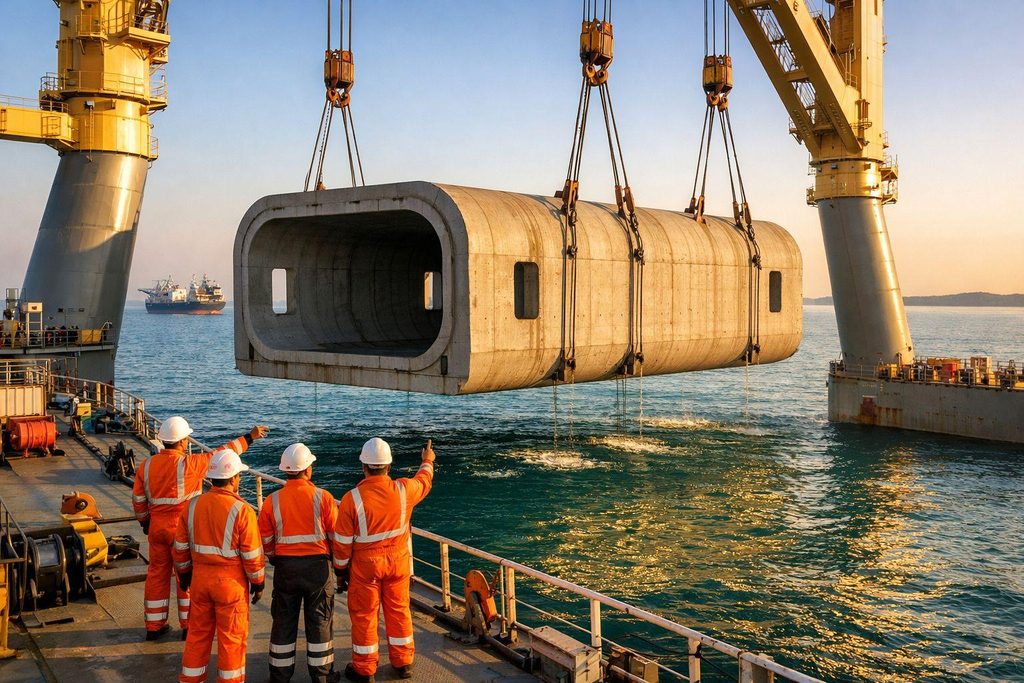
Engineers must design the tunnel’s structural walls, construction joints, waterproofing materials, and drainage systems to work together under continuous exposure to water pressure.
Even a tiny defect can become significant when water is trying to enter a structure for decades.
This challenge becomes particularly interesting in immersed-tube tunnels, where enormous prefabricated sections are manufactured on land, floated into position, and connected underwater.
Each connection creates a potential path for water to enter.
The approximately 18-kilometre Fehmarnbelt Tunnel between Denmark and Germany demonstrates how engineers address this challenge at an extraordinary scale.
Its design uses specialized sealing systems, watertight reinforced concrete, and carefully engineered connections to help protect the roadway and railway from the surrounding Baltic Sea.
But what actually keeps an underwater tunnel dry?
To understand the answer, we need to explore hydrostatic pressure, concrete permeability, rubber gaskets, structural movement, and the science of waterproof construction.
1. The First Challenge: Understanding Water Pressure
Water pressure is one of the most important loads acting on an underwater tunnel.
As depth increases, pressure increases.
The relationship can be expressed using a fundamental equation from fluid mechanics:
P = ρgh
Where:
- P = hydrostatic gauge pressure, measured in pascals
- ρ = water density, measured in kilograms per cubic metre
- g = gravitational acceleration, approximately 9.81 m/s²
- h = depth below the water surface, measured in metres
Consider a simplified example.
Imagine the exterior surface of a tunnel is located 30 metres below the surface of the sea.
Using an approximate seawater density of 1,025 kg/m³:
P = 1,025 × 9.81 × 30
P ≈ 302,000 pascals, or 302 kPa
That is approximately three times standard atmospheric pressure in additional gauge pressure.
This pressure acts continuously on the exterior of the submerged structure.
It also acts in multiple directions.
Water pushes downward on upper surfaces, horizontally against exposed sides, and upward against lower surfaces.
Why even a small opening matters
Water does not need a large hole to create a problem.
If there is a continuous pathway through the tunnel’s outer envelope, pressure can drive water inward.
The amount of leakage depends on factors including the opening geometry, pressure difference, material properties, and length of the flow path.
In concrete, water may move through interconnected pores or cracks.
At structural joints, it may pass through gaps if the sealing system is ineffective.
Therefore, engineers cannot rely solely on making the tunnel walls thick.
They must control the possible pathways through which water could enter.
2. Waterproofing Begins With the Concrete Itself
Reinforced concrete is the primary structural material for many immersed-tube tunnels.
It is strong, durable, relatively economical, and suitable for manufacturing large prefabricated elements.
However, concrete is not automatically waterproof.
Even high-quality concrete contains small pores formed during mixing, hydration, and hardening.
The size, distribution, and connectivity of these pores influence how readily fluids can move through the material.
Designing concrete for low permeability
One of the most important factors is the water-to-cementitious-materials ratio.
This describes the mass of mixing water relative to the mass of cement and other relevant cementitious materials.
In general, reducing excessive mixing water can produce a denser hardened cement paste, provided the concrete is properly designed, placed, consolidated, and cured.
Engineers may also use supplementary cementitious materials and admixtures to improve durability and control concrete performance.
The objective is to create a concrete mixture that satisfies strength, workability, permeability, and long-term durability requirements.
But a low-permeability mix alone is not enough.
If the concrete is poorly placed, inadequately compacted, or allowed to crack excessively, its resistance to water ingress may be compromised.
This makes construction quality just as important as material selection.
3. Why Concrete Cracking Is Such an Important Concern
Concrete develops strength through the hydration of cement.
During this chemical process, heat is generated.
For massive structural sections, temperature differences can develop between the interior and exterior concrete.
When the concrete subsequently cools, it contracts.
If contraction is restrained, tensile stresses may form.
Concrete has relatively low tensile strength compared with its compressive strength, so cracking can occur.
Other causes of cracking include drying shrinkage, settlement, bending loads, and structural restraint.
Are all concrete cracks dangerous?
No.
Reinforced-concrete structures are designed with the understanding that cracking can occur under certain conditions.
The critical factors include crack width, location, movement, exposure conditions, and the requirements of the structure.
For underwater tunnels, crack control is especially important because some cracks could create a pathway for water.
Engineers therefore design reinforcement and concrete mixtures to control cracking within acceptable limits.
They also manage curing conditions and construction sequences to reduce unnecessary early-age stresses.
The importance of reinforcement
Steel reinforcement does more than increase the structural capacity of concrete.
Properly distributed reinforcement also helps control the spacing and width of cracks.
Instead of allowing deformation to concentrate into a small number of wide cracks, suitable reinforcement can encourage a more distributed cracking pattern.
This improves serviceability and can contribute to durability.
However, reinforcement does not eliminate cracking or automatically guarantee watertightness.
Effective waterproofing depends on the combined performance of the concrete, reinforcement, construction details, and joint systems.
4. The Weakest Locations Are Often the Joints
A major immersed tunnel is not manufactured as one continuous piece of concrete.
It is constructed from separate elements.
The Fehmarnbelt Tunnel, for example, is designed with 79 standard tunnel elements and ten special elements.
Each standard element is approximately 217 metres long.
These elements must be connected underwater to form a continuous enclosed structure.
That creates a major engineering challenge.
Even if each individual concrete section is sufficiently watertight, water could still enter at the connections.
Why ordinary construction joints are not enough
Two concrete surfaces placed next to each other do not automatically form a waterproof joint.
Small irregularities, movement, or incomplete contact can create leakage paths.
Furthermore, concrete structures expand, contract, and deform during their lives.
An underwater tunnel joint must therefore satisfy two requirements.
First, it must prevent water entering under the design pressure.
Second, it must maintain the required performance while accommodating expected structural movement.
This is why specialized sealing systems are used.
5. The Gina Gasket: The First Line of Defence
One of the best-known waterproofing components used in immersed tunnels is the Gina gasket.
A Gina gasket is a specially engineered rubber sealing profile installed around the perimeter of a tunnel element’s connection face.
It is designed to create a seal when two tunnel sections are pressed together.
The gasket typically consists of a relatively stiff body and a softer projecting nose.
The soft nose helps establish initial sealing contact, while the body accommodates compression forces.
How the connection works
When a new tunnel element is lowered into position, its connection face is brought toward the previously installed element.
The Gina gasket makes contact with the adjoining surface.
At this stage, temporary watertight bulkheads remain in place inside the tunnel elements.
Water is trapped in the relatively small space between these bulkheads.
Engineers then pump the water out of that space.
As the water pressure inside the connection chamber decreases, the surrounding hydrostatic pressure pushes the newly installed element toward the adjoining structure.
This compresses the Gina gasket.
The pressure difference helps establish a tight connection.
Using water pressure to prevent leakage
This is one of the most fascinating aspects of immersed-tunnel engineering.
The water surrounding the tunnel is not simply a force that engineers must resist.
During installation, its pressure can help compress the sealing system.
The result is a connection in which hydrostatic pressure plays a useful role in achieving the required watertightness.
However, the sealing system must be carefully designed.
The gasket’s compression characteristics, contact pressure, material properties, and expected joint movements all affect its performance.
The rubber must also remain suitable for long-term exposure to the surrounding environment.
6. The Omega Seal: A Second Protective Barrier
Although the Gina gasket provides the initial and primary sealing function in many immersed-tunnel designs, engineers often introduce a second seal.
This is known as the Omega seal.
The name comes from the curved profile, which resembles the Greek letter omega.
An Omega seal is typically installed on the interior side of a joint after the space between the tunnel elements has been dewatered.
The seal is attached using engineered clamping systems.
Its purpose is to provide another barrier against water ingress.
Why use two seals?
Waterproofing is a critical safety and durability requirement.
Using two sealing components can provide additional protection if one component experiences deterioration or unexpected movement.
The Gina and Omega systems have different roles.
The Gina gasket helps establish the initial connection and provides a compression seal.
The Omega seal provides secondary watertight protection and is designed to accommodate joint movements.
The curved Omega geometry allows it to deform as the gap between adjoining structures changes.
This is important because structural movement cannot always be prevented completely.
The sealing system must maintain its function despite the movements anticipated in the design.
A Fehmarnbelt-specific solution
Specialist manufacturer Trelleborg was contracted to provide Gina gaskets, Omega seals, waterstops, and clamping systems for the Fehmarnbelt Tunnel.
The company developed project-specific solutions to account for the crossing’s scale, ground conditions, and engineering requirements.
These include sealing systems intended to accommodate movement while maintaining watertightness.
The project demonstrates how a relatively small component, compared with the enormous concrete structure, can be essential to the performance of the entire tunnel.
7. How Engineers Design Seals That Can Move
An underwater tunnel is not a perfectly rigid structure.
Its individual elements may experience small movements during their service life.
These movements can result from temperature changes, concrete creep, shrinkage, foundation settlement, and loading.
In some regions, seismic activity must also be considered.
Settlement and differential movement
Imagine two adjoining tunnel elements resting on slightly different foundation conditions.
If one element settles more than the other, movement may occur at the connection.
A sealing system that could function only when both elements remained perfectly aligned would be vulnerable.
Engineers therefore evaluate the expected movement range and design the joints accordingly.
Material behaviour
Rubber is useful for tunnel seals because it can undergo deformation while maintaining contact with adjoining surfaces.
However, the rubber’s behaviour depends on its composition, temperature, compression, ageing, and exposure conditions.
Engineers must consider how these properties may change over time.
A seal that works during installation must also remain effective after years of service.
For this reason, manufacturers conduct material testing and assess performance under expected pressure and deformation conditions.
Seal design is therefore a combination of structural mechanics, materials engineering, and waterproofing technology.
8. Waterstops: Protecting Joints Within the Concrete Structure
The connections between complete tunnel elements are not the only places where waterproofing is necessary.
Large concrete structures may also contain construction joints created during casting.
At these locations, concrete is placed in separate stages.
The joint between two pours may require a specific water barrier.
This is where waterstops become important.
A waterstop is a specially designed sealing component placed across or along a construction joint to interrupt potential water flow.
Waterstops can be manufactured using rubber, PVC, or other suitable materials.
Their precise configuration depends on the joint type and structural requirements.
How waterstops work
A waterstop creates a barrier within the potential leakage path.
It is positioned so that water attempting to pass through the joint encounters the sealing material.
Some waterstops are embedded within the concrete, while others are attached to suitable surfaces.
Certain types are designed to accommodate movement.
Others are intended for relatively static construction joints.
At Fehmarnbelt, the sealing package includes waterstops for tunnel elements and associated structures.
Trelleborg has also described a specially developed interlocking waterstop system intended to accommodate movements and improve installation efficiency.
The distinction between different waterproofing components is important.
Gina and Omega seals primarily address the connections between immersed elements.
Waterstops address selected joints within or between concrete structural components.
Together, they contribute to a more comprehensive waterproofing strategy.
9. How Engineers Test Whether a Tunnel Joint Is Watertight
A waterproofing system cannot simply be installed and assumed to work correctly.
Testing and inspection are essential.
The exact procedures depend on the tunnel design, sealing system, and project specifications.
However, several general principles apply.
Inspection before installation
Sealing surfaces must be examined for damage, contamination, or dimensional problems.
The gaskets themselves must also be checked.
Damage to a rubber sealing profile can affect its ability to maintain contact pressure.
Verification during connection
During immersion, engineers monitor the position of the element and the condition of the connection.
After the space between adjoining bulkheads has been dewatered, the initial seal can be assessed.
Unexpected water inflow may indicate a problem requiring investigation.
Pressure testing
In many immersed-tunnel designs, secondary seals and associated spaces can be pressure-tested.
This helps verify whether the assembled system meets the intended watertightness requirements.
A successful test provides evidence that the sealing arrangement performs under the specified conditions.
However, testing must be interpreted correctly.
Passing a construction-stage test does not remove the need for long-term inspection and maintenance.
Waterproofing performance must be considered throughout the tunnel’s service life.
10. What Happens If Water Enters an Underwater Tunnel?
An underwater tunnel is designed to prevent unacceptable water ingress, but responsible engineering also considers what happens if leakage occurs.
Not every instance of water inside a tunnel represents a catastrophic failure.
The seriousness depends on the quantity, location, source, and rate of inflow.
Small amounts of water can arise from sources such as condensation, cleaning, or localized seepage.
These must be distinguished from significant pressurized leakage through the structural envelope.
Drainage systems
Transportation tunnels generally require drainage arrangements to manage water arising during normal operation and maintenance.
Depending on the design, collected water may be directed into drainage channels, sumps, or pumping systems.
These systems must be planned to work under the tunnel’s operating conditions.
However, drainage is not a substitute for an effective structural waterproofing system.
The primary objective remains preventing unacceptable external water ingress.
Monitoring and maintenance
Tunnel operators may use inspection programmes, sensors, and maintenance procedures to identify changes in structural condition.
Engineers investigate signs such as unusual moisture, persistent seepage, joint movement, or deterioration of concrete surfaces.
Early identification of a problem allows appropriate corrective action before it becomes more serious.
The actual equipment and procedures depend on the specific tunnel design and operator.
11. How Backfilling Helps Protect the Tunnel
Once an immersed tunnel element has been installed and connected, the surrounding trench is backfilled.
Suitable materials may include sand, gravel, and protective rock.
Backfilling serves several purposes.
It provides support around the structure, helps stabilize the element, and protects the tunnel from external influences.
A protective covering may also reduce the risk of mechanical damage, according to the tunnel’s location and design requirements.
Does backfill make the tunnel waterproof?
Not by itself.
Soil and rock placed around a tunnel generally do not create an impermeable barrier.
Water can still exist within the surrounding ground.
Therefore, engineers must design the tunnel’s concrete structure and joints to resist the applicable groundwater or seawater pressures.
The backfill primarily contributes to structural stability and protection.
This distinction is important because waterproofing and structural protection are related but different engineering functions.
A successful immersed tunnel needs both.
12. Why Marine Environments Create Long-Term Durability Challenges
The marine environment can be demanding for reinforced concrete and sealing materials.
Seawater contains dissolved salts, including chlorides.
If chlorides penetrate concrete and reach embedded steel reinforcement in sufficient concentrations, they may contribute to corrosion.
Reinforcement corrosion can damage concrete and reduce structural durability.
Engineers address this through suitable concrete specifications, cover thickness, crack control, construction quality, and other protective measures.
The required durability strategy depends on the actual exposure conditions.
Designing for a long service life
The Fehmarnbelt Tunnel has a stated design service life of at least 120 years.
A design service life is not a guarantee that no maintenance will ever be required.
It means the structure is designed with durability, maintenance, and long-term performance requirements appropriate to the intended period.
Engineers must therefore consider how materials behave over many decades.
These considerations include concrete deterioration, reinforcement corrosion, seal ageing, joint movement, and the performance of protective systems.
Long-term infrastructure reliability depends on both good initial design and effective management throughout operation.
13. What Makes the Fehmarnbelt Waterproofing Challenge Extraordinary?
The Fehmarnbelt Tunnel is unusual because of its length, structural scale, and repetitive underwater connections.
The project requires 89 tunnel elements in total.
Its elements are manufactured in a purpose-built factory, transported to sea, and immersed into a prepared trench.
Each large element must remain watertight during flotation and transportation.
Temporary steel bulkheads prevent water from entering the internal spaces during these operations.
Once an element has been immersed, the permanent connection process requires engineered seals.
The sealing system must accommodate the project’s marine and ground conditions, including possible differential movements.
For Fehmarnbelt, specialist suppliers have developed tailored sealing arrangements rather than relying on a generic solution without modification.
The project therefore demonstrates how engineers combine established waterproofing principles with project-specific design.
It also demonstrates why successful underwater construction requires close collaboration between structural engineers, geotechnical specialists, marine contractors, concrete technologists, and sealing-system manufacturers.
No single waterproofing material can solve every challenge.
Reliability comes from the complete system.
14. What Civil Engineering Students Can Learn From Tunnel Waterproofing
The waterproofing of underwater tunnels brings several fundamental engineering subjects together.
Fluid mechanics: Hydrostatic pressure determines important loads on tunnel walls, foundations, and joints.
Structural engineering: Reinforced-concrete elements must resist pressure, bending, shear, and other design actions.
Materials engineering: Concrete permeability, reinforcement corrosion, rubber deformation, and long-term material performance influence durability.
Geotechnical engineering: Groundwater, foundation settlement, and soil–structure interaction affect tunnel performance.
Construction engineering: Accurate casting, installation tolerances, joint preparation, and testing are essential to watertight construction.
Infrastructure management: Monitoring, inspection, maintenance, and risk management contribute to long-term reliability.
One particularly valuable lesson is the importance of designing for movement.
A structure does not need to remain perfectly motionless to remain watertight.
Instead, engineers can create systems that maintain sealing performance while accommodating anticipated changes in geometry.
This principle also applies to expansion joints in bridges, water-retaining structures, basements, and other infrastructure.
Conclusion: The Engineering That Keeps the Sea Outside
Underwater tunnels demonstrate how engineers can create safe transportation spaces within some of the most demanding environments on Earth.
Keeping the water outside requires more than thick concrete walls.
Engineers must understand hydrostatic pressure, design durable reinforced-concrete structures, control cracking, develop reliable joint connections, and provide suitable monitoring and maintenance systems.
The connections between immersed tunnel elements are particularly important.
Specialized Gina gaskets establish the initial watertight connection, while Omega seals provide additional protection and accommodate movement.
Waterstops help protect selected construction joints, and carefully manufactured concrete limits unwanted water penetration.
The Fehmarnbelt Tunnel brings these engineering principles together on an extraordinary scale.
Its massive prefabricated elements must float during transportation, descend to the seabed, and become part of a continuous underwater structure.
Every connection must function within a demanding marine environment.
When completed, the tunnel will carry road and railway traffic beneath the Baltic Sea, demonstrating the capabilities of modern structural, marine, and materials engineering.
Perhaps the most interesting aspect of this technology is that engineers do not always fight against the surrounding water pressure.
Sometimes they use that pressure to help seal the tunnel itself.
That is the ingenuity behind underwater tunnel waterproofing: controlling water through a carefully engineered combination of materials, structural design, and fundamental physics.
Explore More Engineering With VCE Build
At VCE Build, we explore the engineering principles, construction technologies, and technical decisions behind the world’s most ambitious infrastructure projects.
Watch our YouTube channel for engineering documentaries, megaproject explanations, and visual construction breakdowns.
For deeper technical learning, join VCE Build on Patreon, where members can access illustrated engineering case studies, construction tutorials, downloadable technical guides, and professional project analysis according to their membership level.
Interested in engineering research, technical illustrations, infrastructure education, or construction-related content development? Explore VCE Build’s professional services through our website.
VCE Build — Understand the Engineering. Learn the Construction. Explore the Megaprojects.
No responses yet