For decades, infrastructure design has relied on historical assumptions. Engineers, architects, and construction professionals have traditionally used climate records, material performance data, and established design standards to create roads, buildings, bridges, and public infrastructure expected to last for generations.
Today, however, the rules are changing.
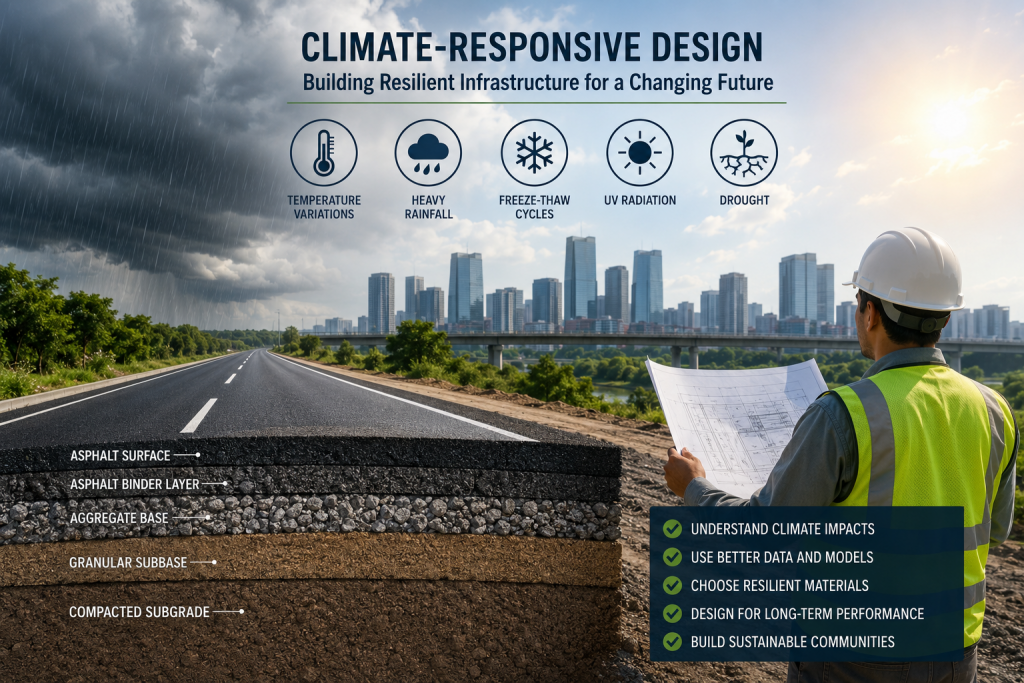
Extreme weather events are becoming more frequent, temperature patterns are shifting, rainfall intensity is increasing in many regions, and prolonged droughts are affecting others. These changes are forcing the construction industry to reconsider a fundamental question:
Are we designing infrastructure for the climate we had—or the climate we will have?
The answer has significant implications for every sector of the built environment. From pavement deterioration and foundation movement to building envelope performance and drainage capacity, climate conditions now play a larger role than ever in determining how long infrastructure will last and how much it will cost to maintain.
As the construction industry continues to evolve, climate-responsive design is no longer a specialized niche. It is rapidly becoming a core requirement for resilient, sustainable, and economically viable infrastructure.
The Hidden Relationship Between Climate and Infrastructure Performance
Climate affects infrastructure in ways that are both obvious and subtle.
When people think about climate impacts, they often imagine dramatic events such as floods, hurricanes, or heatwaves. While these events certainly create immediate damage, the greater challenge is often the cumulative effect of everyday environmental conditions.
Temperature fluctuations cause materials to expand and contract.
Moisture penetrates structural systems and weakens materials over time.
Freeze-thaw cycles create cracking and deterioration.
Ultraviolet radiation accelerates material aging.
Heavy rainfall overwhelms drainage systems.
Extended droughts alter soil behavior beneath structures.
These factors continuously interact with the built environment, influencing performance throughout the entire lifecycle of a project.
The result is that infrastructure deterioration is often driven as much by environmental exposure as by usage.
A roadway carrying moderate traffic in a harsh climate may deteriorate faster than a heavily trafficked road in a stable environment. Similarly, a building envelope designed without consideration for future climate conditions may experience accelerated maintenance requirements despite meeting current code standards.
Understanding this relationship is becoming increasingly important for professionals responsible for planning, designing, and constructing long-lasting infrastructure.
Moving Beyond Historical Design Assumptions
Traditional design methodologies are built upon historical data.
Engineers typically evaluate decades of weather records to determine design temperatures, precipitation levels, wind loads, and other environmental factors. These datasets have served the industry well for many years because climate patterns were relatively stable and predictable.
However, recent trends indicate that historical records may no longer be sufficient as the sole basis for future design decisions.
Many regions are experiencing:
- More intense rainfall events
- Longer heatwaves
- Greater seasonal variability
- Increased flooding risks
- More frequent freeze-thaw cycles
- Rising groundwater challenges
- Increased storm intensity
These conditions create uncertainty in design assumptions that were once considered reliable.
A storm classified as a “once-in-100-year event” may occur far more frequently than anticipated. Similarly, temperature ranges that were historically uncommon may become normal operating conditions for infrastructure systems.
This shift requires professionals to think differently about risk management.
Instead of designing solely for historical averages, infrastructure projects increasingly need to account for future climate scenarios and changing environmental conditions.
Why Pavement Infrastructure Provides an Important Lesson
Among all infrastructure assets, roadways offer one of the clearest examples of climate-related vulnerability.
Pavements operate in direct contact with environmental conditions every day of their service life. Unlike many building systems, they have little protection from temperature changes, moisture infiltration, solar radiation, or freeze-thaw effects.
Even small environmental variations can significantly influence pavement performance.
High temperatures soften asphalt materials and increase susceptibility to rutting.
Cold temperatures contribute to thermal cracking.
Excess moisture weakens subgrade soils and reduces structural capacity.
Freeze-thaw cycles create internal stresses that accelerate deterioration.
These interactions demonstrate an important principle that extends far beyond transportation infrastructure:
Environmental conditions directly influence material behavior.
The same principle applies to buildings, bridges, retaining walls, foundations, and utility systems.
When climate factors are underestimated, infrastructure often experiences reduced service life, increased maintenance requirements, and higher lifecycle costs.
The Economic Case for Climate-Responsive Design
Climate resilience is often discussed in environmental terms, but the economic argument may be even more compelling.
Infrastructure owners are increasingly focused on lifecycle value rather than initial construction costs.
A design that reduces future maintenance requirements can provide substantial long-term savings even if upfront costs are slightly higher.
Consider the financial consequences of premature infrastructure failure:
- Emergency repairs
- Traffic disruptions
- Business interruptions
- Increased maintenance budgets
- Reduced asset value
- Public safety concerns
- Accelerated replacement schedules
When these costs are evaluated over decades, climate-responsive design strategies frequently prove to be cost-effective investments.
The objective is not necessarily to build stronger structures in every situation.
Instead, it is to build smarter structures that are optimized for their environmental context.
This distinction is critical.
Resilience does not mean overdesigning every project. It means understanding environmental risks and making informed decisions that balance performance, cost, and sustainability.
The Role of Materials in Climate Adaptation
Materials represent one of the most powerful tools available to designers and contractors.
The selection of materials influences how infrastructure responds to environmental stress throughout its service life.
For example, modern construction increasingly relies on materials engineered for specific climate conditions.
These may include:
- High-performance concrete mixes
- Modified asphalt binders
- Advanced waterproofing systems
- Corrosion-resistant reinforcement
- Enhanced insulation materials
- Permeable pavement systems
- Geosynthetics for moisture control
Material innovation is helping infrastructure adapt to changing environmental demands.
However, selecting the right material requires more than simply choosing the latest technology.
Successful implementation depends on understanding local climate conditions, site characteristics, construction quality, and long-term performance objectives.
The best material in one environment may not be the best choice in another.
This reinforces the importance of site-specific design and performance-based decision making.
Drainage: The Most Underrated Infrastructure System
Ask experienced engineers what causes the majority of infrastructure failures, and many will provide a surprisingly simple answer:
Water.
Water remains one of the most destructive forces affecting the built environment.
Whether it appears as surface runoff, groundwater, flooding, snowmelt, or moisture infiltration, unmanaged water can compromise nearly every type of infrastructure.
Unfortunately, drainage systems are often viewed as secondary design considerations.
In reality, drainage should be treated as a primary resilience strategy.
Effective drainage influences:
- Pavement longevity
- Foundation stability
- Building durability
- Slope performance
- Utility protection
- Site accessibility
- Public safety
As rainfall patterns become increasingly unpredictable, drainage infrastructure must evolve accordingly.
Design teams should evaluate not only historical precipitation data but also future rainfall intensity projections where possible.
Infrastructure that can effectively manage water today may not be adequate twenty years from now.
Collaboration Is the Future of Resilient Design
One of the most important shifts occurring in the industry is the growing recognition that resilience cannot be achieved in isolation.
Engineers, architects, contractors, planners, environmental specialists, and asset managers must collaborate more closely than ever before.
Climate-responsive design crosses disciplinary boundaries.
An architect may influence thermal performance.
A civil engineer may determine drainage capacity.
A geotechnical engineer may assess climate-related soil behavior.
A contractor may recommend construction techniques that improve durability.
An asset manager may provide valuable insights regarding maintenance trends.
When these perspectives are integrated early in the project lifecycle, outcomes improve significantly.
Resilience becomes a shared objective rather than an isolated design requirement.
Technology Is Transforming Decision Making
The construction industry is experiencing a rapid expansion of digital tools that support climate-informed design.
Modern technologies now allow professionals to analyze environmental risks with greater accuracy than ever before.
Examples include:
- Building Information Modeling (BIM)
- Digital twins
- Geographic Information Systems (GIS)
- Climate simulation software
- Predictive maintenance platforms
- Advanced pavement modeling tools
- Remote sensing technologies
These tools enable designers to move beyond static assumptions and develop dynamic, data-driven solutions.
Instead of asking how infrastructure performs under average conditions, professionals can evaluate how it performs under a range of future scenarios.
This capability is transforming risk management and improving long-term project outcomes.
Sustainability and Resilience Are No Longer Separate Goals
For many years, sustainability and resilience were often discussed as distinct objectives.
Sustainability focused on reducing environmental impact.
Resilience focused on withstanding disruption.
Today, the two concepts are increasingly interconnected.
Infrastructure that fails prematurely is rarely sustainable.
Frequent repairs consume additional materials, energy, labor, and financial resources.
Similarly, resilient infrastructure often supports sustainability objectives by extending service life and reducing resource consumption.
A roadway that lasts longer requires fewer reconstruction cycles.
A building designed for future climate conditions may consume less energy over time.
A drainage system capable of managing extreme rainfall can reduce environmental damage and maintenance requirements.
The future of infrastructure lies in solutions that achieve both sustainability and resilience simultaneously.
Preparing for the Next Generation of Infrastructure Challenges
The infrastructure challenges of the next several decades will differ significantly from those of the past.
Population growth, urbanization, climate variability, resource constraints, and aging infrastructure networks are creating new pressures on the built environment.
Meeting these challenges requires a shift in mindset.
Rather than asking whether climate considerations should influence design, the better question is:
How can climate considerations be integrated more effectively into every project?
This requires:
- Better data
- Improved modeling tools
- Cross-disciplinary collaboration
- Performance-based specifications
- Lifecycle thinking
- Continuous innovation
Organizations that embrace these principles will be better positioned to deliver infrastructure that remains functional, safe, and cost-effective for future generations.
Building for Tomorrow Starts Today
Every infrastructure project represents a long-term commitment.
The roads, buildings, bridges, and public spaces being designed today will continue serving communities for decades.
That reality carries a responsibility.
Design decisions made during planning and construction influence future maintenance costs, operational performance, public safety, environmental impact, and overall resilience.
Climate-responsive design is not about predicting the future perfectly.
It is about recognizing uncertainty and making informed decisions that improve the likelihood of long-term success.
For civil engineers, architects, construction professionals, and infrastructure owners, the message is clear:
The future of resilient infrastructure depends on understanding how environmental conditions influence performance—and incorporating that understanding into every stage of project development.
Those who adapt will create infrastructure that lasts longer, performs better, and delivers greater value throughout its lifecycle.
And in an era defined by change, that may become the most important design objective of all.
No responses yet