There are not many places on earth that have pushed the limits of human imagination quite like Tokyo. It is not merely a city—it is the largest metropolitan area ever built. This city is an interconnected organism of infrastructure, culture, and economic power. With tens of millions of people moving through it every day, Tokyo operates with a level of precision and complexity that rivals entire nations.
What makes Tokyo extraordinary is not just its size, but the fact that it was built on a flood-and earthquake geographic area. Although, in the past it has endured repeated destruction, it has managed to become the most advanced urban system in the world. Engineers and planners have created this city by constantly reinventing new ways to build using engineering and science. Its culture is also unique because it still maintains its tradition and modern influence. This combination has created a city that have fused over centuries to create something unparalleled. The Japanese have achieved their engineering prowess mostly by doing simple things very well and doing them all the time.
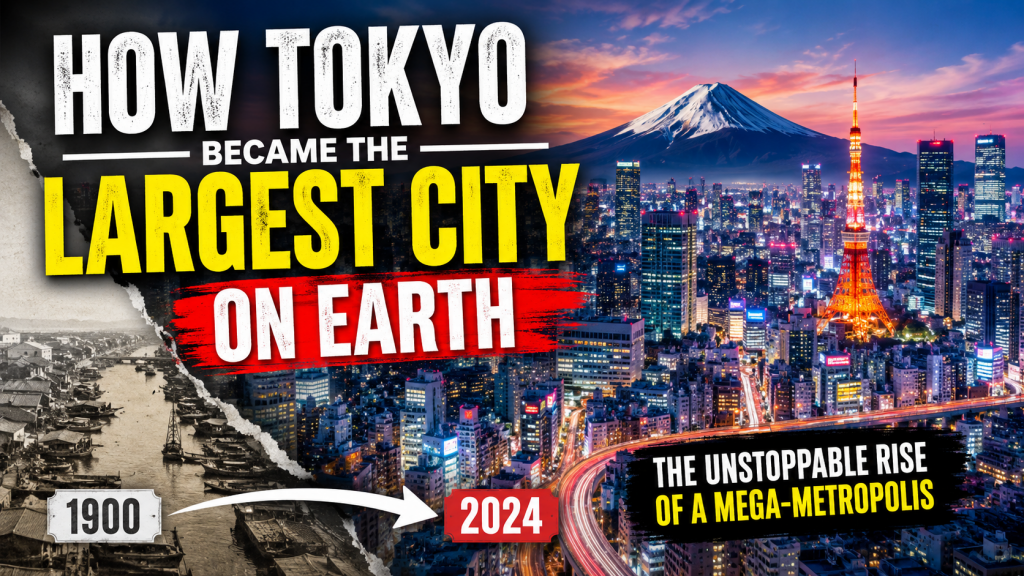
Humble Beginnings: From Edo to Empire.
Tokyo’s origins lie in a small fishing village known as Edo. Situated on low-lying wetlands near a bay, the area was far from ideal for urban development. The land was soft, prone to flooding, and geologically unstable.
Everything changed in the early 17th century when Tokugawa Ieyasu established his military government there. By making Edo the political center of Japan, he triggered one of the most dramatic urban transformations in history.
Instead of leaving the city to expand uncontrolled in an organic manner, it was instead focused on controlled expansion. To accomplish this vision, massive engineering works were undertaken. This included draining and filling wetlands, redirecting rivers, creating canals and reclaiming land from the shorelines
These early interventions applied fundamental civil engineering principles such as soil stabilization, hydraulic control, and land optimization. Even without modern technology, Edo became a masterclass in pre-industrial urban planning.
By the 18th century, Edo had grown into one of the largest cities on Earth, with a population exceeding one million—a staggering figure for the time.
Social Engineering as Urban Strategy.
One of the most unusual drivers of Edo’s growth was not physical engineering, but social policy. Although it ranks relatively low among major cities, in the past during the Edo period in Japan, which ranged from 1603 to1868, several policies did make it one of the leaders during that period. This period was unique because it was characterized by strict social hierarchy and engineering advances designed to support a stable, centralized state. For example, it included Social Order, known as Shinōkōshō. The Tokugawa shogunate established a strict four-tiered hierarchy which included samurai, peasants, artisans and merchants. This all helped maintain social order. Then the controversial “Outcaste” System. This distinct social policy was the creation of a rigid outcaste order known as kawata and hinin.
Another area that experienced great advancements is engineering. While fostering stability, the period saw development in mathematics, cartography, and engineering.
Urbanization also underwent great advances. Through the use of deliberate policies and infrastructure engineering, Edo, now known as Tokyo became one of the largest cities in the world at the time.
Furthermore, during that time, the ruling government implemented a system requiring regional lords to spend extended periods in Edo, bringing with them large groups of retainers, servants, and workers. This created a continuous influx of wealth, labor, and consumption.
This policy effectively transformed Edo into a centrally controlled economic engine, where population density increased not by accident, but by design. It also stimulated the development of housing systems, food supply chains, transportation routes, and commercial districts.
This early concentration of people laid the groundwork for Tokyo’s future as a megacity.
The Birth of Modern Tokyo.
In the late 19th century, Japan underwent rapid modernization, and Edo was renamed Tokyo, meaning “Eastern Capital.” After the emperor moved there with the intention to solidify its role as the nation’s political and cultural center.
This period marked the introduction of Western engineering and scientific principles: These included…
Steel and brick construction replaced traditional wood structures…
Railways connected Tokyo to other regions…
Industrial zones emerged…
Modern sanitation systems improved public health…
You could say that Tokyo became a laboratory for modernization, integrating imported technologies with local innovation. Urban planning began to reflect principles such as efficiency, connectivity, and scalability—all essential for managing a growing population.
Destruction as a Catalyst for Innovation.
Unfortunately, Tokyo’s rise was repeatedly interrupted by catastrophe after catastrophe. But, each disaster forced the city to rebuild smarter. Lets look at few of these disasters.
The Great Kantō Earthquake.
This massive earthquake devastated Tokyo, destroying infrastructure and killing over 100,000 people. Fires spread rapidly through dense wooden neighborhoods, revealing the vulnerabilities of the city’s design.
World War II Bombing.
During the final years of the war, Tokyo was heavily bombed, reducing vast areas to ashes. Entire districts disappeared overnight.
Engineering Lessons from Disaster.
These unfortunate circumstances resulted in drastic measures being taken to improve the engineering infrastructure. So, instead of simply rebuilding, engineers and planners introduced a few measures. There are 4 major ones. The first was Earthquake-resistant buildings using flexible steel frameworks. Secondly, Firebreaks through wider streets and zoning changes. They also Improved materials designed to withstand heat and shock. Finally, urban resilience planning was introduced…a concept now central to modern city design.
Now, we know Tokyo as one of the most seismically advanced cities in the world. Buildings are designed to absorb and dissipate energy, applying principles of structural dynamics and vibration control. These are structural engineering principles used to analyze how structures …buildings, bridges and machinery respond to time-varying forces. Forces such as wind and earthquakes. Other operations and employ strategies to mitigate undesired oscillations. Oscillation refers to the back-and-forth, rhythmic shaking of the ground caused by seismic waves. It is the periodic variation of ground motion around a central, resting position, often described as a “swaying” or “rolling” motion. Techniques include passive absorbers, active sensors/actuators, and semi-active dampers to prevent fatigue and ensure safety.
The Post-War Economic Explosion.
After World War II, Tokyo experienced extraordinary economic growth. It rapidly transformed into a global financial and industrial powerhouse. Several key factors played a key role to that expansion. These included: Technological innovation. Industrial production. Export-driven economic policies and a highly educated workforce.
As industries grew, millions of people migrated to Tokyo in search of opportunity. The city expanded outward, merging with neighboring urban areas to form a continuous metropolitan region.
This growth reflects a key urban principle, know as agglomeration economics, where businesses and people cluster together to increase productivity and efficiency.
Transportation: The Lifeline of a Mega-City.
Tokyo’s massive population of about 40 million people would be impossible without its world-class transportation system. One such major transportation system is its world class railways.
Rail networks form the backbone of the city, moving millions of passengers daily with incredible precision. Trains operate with near-perfect timing, often measured in seconds.
This system is built on advanced scientific principles: Network optimization ensures efficient routing. Queuing theory manages passenger flow. Data-driven scheduling minimizes delays
Instead of relying on a single city center, Tokyo developed multiple urban hubs connected by transit lines. This decentralized model reduces congestion and distributes economic activity more evenly.
Engineering Against Nature.
Tokyo’s geography presents constant challenges. It sits on soft alluvial soil, making it vulnerable to earthquakes and subsidence. It is also exposed to typhoons and rising sea levels.
To overcome these challenges, engineers have developed extraordinary solutions: Deep foundations anchored into stable layers below the surface…Massive underground flood control systems…Seawalls and storm barriers protecting coastal areas…Advanced drainage systems to manage heavy rainfall.
One of the most impressive features is Tokyo’s underground flood infrastructure, designed to capture and redirect enormous volumes of water during storms. This reflects principles of fluid dynamics and hydraulic engineering on a massive scale.
A City of Layers: Culture Meets Technology.
Tokyo’s uniqueness lies in its ability to balance extremes.
Ancient temples stand beside futuristic skyscrapers. Traditional markets operate alongside cutting-edge robotics labs. This coexistence creates a city that is both deeply rooted in history and constantly pushing forward.
Neighborhoods vary dramatically: Business districts filled with high-rise towers… Quiet residential areas with narrow streets… Entertainment zones illuminated by neon lights
Tokyo is not a single identity—it is a mosaic of interconnected worlds.
Major Attractions That Define Tokyo.
Tokyo’s appeal extends far beyond its size. It offers a diverse range of experiences that attract millions of visitors each year.
Iconic Landmarks has drawn major attraction from locals as well as tourists. One is the Tokyo Skytree, one of the tallest structures on Earth, showcasing advanced structural engineering. The Shibuya Crossing is a symbol of organized urban chaos and The tokyo Metropolitan Government Building, offering panoramic views of the city
A few Cultural Sites also come to mind. Sensō-ji is Tokyo’s oldest temple. The Ueno Park is home to museums and cultural institutions. Each location reveals a different layer of the city’s identity.
Financial Power and Global Influence.
Tokyo is one of the world’s leading financial centers. It hosts major banks, corporations, and one of the largest stock exchanges globally.
This financial strength fuels continuous development, allowing Tokyo to invest heavily in infrastructure, research, and innovation. The city operates as a command center for global commerce, influencing markets far beyond Japan.
Unbelievable Facts About Tokyo.
Tokyo’s metropolitan population is larger than that of many entire countries. The city’s train system transports more people daily than most nations’ entire populations. Tokyo has been almost completely rebuilt multiple times. Despite its size, it remains one of the safest cities in the world. It operates with a level of punctuality and efficiency rarely seen anywhere else
The Challenges of the Future.
Even a city as advanced as Tokyo faces serious challenges.
Japan’s demographic shift is reducing the working-age population, which could impact economic growth.Tokyo remains at risk from major earthquakes and extreme weather events. Balancing energy consumption, environmental impact, and urban density will be critical in the coming decades.
Will Tokyo Ever Be Finished?
Tokyo is not a project with an endpoint. It is a continuously evolving system.
New technologies such as artificial intelligence, smart infrastructure, and renewable energy are already shaping its future. The city will continue to adapt, just as it has for centuries.
Tokyo became the largest city on Earth through a combination of vision, resilience, and relentless innovation.
It transformed unstable land into a thriving metropolis. It turned disasters into opportunities for advancement. It built systems capable of supporting millions with precision and efficiency.
Tokyo is more than a city—it is a blueprint for what human civilization can achieve when engineering, science, and culture align.
No responses yet