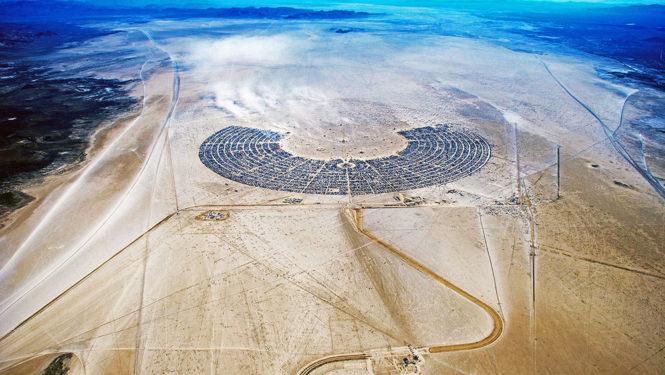
Every year, a seemingly impossible urban experiment emerges from one of the harshest environments in North America. In the remote Black Rock Desert of Nevada, a temporary settlement known as Black Rock City materializes from an empty alkali playa, accommodates approximately 80,000 residents, and then disappears without leaving a trace.
To many observers, Burning Man is primarily known as a cultural festival characterized by large-scale art installations, experimental architecture, and unconventional forms of social interaction. However, from the perspective of architects, civil engineers, urban planners, and construction professionals, Burning Man represents something far more significant: a large-scale case study in temporary urbanism.
Unlike conventional cities, Black Rock City is designed, constructed, inhabited, maintained, and dismantled within a matter of weeks. It operates without permanent buildings, municipal infrastructure, or conventional development patterns. Yet despite these limitations, it successfully functions as a city complete with transportation systems, public spaces, zoning strategies, emergency services, accessibility programs, and governance structures.
Perhaps most remarkably, it does so within an environment characterized by extreme temperatures, limited resources, high winds, dust storms, and complete isolation from traditional urban support systems.
The evolution of Burning Man offers valuable insights into how constraints can shape urban form, how participatory planning can strengthen communities, and how cities might become more adaptable in an increasingly uncertain world.
The Challenge of Building a City in the Desert
Urban development is typically associated with permanence. Cities evolve over decades or centuries through investments in roads, utilities, buildings, and public infrastructure.
Black Rock City operates according to an entirely different model.
The site lacks nearly every condition that planners typically seek when establishing settlements. There is no natural vegetation, no permanent water source, no utility network, and no existing transportation infrastructure. Daytime temperatures can exceed 100°F (38°C), while nighttime temperatures often approach freezing. Dust storms can significantly reduce visibility and create hazardous conditions for residents.
From a civil engineering perspective, the site presents a collection of environmental constraints that would normally discourage development altogether.
Yet these same constraints have become fundamental drivers of the city’s design.
Rather than resisting environmental limitations, Black Rock City’s planners have continuously adapted their urban form to accommodate them. This adaptive approach has become one of the defining characteristics of the settlement’s success.
The city demonstrates an important lesson frequently encountered in architecture and engineering: constraints often generate innovation. Many of history’s most successful urban environments emerged not despite limitations but because designers were forced to respond creatively to them.
From Informal Gathering to Planned Settlement
Burning Man did not begin as a sophisticated urban planning exercise.
Early iterations of the event consisted of relatively small gatherings with only a few hundred participants. However, as attendance increased throughout the 1990s, organizers quickly encountered challenges familiar to rapidly growing cities: traffic congestion, safety concerns, inefficient circulation patterns, and difficulties managing public space.
The first formal planning efforts emerged largely as a response to regulatory requirements. Local authorities required organizers to provide documentation addressing circulation, infrastructure, emergency access, and public safety.
What began as a compliance exercise gradually evolved into a sophisticated urban planning framework.
By 1996, attendance had reached approximately 8,000 participants. To manage growth, planners introduced new circulation routes and established additional organizational layers within the city’s layout. These modifications helped improve movement patterns while preserving the event’s central gathering space.
As population continued to increase, planners recognized that informal arrangements were no longer sufficient. The settlement required a coherent urban structure capable of supporting thousands of residents while maintaining social cohesion.
This challenge would ultimately lead to one of Black Rock City’s defining design features: its radial urban plan.
The Evolution of Black Rock City’s Urban Form
One of the most fascinating aspects of Black Rock City is the way its physical form evolved through experimentation.
In 1997, the event temporarily relocated to a different site, requiring planners to rethink the city’s organization entirely. Landscape architect Rod Garrett was recruited to develop plans that satisfied permitting requirements while addressing logistical challenges associated with the new location.
The resulting design introduced concepts that continue to define Black Rock City today.
Rather than relying on a conventional grid, the settlement adopted a radial and concentric configuration organized around a central focal point. Streets extended outward from the center like spokes on a wheel, while concentric rings created distinct neighborhoods and circulation zones.
When the event returned to Nevada the following year, many of these planning principles remained.
The radial plan offered several advantages:
- Clear orientation and wayfinding.
- Efficient emergency access.
- Strong visual connections to the city center.
- Reduced travel distances.
- Enhanced social interaction.
Unlike conventional suburban developments that often prioritize automobile movement, the radial structure encouraged pedestrian and bicycle circulation while reinforcing a shared sense of place.
From an urban design perspective, the city illustrates how geometry can influence social behavior. The physical layout encourages interaction, visibility, and participation in ways that many contemporary urban environments struggle to achieve.
Growth, Scale, and the Challenge of Social Cohesion
By the early 2000s, Burning Man had grown to approximately 25,000 participants, effectively transforming it into a temporary town.
With growth came new challenges.
Urban planners observed increasing instances of social fragmentation, conflict, and isolation. As the city expanded, residents found it more difficult to maintain the intimate social connections that characterized earlier versions of the event.
This problem is not unique to Burning Man.
Many rapidly growing cities face similar challenges. Population growth can weaken social networks, reduce civic engagement, and create feelings of anonymity among residents.
What makes Black Rock City particularly interesting is the way planners chose to address the issue.
Rather than focusing exclusively on physical infrastructure, they recognized that many emerging problems were fundamentally social in nature.
Their response involved redesigning the city’s spatial organization to encourage greater interaction among residents.
Mixed-Use Planning and the Distribution of Theme Camps
One of the most significant planning innovations involved the redistribution of theme camps throughout the settlement.
Theme camps function as community-generated destinations that provide services, activities, performances, education, hospitality, and social experiences. They operate as temporary civic institutions created by participants for participants.
Initially, many of these camps were concentrated within specific districts. While this arrangement created activity hubs, it also contributed to spatial segregation and uneven distribution of public amenities.
Planners responded by dispersing theme camps throughout the city.
This strategy bears similarities to mixed-use development principles commonly employed in contemporary urban planning. By integrating destinations throughout residential areas, planners sought to increase walkability, strengthen neighborhood identity, and create opportunities for spontaneous interaction.
The results demonstrated measurable benefits.
Residents encountered more activities within walking distance, neighborhoods became more active, and social engagement increased.
However, mixed-use planning also introduced new challenges.
Just as conventional cities experience conflicts between residential and commercial uses, Black Rock City encountered tensions between camps with differing purposes. High-energy entertainment spaces occasionally conflicted with quieter areas dedicated to reflection and relaxation.
These conflicts highlighted the continuing importance of land-use planning and zoning strategies.
Zoning and Urban Governance in a Temporary Environment
To address conflicting land uses, planners introduced increasingly sophisticated zoning mechanisms.
Camp organizers were required to submit detailed plans outlining activities, spatial requirements, infrastructure needs, and operational characteristics months before the event.
Planning teams reviewed proposals to identify potential conflicts and determine appropriate locations.
Although Burning Man often presents itself as an experiment in freedom and self-expression, its success relies upon a surprisingly structured planning process.
This reality reflects a broader truth about urban environments.
Successful cities rarely emerge from complete spontaneity. Even highly flexible communities require governance frameworks that balance individual freedom with collective well-being.
Black Rock City demonstrates that effective planning does not necessarily restrict creativity. Instead, it creates conditions that allow diverse activities to coexist safely and productively.
Safety, Risk Management, and Temporary Infrastructure
One of the most challenging aspects of Black Rock City involves safety management.
The event contains open fires, climbable structures, mobile art vehicles, temporary construction, and large public gatherings. These conditions create risks that would be heavily regulated within conventional urban environments.
Construction professionals are familiar with the extensive requirements imposed by modern building codes. These regulations often appear overly cautious because they are designed around worst-case scenarios and informed by historical accidents.
Permanent buildings undergo rigorous review processes addressing fire protection, structural integrity, accessibility, egress capacity, and emergency response.
Temporary cities operate under different circumstances.
While Burning Man incorporates safety oversight and permitting processes, many installations do not conform to the same standards applied to permanent urban development.
This creates an ongoing tension between experimentation and risk management.
The event serves as a valuable case study in balancing innovation with public safety. It highlights the importance of proportional regulation while demonstrating the challenges associated with managing risk in highly dynamic environments.
Accessibility and Inclusive Urban Design
One of the most important conversations surrounding Burning Man concerns accessibility.
At first glance, the environment appears fundamentally incompatible with universal design principles. Deep dust, extreme temperatures, and uneven terrain create significant barriers for individuals with mobility impairments.
Yet despite these challenges, a substantial community of participants with disabilities attends the event annually.
Organizations such as Mobility Camp have developed programs that provide accessible camping, medical support, transportation assistance, and community resources.
These initiatives reveal an important distinction between accessibility and inclusion.
Accessibility focuses on removing physical barriers.
Inclusion extends beyond physical access to ensure that individuals can participate meaningfully in community life.
Many accessibility advocates argue that successful design should not merely accommodate differences but create equivalent experiences for all users.
This perspective has profound implications for architects and planners.
The goal should not simply be compliance with accessibility standards. Rather, designers should seek to create environments that offer dignity, agency, and engagement for every participant.
Participation as Urban Infrastructure
Perhaps the most significant lesson offered by Burning Man is that cities depend upon more than physical infrastructure.
Roads, buildings, utilities, and public spaces are essential. However, they represent only part of what makes a city function effectively.
The true strength of Black Rock City lies in participation.
Residents do not simply consume services; they actively contribute to the creation of the urban environment. They build installations, organize events, support neighbors, maintain public spaces, and participate in collective decision-making.
This process transforms participants from users into stakeholders.
Urban sociologists frequently describe this phenomenon as social infrastructure—the networks, relationships, and institutions that enable communities to function.
Black Rock City demonstrates that social infrastructure can be as important as physical infrastructure.
When residents feel ownership over their environment, they are more likely to invest time, energy, and resources into maintaining it.
Lessons for Contemporary Urban Planning
The success of Black Rock City offers several important lessons for modern cities.
First, adaptability matters. Cities must be capable of responding to changing conditions, populations, and environmental challenges.
Second, participation matters. Communities become stronger when residents are actively involved in shaping their environments.
Third, accessibility must extend beyond compliance. Designers should strive to create equitable experiences rather than simply meeting minimum standards.
Fourth, social cohesion deserves as much attention as physical infrastructure. Urban success depends not only on roads and buildings but also on relationships and shared identity.
Finally, constraints can become opportunities. Many of Black Rock City’s most innovative features emerged directly from environmental, regulatory, and logistical limitations.
Conclusion
Black Rock City represents one of the most compelling urban experiments of the modern era.
Constructed annually within an inhospitable desert landscape, it demonstrates how thoughtful planning, adaptive design, participatory governance, and strong community engagement can transform extreme constraints into opportunities for innovation.
For architects, civil engineers, urban planners, and construction professionals, Burning Man offers valuable insights into the future of urban development. It challenges conventional assumptions about permanence, infrastructure, accessibility, and governance while illustrating the profound relationship between physical design and social behavior.
Ultimately, the most important lesson may be that successful cities are not defined solely by their buildings, roads, or utilities. They are defined by the people who inhabit them and the systems that empower those people to participate in shaping their shared environment.
In a world increasingly confronted by rapid urbanization, climate uncertainty, and evolving social needs, the temporary city of Black Rock City may offer surprisingly permanent lessons about how communities can be designed, built, and sustained.
No responses yet