The New Global Race for Height
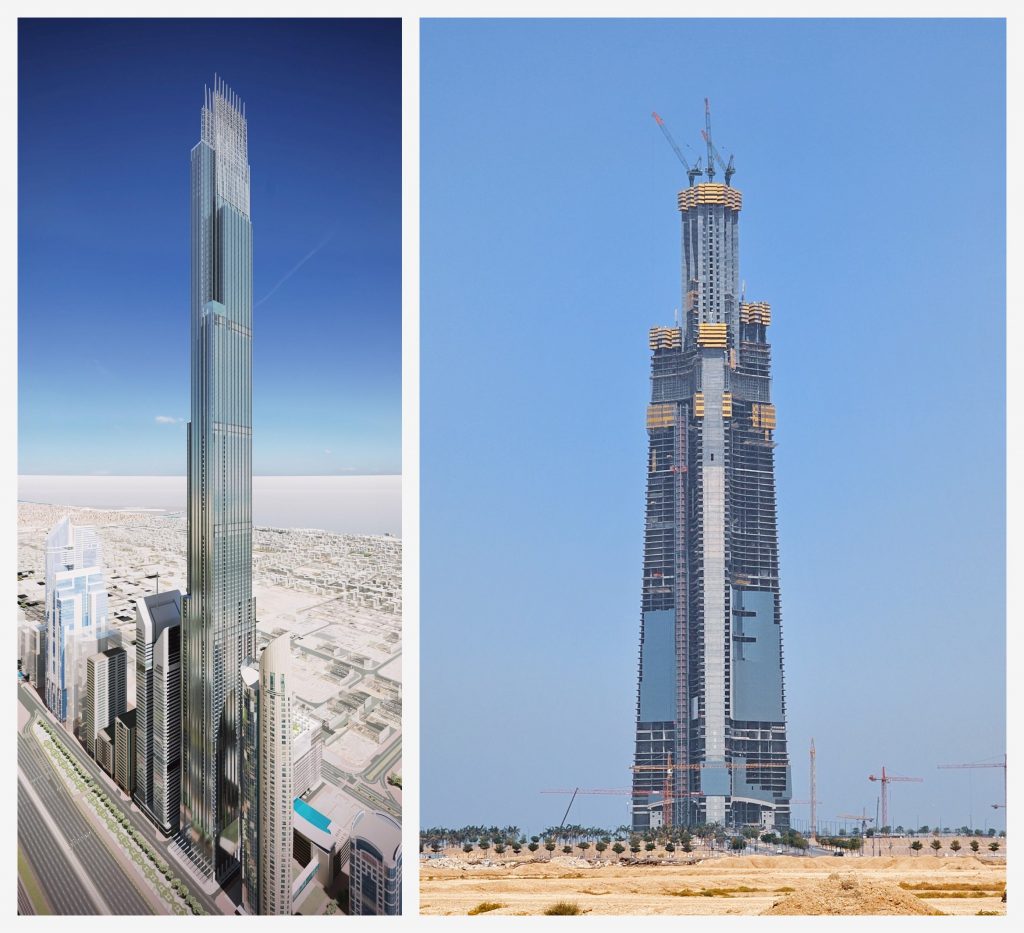
The race to build the world’s tallest structures is entering a new chapter.
Dubai’s Burj Azizi, currently under construction along Sheikh Zayed Road, is planned to reach an astonishing height of 725 meters, making it the second-tallest building in the world upon completion. However, its position is far from guaranteed.
Approximately 2,000 kilometers away, Saudi Arabia’s Jeddah Tower has resumed construction and is also targeting completion around 2028. If completed as planned, Jeddah Tower will exceed 1 kilometer in height, surpassing the Burj Khalifa and becoming the tallest building ever constructed.
This creates one of the most fascinating engineering competitions of the modern era—a race not just for height, but for technological innovation, urban ambition, and construction excellence.
Why Dubai Continues to Build Upward
At first glance, Dubai’s skyline appears similar to dense skyscraper cities such as New York, Hong Kong, or Shenzhen.
However, there is a crucial difference.
Cities like Hong Kong and Manhattan grew vertically because of limited land availability. Dubai, by contrast, possesses vast amounts of surrounding land. Its vertical development strategy is largely intentional.
The development of Sheikh Zayed Road transformed the city into a concentrated urban corridor designed to:
- Create a globally recognizable skyline
- Attract international investment
- Establish Dubai as a major financial and business hub
- Showcase architectural ambition on a global stage
The corridor became attractive to developers because of three key factors:
- Prestige and visibility
- Strong economic opportunities
- Zoning regulations that permit supertall construction
These conditions ultimately enabled landmark projects such as the Burj Khalifa and now the Burj Azizi.
The Significance of Dubai’s 2025 Freehold Reform
One of the most important yet often overlooked developments occurred in January 2025.
Dubai opened 128 plots along Sheikh Zayed Road for freehold conversion, allowing foreign investors and developers to own both the building and the land beneath it.
Historically, many prime sites were available only through long-term leasehold arrangements, typically lasting around 99 years. This allowed government authorities to maintain significant influence over strategic development areas.
The transition to freehold ownership represents a major shift in Dubai’s real estate market. Benefits include:
- Increased foreign investment
- Greater development flexibility
- Rising property demand
- Increased land values
- More opportunities for landmark skyscraper projects
For urban planners and developers, this change may have long-term impacts on Dubai’s skyline and economic growth.
Introducing Burj Azizi
Burj Azizi is being developed by Azizi Developments and is intended to become one of the most iconic skyscrapers ever built.
Key Facts
- Height: 725 meters
- Expected completion: 2028–2029
- Location: Sheikh Zayed Road, Dubai
- Ranking: Potentially the world’s second-tallest building
Unlike the Burj Khalifa, which occupies a relatively spacious site, Burj Azizi is being built on a much tighter urban plot. This constraint has heavily influenced its engineering and architectural design.
The tower will feature:
- Luxury residences
- Premium penthouses
- A seven-star-inspired hotel
- Observation decks
- Restaurants
- Retail spaces
- Entertainment facilities
- Cultural attractions
The development is designed as a vertical city where residents and guests can live, work, shop, and relax without leaving the building.
Record-Breaking Ambitions
Developers claim the tower will contain numerous world records, including:
- Highest observation deck
- Highest hotel lobby
- Highest restaurant
- Highest nightclub
- Highest hotel room
- Highest rock-climbing wall
- One of the highest museums in the world
These features highlight a growing trend in supertall construction: creating experiential destinations rather than simply tall buildings.
The Site’s Previous Life: From Entisar Tower to Burj Azizi
Interestingly, Burj Azizi was not the original project planned for the site.
The location was initially intended for Entisar Tower, a proposed 570-meter skyscraper developed by Meydan Group in 2016.
However, financial difficulties led to a stop-work order.
In 2018, Azizi Developments acquired the site, and construction officially restarted in 2025 under a new vision: creating the world’s second-tallest tower.
One important advantage remained—the original foundations had already been completed.
Rather than starting from scratch, engineers were able to adapt the existing substructure for the new design, although this also introduced significant engineering constraints.
Engineering Challenge #1: Foundation Design
One of the most important differences between Burj Khalifa and Burj Azizi is their footprint.
Burj Khalifa benefits from a broad base that distributes loads effectively and provides natural stability.
Burj Azizi, however, occupies a much narrower site.
To compensate, engineers rely on:
- Deep foundations
- Extensive piling systems
- Enhanced ground stabilization
The principle is straightforward: the deeper the structure is anchored into the ground, the greater its resistance to lateral movement at extreme heights.
Engineering Challenge #2: Extreme Slenderness
Burj Azizi is expected to become one of the slimmest supertall skyscrapers ever constructed.
Its proportions invite comparisons with New York’s 432 Park Avenue, a tower famous for its slenderness and wind-related performance challenges.
However, Burj Azizi introduces an entirely new scale.
It will rise roughly 300 meters taller than 432 Park Avenue while maintaining a similarly narrow profile.
This creates significant structural and occupant comfort challenges.
Understanding Wind Engineering in Supertall Building
Wind is one of the most critical design considerations for skyscrapers.
When airflow encounters a tall structure, it can move:
- Up the façade
- Down the façade
- Around the sides
Each scenario creates different engineering challenges.
Downdrafts
Air accelerating downward can create strong gusts at street level, affecting pedestrian comfort and safety.
Turbulence at the Roof
Airflow converging near the top of the tower can generate complex turbulence patterns.
Vortex Shedding
Wind flowing around sharp edges can create alternating pressure zones that induce oscillations and building sway.
These effects can lead to:
- Structural movement
- Occupant discomfort
- Noise issues
- Increased fatigue on building systems
Why Burj Azizi Does Not Use a Tuned Mass Damper
Many supertall buildings use a Tuned Mass Damper (TMD)—a massive pendulum-like device located near the top of the structure that helps reduce sway.
Examples include Taipei 101 and numerous modern skyscrapers.
Burj Azizi, like Burj Khalifa, is not expected to use a conventional TMD.
At extreme heights, the weight of a large damper becomes a significant structural burden.
Instead, engineers are relying on:
- Aerodynamic shaping
- Structural stiffness
- Advanced core systems
- Outrigger structures
to manage wind forces.
Aerodynamic Design Strategie
To reduce wind loads, engineers conduct extensive wind tunnel testing using scaled physical models.
The resulting data informs subtle adjustments to the tower’s geometry.
Burj Azizi incorporates several aerodynamic features:
Setbacks
Large setbacks interrupt wind flow as it moves up the façade, reducing aerodynamic excitation.
Notched Corners
Modified corners help disrupt vortex formation and reduce lateral forces.
High-Performance Cladding
Advanced glazing systems help control solar heat gain in Dubai’s harsh desert climate.
Embedded Thermal Monitoring
Sensors within the concrete structure monitor temperature variations that could affect long-term performance.
Structural Systems
The tower’s structural system includes:
Central Reinforced Core
The core houses:
- Building services
- Mechanical systems
- Vertical transportation
- Structural reinforcement
44 Elevators
A sophisticated vertical transportation network is essential for a building of this height.
Outrigger System
Outriggers connect the core to perimeter structural elements, increasing stiffness and improving resistance to lateral movement.
This system is commonly used in modern supertall skyscrapers because it efficiently transfers loads throughout the structure.
Construction Challenges on a Tight Urban Site
Building a 725-meter tower in a dense urban corridor introduces significant logistical challenges.
The site offers limited space for:
- Material storage
- Crane operations
- Worker circulation
- Equipment staging
To mitigate risks, tower cranes are equipped with advanced anti-collision systems that coordinate movement within the confined construction zone.
This demonstrates how modern construction increasingly relies on digital monitoring and automation to manage complexity.
Jeddah Tower: The Ultimate Competitor
While Burj Azizi pushes toward 725 meters, Jeddah Tower aims even higher.
Construction began in 2013 before stalling in 2018 at approximately 250 meters.
Work resumed in January 2025.
By May 2026:
- The tower had reached approximately 101 floors
- Reported height exceeded 400 meters
- It remained less than halfway complete
Once finished, Jeddah Tower is expected to surpass 1,000 meters, becoming the first building in history to cross the one-kilometer threshold.
What Does This Mean for the Future of Skyscrapers
Whether Burj Azizi ultimately becomes the second- or third-tallest building in the world may be less important than what it represents.
Projects like Burj Azizi and Jeddah Tower signal a new phase in skyscraper development where engineers, architects, and developers are pushing the limits of:
- Structural design
- Wind engineering
- Foundation technology
- Vertical transportation
- Urban identity
The larger question remains:
Are these towers practical solutions for increasing urban density, or are they primarily symbols of prestige and national ambition?
Future generations may view today’s race toward the one-kilometer mark as either the beginning of an even taller era—or the point at which skyscraper height reached its practical limits.
Either way, Burj Azizi and Jeddah Tower are helping redefine what is possible in civil engineering and construction.
No responses yet