Imagine constructing an 18-kilometre tunnel beneath the Baltic Sea without using a tunnel-boring machine.
Instead of excavating deep underground, engineers are manufacturing enormous concrete sections on land, transporting them into the sea, and carefully lowering them into a specially prepared trench on the seabed.
That is the extraordinary construction method behind the Fehmarnbelt Tunnel, one of Europe’s most ambitious infrastructure projects.
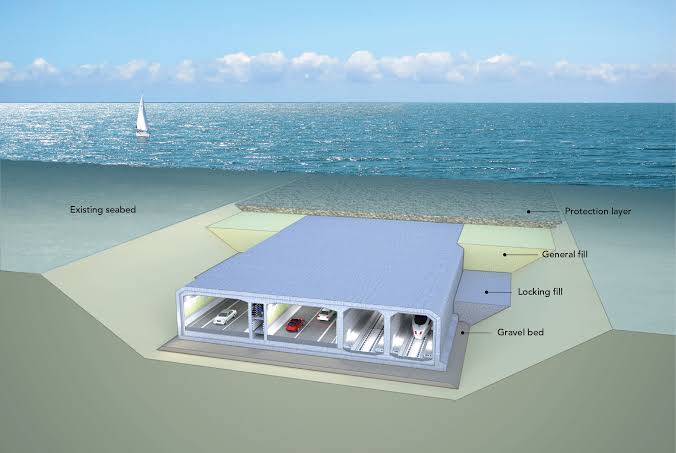
Connecting Denmark and Germany, this project is designed to transform transportation between Scandinavia and continental Europe. Once completed, it will become the world’s longest immersed road and rail tunnel, combining four motorway lanes and two electrified railway tracks within a single underwater infrastructure system.
But constructing such an enormous structure presents challenges far beyond simply placing concrete beneath the sea.
Engineers must control buoyancy, manage water pressure, manufacture exceptionally durable structures, coordinate specialized marine equipment, and achieve precise alignment between enormous tunnel elements.
So how exactly is the Fehmarnbelt Tunnel being built?
Let’s explore the engineering behind this remarkable project, from its earliest construction stages to the final installation of its road and railway systems.
1. What Is the Fehmarnbelt Tunnel?
The Fehmarnbelt Tunnel is an approximately 18-kilometre underwater transportation link connecting Rødbyhavn on the Danish island of Lolland with Puttgarden on the German island of Fehmarn.
The tunnel is designed to carry both road and railway traffic, replacing a major missing fixed connection between the two countries.
Currently, much of the direct traffic across the Fehmarnbelt relies on ferry services.
Although the ferry crossing takes approximately 45 minutes, passengers and freight operators must also account for loading, unloading, and waiting times.
The new tunnel is designed to reduce the actual crossing time to approximately seven minutes by train and ten minutes by car.
For international freight transportation, the project could be particularly significant. By creating a permanent rail connection, the tunnel is expected to improve the movement of goods between Scandinavia and continental Europe.
The project also forms part of the European Union’s Scandinavian–Mediterranean transport corridor, a major network intended to improve connectivity between northern and southern Europe.
However, the engineering significance of the Fehmarnbelt Tunnel extends beyond its transportation benefits.
Its most remarkable feature is how it is being constructed.
2. Why Engineers Are Not Using a Tunnel-Boring Machine
When people think of underwater tunnels, they often imagine massive tunnel-boring machines excavating through rock or soil deep beneath the seabed.
This approach has been used on major infrastructure projects around the world.
But the Fehmarnbelt Tunnel uses a different technique known as immersed-tube construction.
Instead of boring a continuous underground passage, engineers manufacture separate watertight tunnel elements at a factory.
These elements are then transported to the construction site, lowered into a previously excavated trench, connected, and covered with protective materials.
There are important engineering reasons to consider this technique.
An immersed tunnel can follow a relatively shallow alignment through suitable seabed conditions, rather than requiring a bored tunnel to pass deeper beneath the seabed.
This can influence the lengths and gradients of the approach sections, which are particularly important for railway infrastructure.
The method also allows concrete construction to take place within a controlled factory environment.
Rather than manufacturing the tunnel structure entirely offshore, workers can construct, inspect, and prepare individual sections on land before installation.
However, immersed-tube construction introduces its own difficulties.
Engineers must excavate the seabed, manage marine operations, maintain element stability during transportation, and achieve watertight connections underwater.
For the Fehmarnbelt project, the chosen method requires an extraordinary combination of industrial manufacturing and marine engineering.
3. Excavating an 18-Kilometre Trench Across the Seabed
Before the tunnel elements can be installed, engineers must prepare the seabed.
This is one of the most important construction stages because the tunnel requires a continuous, accurately formed foundation along its alignment.
The Fehmarnbelt project involved excavating an approximately 18-kilometre trench between the Danish and German coasts.
The trench has an average depth of approximately 12 metres and an average width of approximately 100 metres.
Around 15 million cubic metres of seabed material were excavated during the dredging operation, which was completed in 2024.
This work required specialized dredging vessels capable of removing large quantities of sand, sediment, and other seabed materials.
Excavating underwater is substantially different from conventional earthworks.
Visibility is limited, currents influence marine operations, and engineers must work within carefully defined environmental and navigation requirements.
The trench must also have suitable dimensions to accommodate the tunnel elements, their bedding material, and the protective backfill.
After excavation, a prepared layer of gravel is placed along the bottom of the trench.
This bedding layer provides a carefully controlled surface on which the concrete elements can be positioned.
The accuracy of this preparation is critical.
If the support conditions are unsuitable, the tunnel elements may experience uneven loading or settlement.
For a structure intended to remain in service for at least 120 years, the quality of its foundation is a fundamental design consideration.
Interestingly, much of the excavated material has been reused to create new coastal land and nature areas near Rødbyhavn.
This illustrates how major infrastructure projects must coordinate structural engineering, marine construction, material management, and environmental planning.
4. The Enormous Tunnel Factory in Denmark
One of the most impressive features of the project is the purpose-built concrete manufacturing facility near Rødbyhavn.
Rather than constructing the tunnel elements at numerous separate locations, the project uses a large industrial production complex designed specifically for the task.
The facility includes multiple production halls and six production lines.
Five lines manufacture the standard tunnel elements, while a sixth is dedicated to special elements that contain additional space for technical installations.
A typical standard tunnel element is approximately 217 metres long and weighs around 73,500 tonnes before the addition of immersion ballast.
To understand that scale, consider that a single finished section is longer than two football pitches placed end to end.
Each standard element is manufactured from nine individual concrete segments, each approximately 24 metres long.
The segments are cast sequentially within the factory.
Once a segment has been completed, it is moved forward so the formwork can be prepared for the next casting operation.
This process continues until the nine segments form one complete tunnel element.
The project requires 79 standard elements and ten shorter special elements.
The special elements incorporate an additional basement level for electrical and other technical installations.
Why factory construction matters
Manufacturing the elements inside controlled production halls offers several engineering advantages.
Concrete quality can be monitored more consistently, reinforcement placement can be carefully inspected, and construction activities are less exposed to changing marine weather conditions.
Engineers can also standardize production processes across repeated structural sections.
This is especially important for a project requiring so many similar elements.
However, industrial-scale concrete production introduces demanding logistical requirements.
The construction team must coordinate reinforcement deliveries, concrete production, formwork movement, curing, dimensional inspections, and element transportation.
At this scale, the tunnel factory operates almost like a manufacturing plant, with each completed element representing an enormous finished structural product.
5. How Can a 73,500-Tonne Concrete Tunnel Float?
One of the most fascinating engineering questions surrounding the Fehmarnbelt Tunnel is how something made from tens of thousands of tonnes of concrete can float.
The answer lies in a fundamental principle of fluid mechanics: buoyancy.
According to Archimedes’ principle, an object submerged in water experiences an upward force equal to the weight of the water it displaces.
Concrete is denser than water, but a hollow concrete structure can still float if its overall average density is sufficiently low.
This is the same basic principle that allows large steel ships to remain afloat.
The tunnel elements contain substantial hollow spaces intended for future road and railway traffic.
Before transportation, watertight steel bulkheads are installed at their ends, preventing water from entering these internal spaces.
The enclosed air contributes to the element’s overall displacement and allows it to remain buoyant.
But flotation alone is not enough.
Engineers must also control stability.
Because the arrangement and weight of the road and railway tubes are not perfectly symmetrical, the structure requires additional temporary measures to maintain the correct balance during transportation and immersion.
Temporary water chambers and ballast arrangements are used to control the orientation and weight of the element.
Before the first tunnel element was immersed, approximately 4,500 tonnes of additional ballast concrete were installed.
The purpose was to increase its weight and enable a carefully controlled descent toward the seabed.
This demonstrates an important engineering distinction: a structure that floats safely during transportation must subsequently be made heavy enough to remain in its final underwater position.
Achieving both conditions requires detailed calculations of buoyancy, centre of gravity, stability, and ballast distribution.
6. Transporting the Tunnel Elements Into the Baltic Sea
Once an element is ready, it is moved from the factory area into the work harbour.
It is then prepared for its journey to the installation location.
Specialized tugboats and immersion equipment transport the massive concrete structure through the water.
The first element was transported in May 2026 using five tugboats and the specially developed immersion vessel IVY.
The initial journey to the installation location covered just over two kilometres.
Although this distance might seem short, transporting such an enormous structure requires exceptional control.
Marine engineers must consider wind, currents, vessel movements, water depth, towing forces, and the interaction between the floating element and its supporting equipment.
The operation also involves communication between multiple vessels and engineering teams.
Because the element is very large and moves relatively slowly, even a small positioning error can create significant difficulties during installation.
The transportation phase is therefore not simply a towing operation.
It is a coordinated marine engineering procedure that prepares an enormous concrete structure for precise placement beneath the sea.
7. Lowering the Tunnel Elements Onto the Seabed
The immersion stage is arguably the most technically demanding part of construction.
Once a tunnel element reaches its designated location, the specialized immersion system begins lowering it toward the trench.
The process must happen gradually.
Engineers control the element’s weight, buoyancy, orientation, and position as it descends through the water.
The element must remain sufficiently stable to prevent excessive rotation or movement.
Meanwhile, its position must be monitored relative to the prepared seabed and any previously installed tunnel sections.
For the first element in May 2026, the immersion process took approximately 14 hours from the beginning of lowering until it reached its intended position.
Following placement, the element was connected to the Danish tunnel portal and its alignment was checked using precise laser measurements.
This illustrates why immersed-tunnel construction requires far more than heavy lifting.
A tunnel element weighing tens of thousands of tonnes must be installed with enough accuracy to become part of a continuous transportation structure.
Each successful installation represents the combined work of structural engineers, surveyors, marine specialists, geotechnical engineers, and construction teams.
8. Connecting the Tunnel Elements Without Allowing Water Inside
Placing a tunnel element on the seabed is only part of the challenge.
The next task is connecting it securely to the adjoining structure.
An underwater tunnel cannot function if water enters through its joints.
For that reason, the connection system is among the most important components of the project.
The elements are manufactured with watertight temporary end bulkheads and engineered sealing arrangements.
During connection, the new element is positioned against the previously installed section.
A sealed space between the bulkheads can then be dewatered.
Removing the water from this space creates a pressure difference that allows the surrounding water pressure to help push the elements together.
This action compresses the sealing system and contributes to forming a watertight connection.
Once the structural connection has been secured and verified, the temporary separation arrangements can be removed as required by the construction sequence.
The goal is to create a continuous enclosed tunnel while maintaining protection against external water pressure.
The joint design must also account for structural movements, installation tolerances, and long-term durability.
For a tunnel intended to operate for more than a century, the performance of these connections is a critical engineering consideration.
9. Protecting the Tunnel After Installation
After the concrete elements have been immersed and connected, they are stabilized and protected within the excavated trench.
Gravel and sand are placed around the structures, helping support the elements and secure their position.
A protective stone layer is then placed over the tunnel.
The exact construction sequence and material placement are controlled using specialized marine equipment.
These protective layers help shield the tunnel from external influences and contribute to its long-term stability.
However, the design must also consider the interaction between the concrete structure and surrounding soil.
The engineering challenges include settlement, soil pressure, water pressure, and the behavior of the seabed over the tunnel’s service life.
The completed tunnel must resist these effects while safely carrying road and railway loads.
This makes the Fehmarnbelt Tunnel an important example of structural and geotechnical engineering working together.
10. Installing the Roads, Railways, and Technical Systems
Even after the structural tunnel has been assembled, a substantial amount of construction work remains.
The Fehmarnbelt Tunnel is designed to contain separate tubes for motorway and railway traffic, together with a central service tube.
The motorway will provide four traffic lanes, while the railway will consist of two electrified tracks.
The interior requires numerous technical systems before vehicles or trains can use the tunnel.
These include lighting, ventilation, communications, monitoring equipment, traffic management systems, railway installations, and safety infrastructure.
The technical systems must operate reliably within a long enclosed transportation environment.
Ventilation and emergency arrangements are especially important because incidents inside tunnels create different challenges from those on open roads.
Engineers must consider smoke movement, evacuation routes, incident detection, emergency access, and maintenance requirements.
All installations must also be tested and integrated before the tunnel opens.
This final stage demonstrates that a major infrastructure project is not complete when its concrete structure is finished.
Its operational systems are equally important.
11. What Is the Construction Status in November 2026?
The Fehmarnbelt Tunnel remains under construction.
A major milestone occurred in May 2026 when engineers successfully immersed the first standard tunnel element and connected it to the Danish portal.
Further installations followed during the summer.
By September 28, 2026, four standard elements had been immersed, bringing the installed underwater section to almost 900 metres.
The next planned major installation was the first special element, incorporating an additional basement level for technical equipment.
Progress has also continued on the land-based sections.
On October 30, 2026, the project announced that structural works had been completed on the German tunnel portal at Puttgarden.
The approximately 600-metre land section includes a cut-and-cover tunnel and a light transition zone.
These milestones represent substantial progress, but the majority of the immersed tunnel elements still need to be installed.
The project has also faced the complex operational and organizational challenges associated with megaproject construction.
The construction programme remains dependent on the successful completion of marine works, tunnel connections, technical installations, testing, and regulatory approvals.
As a result, historical target opening dates should not be treated as guaranteed completion dates.
For the latest confirmed milestones, readers should consult the official project updates published by Femern A/S.
12. Why the Fehmarnbelt Tunnel Matters to Civil Engineering
The Fehmarnbelt Tunnel is more than a transportation project.
It demonstrates how several engineering disciplines must work together to deliver infrastructure at an extraordinary scale.
Structural engineers are responsible for ensuring that the reinforced-concrete elements safely resist loads throughout construction and operation.
Geotechnical engineers assess seabed conditions, foundation behavior, and the interaction between the tunnel and surrounding ground.
Marine engineers coordinate floating stability, vessel operations, immersion, and underwater installation.
Transportation engineers address the operational requirements of motorway and railway traffic.
Construction and project management specialists coordinate logistics, schedules, resources, contractors, risks, and interfaces between different parts of the project.
For engineering students, this project provides a valuable reminder that real-world infrastructure rarely belongs to one discipline.
A tunnel may appear to be primarily a structural engineering achievement, but its success depends on the integration of design, materials, construction, environmental management, transport planning, and operational safety.
For construction professionals, it also illustrates how industrialized manufacturing and specialized equipment can transform the way enormous structures are delivered.
And for engineering enthusiasts, it reveals something remarkable about modern construction: engineers are capable of manufacturing a massive tunnel on land and assembling it beneath the sea.
Conclusion: Engineering Beneath the Baltic Sea
The Fehmarnbelt Tunnel demonstrates how modern engineering can solve complex transportation challenges through innovative construction methods.
Instead of excavating the entire tunnel underground, engineers are manufacturing enormous reinforced-concrete sections, transporting them across the water, and positioning them within an excavated seabed trench.
Every stage presents a different technical challenge.
The concrete elements must be strong enough to withstand long-term loads, light enough to float during transportation, stable enough for controlled immersion, and accurately aligned to create a continuous watertight structure.
The project also highlights the importance of construction logistics, quality control, marine engineering, and multidisciplinary coordination.
When completed, the Fehmarnbelt Tunnel is expected to provide a faster permanent connection between Denmark and Germany while strengthening an important European transportation corridor.
But perhaps its greatest significance lies in what it teaches us about engineering.
Some of the world’s most extraordinary infrastructure is not built through one revolutionary invention. It is created by bringing together established engineering principles, sophisticated construction methods, and thousands of carefully coordinated decisions.
The Fehmarnbelt Tunnel is a powerful example of that process.
Explore More Engineering With VCE Build
At VCE Build, we explore the engineering, construction methods, and technical decisions behind the world’s most ambitious infrastructure projects.
Visit our YouTube channel for visual explanations of megaprojects, structural systems, construction technologies, and engineering challenges.
For deeper learning, join VCE Build on Patreon to access illustrated project case studies, downloadable technical guides, construction tutorials, and professional engineering resources.
Interested in working with VCE Build? Explore our engineering research, educational content development, and technical visualization services through our professional website.
VCE Build — Understand the Engineering. Learn the Construction. Explore the Megaprojects.
No responses yet