Throughout history, architecture has served as a reflection of humanity’s ambitions, fears, technological capabilities, and social structures. From the monumental pyramids of Egypt to modern skyscrapers that define contemporary skylines, the built environment reveals how societies envision their future. Fictional worlds often amplify these visions, providing architects, planners, and engineers with conceptual frameworks through which real-world challenges can be examined.
One of the most fascinating examples of speculative urbanism is the concept of the Hive City, a central feature of the Warhammer 40,000 universe. These colossal urban megastructures house populations ranging from billions to tens of billions of inhabitants within vertically layered environments that stretch far beyond the scale of any city humanity has ever constructed. While fictional, Hive Cities raise compelling questions about urban density, resource management, infrastructure resilience, social inequality, sustainability, and the future of mega-urban development.
At first glance, Hive Cities appear to be exaggerated dystopian fantasies. However, beneath their dramatic imagery lies a surprisingly relevant exploration of many issues facing modern cities today. Rapid urbanization, housing shortages, environmental degradation, resource scarcity, and increasing social stratification are challenges already confronting planners and policymakers across the globe.
For professionals in civil engineering, architecture, and construction, Hive Cities offer a thought-provoking case study of what can happen when urban growth becomes the dominant objective while sustainability, adaptability, and human well-being are neglected.
Understanding the Hive City Concept
Hive Cities are enormous self-contained urban environments that evolve vertically rather than horizontally. In the fictional setting, surrounding landscapes have become largely inhospitable due to industrial pollution, resource depletion, and environmental collapse. As a result, urban growth is forced upward.
The social structure of these cities is reflected physically within their architecture. Wealthy elites occupy the upper levels, where access to sunlight, clean air, and superior infrastructure is abundant. Lower levels become progressively more crowded, darker, and environmentally degraded. At the lowest levels, often referred to as the “underhive,” residents struggle to survive amidst decaying infrastructure and extreme scarcity.
From an urban planning perspective, this represents an extreme form of vertical segregation. Social divisions are no longer merely economic or geographic; they become embedded directly into the physical structure of the city itself.
The result is a built environment where architecture does not simply house society—it actively reinforces and amplifies inequality.
Arcologies: The Real-World Inspiration
The Hive City concept shares similarities with the architectural theory of the arcology, a term combining “architecture” and “ecology.”
Developed by architect Paolo Soleri during the 1960s, arcology proposed highly compact, self-sustaining urban environments capable of accommodating large populations within a single integrated structure. Soleri envisioned cities that minimized land consumption, reduced transportation needs, improved resource efficiency, and created stronger social connections between residents.
Unlike conventional cities, which often sprawl outward across vast areas, arcologies concentrate housing, commerce, education, recreation, food production, and infrastructure into a unified system.
The underlying goal was sustainability.
By reducing travel distances and consolidating urban functions, arcologies aimed to lower environmental impacts while improving quality of life.
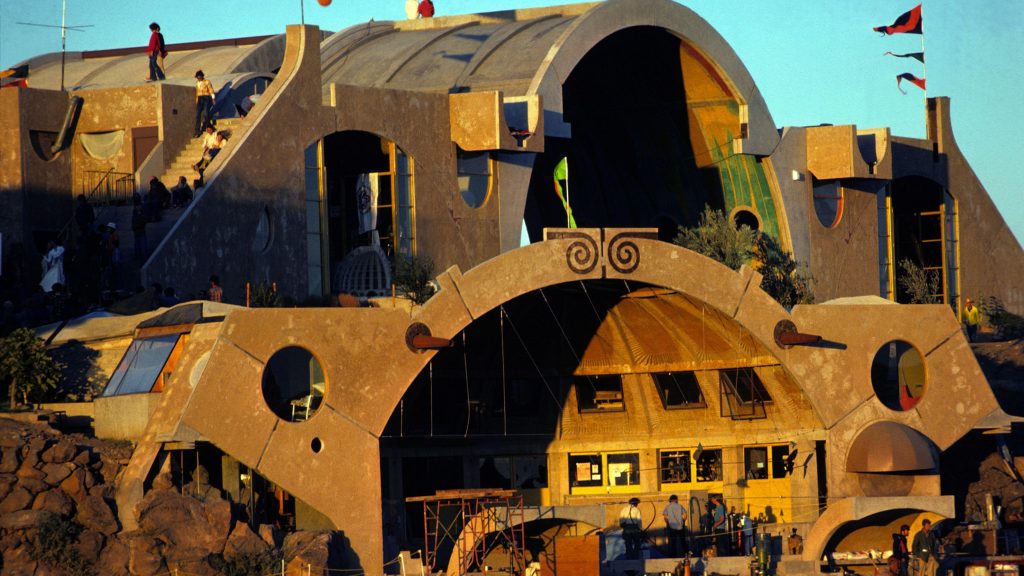
One of the most famous experimental implementations of this philosophy is Arcosanti in Arizona, a prototype community designed according to Soleri’s principles. Although innovative, Arcosanti remained relatively small and never achieved the scale originally envisioned.
Several conceptual megaprojects have attempted to expand upon arcological ideas, including floating cities, vertical megastructures, and integrated urban ecosystems. Yet most remain unbuilt due to technological, financial, logistical, and political challenges.
Hive Cities can therefore be understood as a dystopian inversion of arcology—a scenario in which density and self-containment are achieved, but sustainability and human-centered design are abandoned.
Vertical Urbanism and Social Stratification
One of the most important lessons emerging from the Hive City model concerns the relationship between vertical development and social equity.
As cities become increasingly dense, architects and planners face difficult questions regarding access to environmental resources. Natural light, ventilation, green space, views, and mobility become highly valuable commodities in vertically organized environments.
Hive Cities exaggerate this reality by assigning environmental privilege according to social status. Residents living near the top enjoy favorable living conditions, while those lower down endure darkness, pollution, and overcrowding.
Although extreme, this concept reflects genuine concerns within contemporary urban development.
Large-scale vertical city projects, including emerging megastructures currently under development, raise questions regarding equitable access to daylight, public space, transportation infrastructure, and environmental quality.
As buildings become taller and urban systems more vertically integrated, ensuring fair distribution of these resources becomes increasingly important.
For architects and engineers, this highlights the need to prioritize human-centered design principles alongside technical efficiency.
The Challenge of Infinite Growth
Perhaps the most significant weakness of Hive Cities is their dependence on perpetual growth.
Population expansion drives continuous construction, resulting in ever-increasing density and infrastructure demand. New layers are constantly added to accommodate additional inhabitants, often without sufficient consideration for long-term system performance.
This mirrors one of the most difficult challenges confronting modern cities.
Urban growth is frequently treated as a measure of economic success. However, growth itself does not guarantee sustainability. Transportation systems, utility networks, housing stock, energy infrastructure, and environmental resources all possess finite capacities.
When growth exceeds these capacities, cities experience congestion, housing crises, resource shortages, and declining quality of life.
Hive Cities illustrate what occurs when expansion becomes the sole organizing principle of urban development.
Rather than adapting intelligently, the city simply accumulates additional layers of complexity until systemic failure becomes inevitable.
Metabolism and Adaptive Urban Systems
A fascinating architectural movement that addresses this challenge is Metabolism, which emerged in post-war Japan during the 1950s and 1960s.
Japanese architects recognized that cities function as dynamic systems rather than static objects. Rapid urbanization required new approaches capable of adapting to changing demographic and economic conditions.
Metabolist architects proposed cities that could grow, evolve, and transform over time.
Inspired by biological organisms, many designs featured permanent structural frameworks combined with replaceable modular components. Residential units could theoretically be attached, removed, upgraded, or relocated as needs changed.
The city itself would behave like a living organism.
Examples included enormous structural spines stretching across urban regions and vertical megaframes supporting interchangeable housing capsules.
From a contemporary engineering perspective, these proposals anticipated many concepts associated with modular construction, prefabrication, and adaptive infrastructure.
Although most metabolist projects were never fully realized, the movement remains influential because it addressed a critical question:
How can cities accommodate growth without sacrificing flexibility?
Had Hive Cities incorporated such principles, their development might have been guided by coherent planning rather than chaotic expansion.
Construction Logistics and the Complexity of Modular Growth
The practical challenges associated with adaptive megastructures reveal why many visionary projects remain unbuilt.
Creating a modular city requires far more than innovative design concepts. Successful implementation depends upon integrated construction systems, advanced manufacturing capabilities, transportation networks, regulatory coordination, maintenance protocols, and long-term governance frameworks.
Each additional module must be fabricated, transported, installed, serviced, and eventually replaced.
This level of coordination is extraordinarily difficult even within technologically advanced societies.
The lesson for construction professionals is clear: scalability is not merely a design challenge—it is a systems challenge.
Large-scale urban projects succeed only when architecture, engineering, logistics, policy, and economics operate in alignment.
Without this coordination, complexity becomes a source of instability rather than resilience.
Parasitic Architecture and Informal Urban Growth
As Hive Cities expand, their built environment begins to exhibit characteristics similar to what architects have described as parasitic architecture.
Parasitic architecture refers to structures that attach themselves to existing buildings, utilizing the host’s infrastructure, structural support, or services. While the term may sound negative, many early examples emerged from humanitarian concerns.
During the 1960s and 1970s, architects explored temporary and adaptable structures that could provide affordable housing, community space, or emergency shelter without requiring extensive new construction.
These interventions often bypassed traditional regulatory processes and sought to address urgent social needs quickly.
In many ways, parasitic architecture represented a critique of slow bureaucratic systems that struggled to respond effectively to housing shortages and urban inequality.
Within Hive Cities, however, this concept becomes extreme.
Unregulated additions accumulate over centuries, eventually overwhelming the structural capacity of the original framework. Buildings support additional buildings, infrastructure is stretched beyond its intended limits, and entire neighborhoods become dependent upon unstable systems.
The result is architectural fragility on a massive scale.
Infrastructure Collapse and Systemic Risk
One of the most striking aspects of Hive Cities is the frequency of catastrophic structural failures.
As unplanned growth continues, entire districts collapse under their own weight. Infrastructure deteriorates, maintenance becomes impossible, and aging systems struggle to support expanding populations.
This fictional scenario reflects a genuine concern in urban infrastructure management.
Infrastructure systems possess finite service lives. Roads, bridges, water networks, electrical grids, and buildings require continuous investment and maintenance.
When maintenance is deferred, vulnerabilities accumulate.
Modern cities already face significant infrastructure challenges due to aging assets, climate change, increasing demand, and funding limitations.
Hive Cities simply magnify these risks to an extreme scale, demonstrating what happens when expansion consistently outpaces maintenance and renewal.
For civil engineers, this serves as a powerful reminder that resilience depends not only on initial construction quality but also on long-term stewardship.
Environmental Sustainability and Resource Consumption
Another major theme represented by Hive Cities is ecological overshoot.
These megastructures consume enormous quantities of energy, water, materials, and food while generating equally significant amounts of waste and pollution.
Over time, surrounding environments become depleted and degraded.
This dynamic resembles the economic principle known as the Tragedy of the Commons, in which individuals acting in their own short-term interests collectively exhaust shared resources.
Urban sustainability requires balancing consumption with regeneration.
When resource extraction exceeds ecological capacity, environmental decline becomes inevitable.
Modern cities are increasingly adopting circular economy principles, renewable energy systems, water recycling technologies, and sustainable construction practices to mitigate these risks.
However, Hive Cities illustrate the consequences of ignoring environmental limits altogether.
The city survives by consuming increasingly larger quantities of resources until the supporting ecosystem can no longer sustain it.
Cities as Living Organisms
A recurring metaphor throughout urban theory is the comparison between cities and living organisms.
Transportation networks resemble circulatory systems. Utility infrastructure functions like metabolic pathways. Buildings act as organs supporting various social and economic functions.
Hive Cities embody this metaphor literally.
Their growth patterns resemble biological processes. Their resource demands mirror metabolic systems. Their structural failures resemble disease.
Interestingly, biological systems maintain health through balance, adaptation, and renewal.
When growth becomes uncontrolled, organisms develop pathologies.
Similarly, cities require mechanisms that regulate expansion, maintain infrastructure, distribute resources, and adapt to changing conditions.
Without these mechanisms, urban systems become increasingly vulnerable.
Lessons for Future Megacities
As global urbanization continues, cities will inevitably become denser and more technologically complex.
Emerging concepts such as smart cities, vertical urbanism, autonomous infrastructure systems, and integrated megaprojects promise significant improvements in efficiency and sustainability.
However, the Hive City serves as an important cautionary tale.
It demonstrates that technological advancement alone cannot guarantee successful urban development.
Future cities must balance density with livability, efficiency with equity, growth with sustainability, and innovation with resilience.
Architects, engineers, planners, and policymakers must recognize that cities are not merely collections of buildings. They are complex socio-technical systems that shape human experiences and societal outcomes.
Conclusion
Although entirely fictional, Hive Cities offer valuable insights into some of the most pressing urban challenges of the twenty-first century.
They highlight the risks of uncontrolled growth, environmental degradation, infrastructure neglect, social stratification, and unsustainable resource consumption. At the same time, they encourage meaningful discussions about arcologies, adaptive urban systems, modular construction, and resilient infrastructure design.
For professionals in civil engineering, architecture, and construction, the Hive City represents more than a dystopian fantasy. It serves as a thought experiment exploring the consequences of prioritizing expansion over sustainability and efficiency over humanity.
Ultimately, the future of urban development will depend on our ability to learn from both real-world experience and speculative visions. Whether designing skyscrapers, transportation networks, housing systems, or entire cities, the goal should not simply be to build bigger structures.
The goal should be to create urban environments capable of supporting human prosperity, environmental resilience, and social well-being for generations to come.
No responses yet