For centuries, cities have been defined by permanence. From the ancient urban centers of Mesopotamia to the modern skyscraper districts of New York, London, and Tokyo, civilization has largely equated urban success with stability, fixed infrastructure, and long-term territorial occupation. Roads, bridges, utilities, and buildings are designed with the expectation that they will remain in place for decades—or even centuries.
Yet during the 1960s, a radical group of British architects challenged this fundamental assumption. Known as Archigram, they proposed a future in which cities would no longer be static entities anchored to geography. Instead, they envisioned urban environments capable of movement, adaptation, and continuous transformation. Their most famous proposal, the Walking City, imagined enormous mobile megastructures traversing landscapes, carrying entire communities while interacting with other mobile settlements.
Although the concept remained largely theoretical, its influence on architecture, urban planning, and future city discourse has been profound. More importantly, many of the questions raised by Archigram remain relevant today. As societies confront climate change, population displacement, technological disruption, and evolving patterns of work, the notion of adaptable and mobile urban environments has gained renewed significance.
This article explores the architectural, engineering, and urban planning implications of Walking City and related visionary projects, examining how concepts once dismissed as science fiction continue to inform contemporary discussions about the future of cities.
Post-War Reconstruction and the Search for New Urban Models
The emergence of Archigram cannot be understood without considering the historical context in which it developed.
Following the Second World War, Britain faced severe housing shortages, damaged infrastructure, and widespread urban reconstruction challenges. Governments and planners sought innovative solutions capable of delivering housing rapidly while accommodating changing social expectations.
Traditional planning approaches appeared increasingly inadequate for addressing the scale of post-war transformation. At the same time, advances in aerospace engineering, manufacturing, telecommunications, and industrial design were reshaping public perceptions of technology and progress.
Many architects began questioning whether conventional buildings and cities were too rigid to accommodate future societal needs. Rather than designing permanent structures, they explored concepts emphasizing flexibility, adaptability, and technological integration.
Within this environment, Archigram emerged as one of the most influential avant-garde architectural groups of the twentieth century. Their work rejected static urbanism in favor of dynamic systems capable of responding to changing human needs.
The Walking City became the most iconic expression of this philosophy.
The Walking City Concept
At its core, Walking City proposed a radical redefinition of urban mobility.
Instead of individuals commuting between fixed locations, entire urban districts would move across landscapes. Massive robotic structures would transport populations, resources, infrastructure, and services as integrated systems.
The proposal depicted giant mobile units resembling technologically advanced organisms. These self-contained cities could travel independently, interact with one another, exchange resources, and potentially form temporary urban networks before separating again.
The concept challenged one of the most fundamental assumptions of urban planning: that cities must remain geographically fixed.
In Walking City, mobility became the defining characteristic of urban life.
Citizens would no longer be tied to specific territories, political boundaries, or economic regions. Instead, communities could migrate in response to environmental conditions, economic opportunities, technological needs, or social preferences.
Although highly speculative, the project introduced important questions about adaptability, resilience, and urban flexibility that continue to influence contemporary planning discussions.
Engineering the Impossible: Mobility Systems for Megastructures
The most visually striking aspect of Walking City is its mobility system.
Archigram’s illustrations featured enormous mechanical legs inspired by insects and industrial machinery. These structures would theoretically allow the city to traverse diverse terrains including deserts, mountains, and coastal regions.
From a contemporary engineering perspective, such a system presents extraordinary challenges.
The structural loads associated with supporting thousands of residents, utilities, transportation systems, and buildings would be immense. Energy requirements alone would exceed the capabilities of current mobile technologies.
Nevertheless, examining alternative mobility systems provides valuable insight into the feasibility of large-scale mobile infrastructure.
One potential model can be found in crawler transporter technology, originally developed for transporting spacecraft. These vehicles demonstrate that extremely heavy loads can be moved safely across prepared surfaces.
Similarly, advanced rail-based systems suggest possibilities for mobile urban components integrated with existing transportation corridors.
Emerging autonomous transportation technologies, modular infrastructure platforms, and smart logistics networks may eventually support forms of urban mobility that, while less dramatic than Walking City, embody similar principles.
The broader lesson is that future cities may become increasingly dynamic, even if they never literally walk across landscapes.
Megastructures and the Plug-In City Framework
While Walking City focused primarily on mobility, another Archigram proposal explored adaptability from a different perspective.
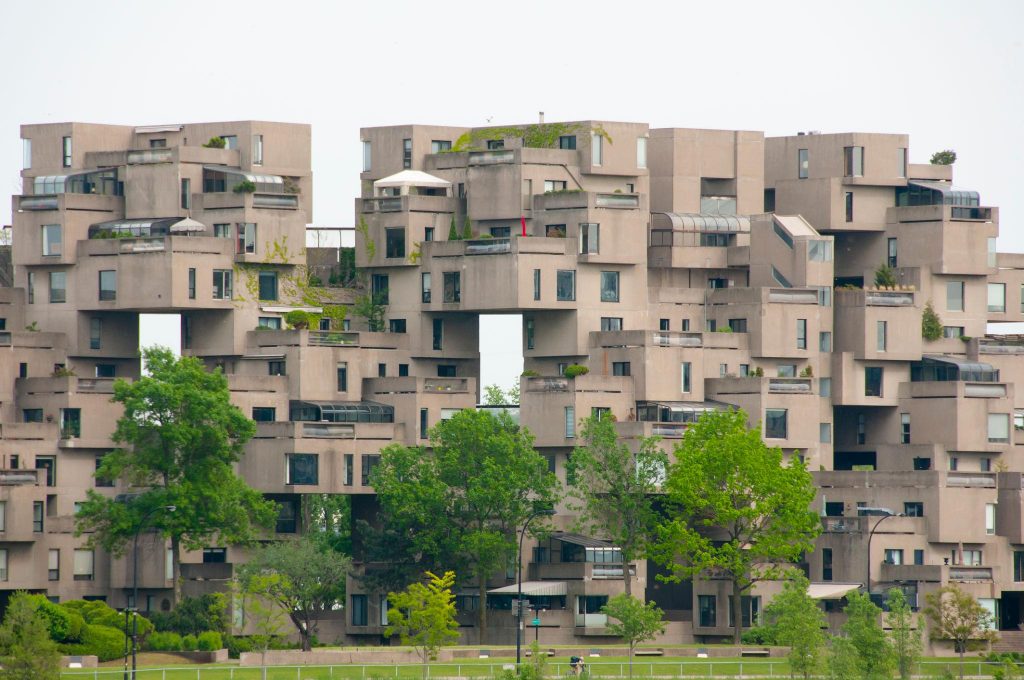
The Plug-In City concept envisioned a permanent structural framework designed to accommodate interchangeable modular units. Housing, offices, commercial spaces, and infrastructure components could be inserted, removed, upgraded, or replaced according to changing needs.
Rather than constructing fixed buildings with predetermined lifespans, Plug-In City proposed treating architecture as an evolving system.
The framework itself would provide essential infrastructure, including transportation networks, utilities, communication systems, and structural support. Individual modules would function as replaceable components.
This approach anticipated many contemporary discussions surrounding modular construction, prefabrication, circular economy principles, and adaptive reuse.
Today, modular building systems are increasingly employed to improve construction efficiency, reduce waste, and accelerate project delivery. Although current implementations remain far more modest than Archigram’s vision, the underlying philosophy remains remarkably relevant.
Buildings are increasingly viewed not as permanent objects but as adaptable systems capable of evolving alongside society.
Lessons from Metabolism and the Nakagin Capsule Tower
At approximately the same time that Archigram was developing its concepts in Britain, Japanese architects associated with the Metabolist movement were pursuing similar ideas.
Metabolism embraced notions of growth, flexibility, and continuous urban transformation. Like Archigram, Metabolist architects sought to create structures capable of adapting to changing social and technological conditions.
The most famous built example was Tokyo’s Nakagin Capsule Tower.
Completed in 1972, the building consisted of prefabricated residential capsules attached to central service cores. Theoretically, capsules could be removed and replaced as needed, allowing the building to evolve over time.
However, the project ultimately revealed significant practical challenges.
Maintenance costs proved extremely high. Building systems deteriorated. Capsule replacement became economically unfeasible. Residents faced problems related to insulation, ventilation, and aging infrastructure.
After decades of decline, the building was demolished in 2022.
For architects and engineers, the Nakagin experience highlights a critical lesson. Flexibility alone does not guarantee long-term viability. Adaptable systems must also be economically sustainable, technically maintainable, and operationally practical.
The failure of Nakagin does not invalidate modular architecture. Instead, it demonstrates the importance of integrating lifecycle management into innovative design strategies.
Adaptive Architecture and Modular Living
One of Archigram’s most intriguing ideas involved breaking residential units into smaller interchangeable components.
Unlike fixed apartments or houses, these living pods could be customized, upgraded, and reconfigured according to occupant preferences.
This approach anticipated many trends visible in contemporary housing design.
Smart homes, modular construction systems, prefabricated housing, and mass customization all reflect growing interest in adaptable living environments.
The concept also aligns with broader societal changes.
Work patterns have become increasingly flexible. Remote employment enables greater geographic mobility. Digital connectivity reduces dependence on traditional workplace locations.
As lifestyles become more dynamic, demand for adaptable residential environments may continue to grow.
The challenge for designers is balancing flexibility with affordability, durability, and operational efficiency.
Nomadism and the Evolution of Urban Settlement
Perhaps the most profound aspect of Walking City is its relationship with human settlement patterns.
Historically, nomadism represented one of humanity’s earliest ways of life. Communities moved in response to seasonal resources, environmental conditions, and economic opportunities.
Urbanization fundamentally transformed this relationship.
Permanent cities offered stability, infrastructure, healthcare, education, and economic specialization. As a result, nomadic cultures declined throughout much of the world.
Yet contemporary society may be witnessing the emergence of new forms of mobility.
Digital technologies enable remote work. Global connectivity facilitates international movement. Flexible employment models reduce dependence on fixed locations.
The rise of digital nomadism reflects growing interest in lifestyles that combine mobility with economic productivity.
However, research consistently demonstrates that mobility alone does not guarantee wellbeing.
Human flourishing remains closely linked to community, social relationships, and a sense of belonging.
This tension between freedom and stability lies at the heart of Walking City’s cultural significance.
Climate Change and Mobile Urban Resilience
Although Archigram developed Walking City decades before climate change became a dominant global concern, the concept has gained renewed relevance in discussions about environmental resilience.
Rising sea levels, extreme weather events, desertification, and environmental displacement may force millions of people to relocate during the coming century.
Traditional urban planning assumes that populations move while cities remain stationary.
Mobile urban systems reverse this assumption.
In theory, adaptable settlements could relocate in response to environmental threats, reducing vulnerability to localized disasters.
While fully mobile cities remain technologically unrealistic, several contemporary concepts draw inspiration from similar principles.
Floating cities, modular emergency settlements, deployable infrastructure systems, and rapidly assembled housing developments all seek to improve resilience through adaptability.
Future urban environments may increasingly incorporate flexible components capable of responding to changing environmental conditions.
The Very Large Structure (VLS): A Contemporary Interpretation
Modern architects continue exploring ideas related to mobile urbanism.
One notable example is the Very Large Structure (VLS), a conceptual project that combines mobility with environmental management.
Unlike Walking City, which primarily focused on habitation, VLS emphasizes territorial stewardship. The structure would move across landscapes while supporting ecological restoration, infrastructure deployment, resource distribution, and environmental monitoring.
In this model, mobility serves a functional purpose beyond transportation.
The city itself becomes an active participant in environmental management.
This represents a significant evolution in urban thinking.
Rather than viewing cities as consumers of resources, future urban systems may become platforms for ecological regeneration and landscape stewardship.
Such concepts align with emerging priorities in sustainable development, climate adaptation, and environmental engineering.
Community as Urban Infrastructure
Perhaps the most important lesson emerging from these visionary projects concerns community.
Technological innovation often dominates discussions about future cities. Yet successful urban environments depend as much on social infrastructure as physical infrastructure.
Transportation systems, buildings, and utilities provide necessary foundations. However, social relationships create belonging, trust, cooperation, and collective identity.
Experiments in intentional communities, co-housing developments, and collaborative living arrangements demonstrate that shared purpose can be a powerful organizing principle.
Modern examples such as mobile villages and cooperative communities suggest that the essence of nomadism may not lie in movement itself but in the pursuit of alternative ways of living.
From this perspective, Walking City becomes less a transportation concept and more a social experiment.
Its true innovation lies in questioning how communities might organize themselves differently.
Implications for Civil Engineering and Construction
For professionals in civil engineering, architecture, and construction, Walking City remains relevant despite its speculative nature.
The concept encourages designers to think beyond conventional constraints and explore systems-based approaches to urban development.
Several themes emerging from the project continue to influence contemporary practice:
- Modular construction and prefabrication.
- Adaptable infrastructure systems.
- Resilient urban design.
- Lifecycle-based architecture.
- Smart city technologies.
- Flexible housing solutions.
- Integrated transportation networks.
- Climate adaptation strategies.
While mobile megacities may never become reality, the principles underlying their design are increasingly reflected in modern infrastructure projects.
Innovation often begins with ideas that initially appear impossible.
Conclusion
The Walking City remains one of architecture’s most ambitious visions of the future. Although conceived as a speculative project, it continues to inspire architects, engineers, planners, and urban theorists seeking new ways to address contemporary challenges.
Its significance lies not in the feasibility of giant robotic cities but in its willingness to question fundamental assumptions about permanence, mobility, community, and urban life.
As climate change, technological disruption, and shifting social expectations reshape the built environment, adaptability may become one of the defining characteristics of successful cities.
The future may not belong to walking cities in the literal sense envisioned by Archigram. Yet the principles of flexibility, resilience, modularity, and human-centered design embedded within the concept are likely to play an increasingly important role in shaping the next generation of urban environments.
More than fifty years after its creation, Walking City remains a powerful reminder that architecture is not merely about constructing buildings. It is about imagining new possibilities for how people might live, work, move, and thrive together in an ever-changing world.
No responses yet