As climate change accelerates and global sea levels continue to rise, cities around the world are facing unprecedented challenges. According to international climate projections, hundreds of millions of people living in coastal regions could be affected by rising seas during the coming decades. For many low-lying nations and coastal megacities, the question is no longer whether adaptation is necessary, but how adaptation can be achieved.
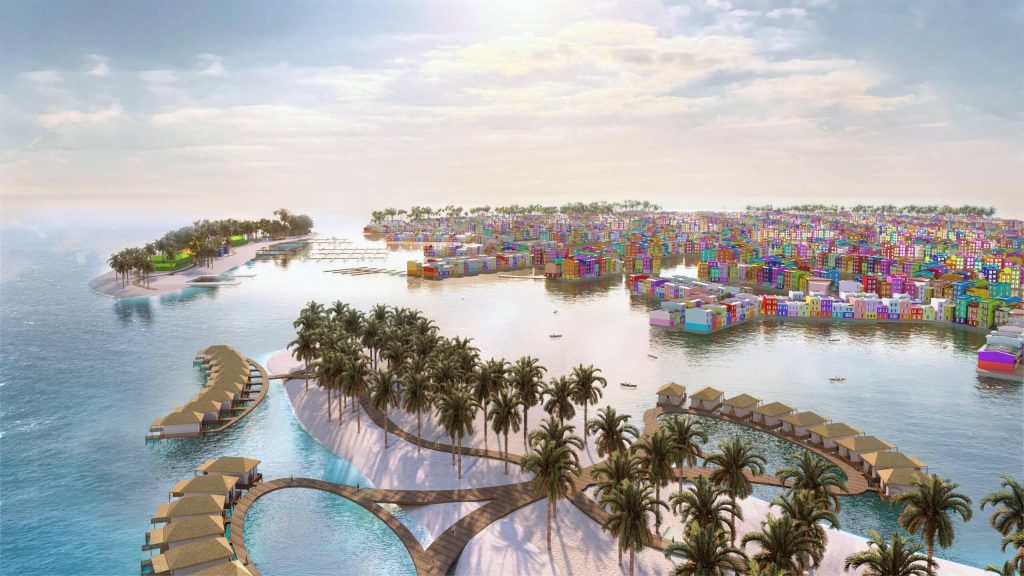
Among the most ambitious responses to this challenge is the concept of the floating city—a self-sustaining urban settlement built on water rather than land. Once confined to the realm of science fiction, floating cities are increasingly appearing in architectural proposals, engineering studies, climate adaptation strategies, and government-led urban development initiatives.
Proponents argue that floating cities could provide resilient housing, reduce pressure on land resources, accommodate climate migrants, and create entirely new models of sustainable urban living. Critics, however, question their economic viability, technical feasibility, environmental impacts, and social inclusivity.
For civil engineers, architects, urban planners, and construction professionals, floating cities represent one of the most fascinating intersections of infrastructure innovation, marine engineering, and climate adaptation. Yet the fundamental question remains: are floating cities a realistic solution to rising sea levels, or are they merely futuristic visions that fail to address the complexities of real-world urban development?
The Origins of the Floating City Concept
The idea of constructing cities on water is not new.
One of the earliest comprehensive floating city proposals emerged during the 1960s when architect and futurist Buckminster Fuller introduced the concept of Triton City. Designed as a modular floating community, Triton City envisioned large tetrahedral platforms anchored to the seabed. These platforms would support housing, offices, public facilities, transportation systems, and essential infrastructure.
The project proposed a highly adaptable urban framework. New residential and commercial modules could theoretically be added as population growth demanded, allowing the city to expand organically over time.
From a design perspective, Triton City anticipated many concepts that remain central to contemporary floating-city proposals, including:
- Modular construction
- Prefabricated building systems
- Marine-based infrastructure
- Mixed-use development
- Self-sustaining urban ecosystems
However, despite attracting attention from government agencies and investors, the project never moved beyond the conceptual stage.
The primary challenge was not architectural ambition but technological readiness. Many of the systems required to support such a city simply did not exist at the time. Furthermore, the enormous structural framework required significant capital investment, making the project economically difficult to justify.
The fate of Triton City reveals a recurring challenge that continues to affect floating-city proposals today: visionary design often advances faster than the engineering, economics, and governance systems required to support it.
Climate Change and the Return of Floating Urbanism
Interest in floating cities has experienced a dramatic resurgence during the twenty-first century.
Unlike earlier proposals motivated primarily by technological optimism, contemporary projects are frequently presented as responses to climate change and sea-level rise.
This shift reflects growing concerns about the vulnerability of coastal communities. Many of the world’s largest urban centers—including New York, Miami, Jakarta, Shanghai, Mumbai, Lagos, and Bangkok—face increasing risks from flooding, storm surges, and land subsidence.
Small island nations face even greater challenges.
The Maldives, for example, is widely recognized as one of the most climate-vulnerable countries in the world. Approximately 80 percent of its land area lies less than one meter above sea level. Rising oceans pose an existential threat to both infrastructure and national identity.
Against this backdrop, floating urban developments have emerged as potential adaptation strategies.
Yet despite their growing popularity, most floating-city proposals continue to encounter significant technical and financial barriers.
Megastructures: The Problem with Building Entire Cities at Once
Many floating-city concepts rely on large-scale megastructures.
Examples include proposals such as Dogen City, Pangeos, and various large-scale marine developments associated with visionary urban projects worldwide.
These projects typically share several characteristics:
- Massive population targets
- Highly complex infrastructure systems
- Advanced technological requirements
- Significant upfront capital investment
- Long development timelines
While visually compelling, such projects often struggle to progress beyond conceptual design.
From a construction and engineering perspective, megastructures introduce enormous complexity. Every system—including structural support, water treatment, power generation, transportation, waste management, communications, and emergency services—must function simultaneously before the city becomes operational.
This creates substantial financial risk.
Unlike traditional urban development, which can expand incrementally, floating megastructures often require enormous investments before any economic returns become possible.
As a result, these projects frequently depend on governments, sovereign wealth funds, or billionaire investors willing to absorb significant risk.
This reality raises important questions about accessibility and equity. If floating cities require extraordinary capital investment, who are they ultimately designed to serve?
The Maldives Floating City: A More Practical Model?
Among current proposals, the Maldives Floating City has attracted considerable attention because it takes a fundamentally different approach.
Rather than relying on a single giant structure, the project consists of numerous interconnected floating units organized around a network of canals.
This modular strategy offers several advantages.
First, it allows construction to occur incrementally. Individual components can be manufactured, deployed, and expanded over time without requiring completion of the entire city before occupation.
Second, the project leverages existing environmental conditions. Instead of constructing massive protective barriers, it utilizes natural lagoons as sheltered environments.
This significantly reduces structural demands and wave-loading requirements.
The design also incorporates transportation systems centered on walking, cycling, and boating, reducing dependence on automobiles and potentially lowering infrastructure costs.
From an urban-planning perspective, this approach aligns with many contemporary principles of sustainable development:
- Human-scale neighborhoods
- Reduced vehicle dependency
- Integrated water-based mobility
- Mixed-use development
- Environmental adaptation
However, important questions remain.
If sea levels continue to rise significantly, will the surrounding lagoons continue to provide protection? Can floating settlements maintain functionality if coastal landscapes change dramatically?
These uncertainties highlight a central challenge in climate adaptation planning: resilience strategies must remain effective under multiple future scenarios.
Marine Engineering Challenges
Building on water presents unique engineering challenges rarely encountered in conventional urban development.
Structural systems must account for:
Wave Loading
Floating structures experience continuous dynamic forces generated by waves, currents, and storms.
Unlike conventional buildings, which primarily resist gravity and wind loads, floating infrastructure must accommodate constant movement without compromising structural integrity.
Anchoring Systems
Most floating-city proposals rely on seabed anchoring systems.
These systems must maintain stability while allowing controlled movement caused by tides and wave action.
Designing reliable anchoring systems requires detailed understanding of:
- Geotechnical conditions
- Seabed composition
- Hydrodynamic forces
- Long-term corrosion behavior
Material Durability
Marine environments are highly aggressive.
Saltwater exposure accelerates corrosion, degrades concrete, and increases maintenance requirements.
As a result, floating infrastructure requires advanced materials capable of withstanding decades of exposure.
Innovations such as marine-grade concrete, corrosion-resistant steel alloys, composite materials, and bio-enhanced construction systems are becoming increasingly important.
Infrastructure Integration
Cities require complex networks of utilities.
Providing power, freshwater, wastewater treatment, telecommunications, emergency services, and transportation becomes significantly more challenging when these systems must operate on floating platforms.
Engineering solutions must ensure reliability despite environmental variability and changing marine conditions.
Oceanix City: A Prototype for Future Floating Communities
Among contemporary proposals, Oceanix City is often considered one of the most technically developed floating-city concepts.
Backed by international organizations and designed in collaboration with leading architects and engineers, the project proposes a network of hexagonal floating platforms capable of supporting approximately 10,000 residents.
Unlike many conceptual designs, Oceanix incorporates principles commonly associated with successful urban environments.
These include:
- Walkable neighborhoods
- Mixed-use development
- Educational facilities
- Employment opportunities
- Public spaces
- Local food production
Buildings are generally limited to four to seven stories, reducing structural loads while maintaining urban density.
The modular arrangement creates compact streets, plazas, and public spaces designed to encourage social interaction.
From a planning perspective, the project recognizes an important reality: successful cities depend not only on physical infrastructure but also on social and economic systems.
Technology alone cannot create a functioning urban environment.
The Economics of Floating Urban Development
Perhaps the greatest obstacle facing floating cities is cost.
According to available estimates, individual floating platforms can cost hundreds of millions of dollars to construct.
When transportation systems, utilities, public facilities, maintenance operations, and environmental protection measures are added, total project costs increase substantially.
This raises a difficult question.
If floating cities are intended to address climate displacement and housing shortages, how can they remain financially accessible?
Many climate-vulnerable populations live in developing nations with limited economic resources.
Yet the technologies required for floating urban development remain expensive.
This creates a paradox: the communities most likely to benefit from climate adaptation infrastructure are often the least able to afford it.
Unless construction costs decrease dramatically, floating cities may risk becoming exclusive developments rather than broad-based solutions.
Sustainability Beyond Technology
Many floating-city proposals emphasize sustainability.
Concept renderings frequently showcase:
- Renewable energy systems
- Closed-loop water cycles
- Urban agriculture
- Waste recycling
- Carbon-neutral operations
While these technologies are important, true sustainability extends beyond environmental performance.
A sustainable city must also sustain:
- Employment
- Education
- Healthcare
- Governance
- Social cohesion
- Economic opportunity
Historically, many planned communities have struggled not because of engineering failures but because they lacked viable economic ecosystems.
Cities are complex organisms composed of interconnected social, economic, political, and physical systems.
Replicating this complexity on water remains one of the greatest challenges facing floating urban development.
Floating Cities and Urban Resilience
A more realistic future may involve hybrid approaches rather than fully independent ocean-based cities.
Instead of functioning as isolated settlements, floating developments could operate as extensions of existing coastal cities.
Such integration offers several advantages:
- Shared infrastructure
- Reduced costs
- Existing employment opportunities
- Access to public services
- Improved transportation connections
Rather than replacing land-based cities, floating districts could complement them.
This approach aligns with contemporary resilience planning, which emphasizes adaptation, flexibility, and incremental implementation rather than large-scale replacement of existing urban systems.
Lessons for Engineers, Architects, and Urban Planners
Floating cities offer valuable lessons regardless of whether they become widespread.
First, they demonstrate the growing importance of climate adaptation in infrastructure planning.
Second, they highlight the need for interdisciplinary collaboration among architects, engineers, urban planners, marine scientists, economists, and policymakers.
Third, they reveal the limitations of purely technological solutions.
The success of future cities will depend not only on innovative engineering but also on governance, affordability, social inclusion, and economic sustainability.
Perhaps most importantly, floating-city proposals encourage professionals to reconsider traditional assumptions about urban development.
As environmental pressures intensify, new approaches to land use, infrastructure design, and settlement patterns may become increasingly necessary.
Conclusion
Floating cities occupy a unique position between visionary architecture and practical climate adaptation.
They represent bold attempts to rethink how humanity might inhabit increasingly vulnerable coastal regions. Advances in marine engineering, modular construction, renewable energy systems, and resilient infrastructure have made concepts once considered science fiction appear increasingly plausible.
Yet significant challenges remain.
Technical feasibility does not automatically translate into economic viability. Environmental sustainability does not guarantee social sustainability. And architectural innovation alone cannot create thriving communities.
For civil engineers, architects, and construction professionals, the future of floating cities will ultimately depend on balancing ambition with practicality. The most successful projects may not be the largest or most technologically advanced, but those that integrate engineering innovation with realistic economic models, human-centered urban design, and long-term resilience strategies.
Whether floating cities become a defining feature of twenty-first-century urban development or remain niche experiments, they have already achieved one important objective: they have expanded the conversation about how cities can adapt to a changing world.
No responses yet