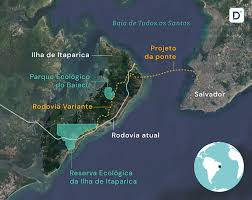
The Salvador–Itaparica Bridge is one of the most ambitious infrastructure undertakings in Brazil’s recent history. Designed to connect the city of Salvador to Ilha de Itaparica by spanning the Baía de Todos-os-Santos, the project represents far more than a single bridge. It includes a comprehensive and highly coordinated system of access roads, tunnels, viaducts, and upgraded highways, collectively known as the “Sistema Rodoviário Ponte Salvador–Ilha de Itaparica.”
The access-roadworks program is the structural foundation that enables the bridge to function as an integrated transport corridor, supporting urban mobility, tourism, logistics, and long-term regional development. Without these road systems, the bridge itself would lack the connectivity needed to deliver its full economic and social benefits.
This article provides a detailed, educational overview of the access roadworks program, its components, engineering features, timeline, challenges, and expected impacts.
1. The Purpose of the Access Roadworks Program
The bridge will reduce travel times between Salvador and Itaparica dramatically, replacing ferry crossings with a direct highway connection. However, to integrate the bridge with existing transportation networks, a series of new roads and improvements are required on both sides of the bay. These works aim to:
- Ensure smooth traffic flow to and from the bridge
- Connect the bridge to major urban roads in Salvador
- Redirect traffic on Ilha de Itaparica to avoid congestion in local communities
- Upgrade the island’s key highways to accommodate increased demand
- Promote long-term development aligned with regional mobility planning
The program is structured into five main segments, each with a specific role in the wider system.
2. Main Segments of the Access Roadworks Program
• Segment 1: Access Roads in Salvador
This segment focuses on integrating the bridge with Salvador’s dense urban road network. It includes about 4 kilometers of new or upgraded roads, with complex engineering elements such as tunnels, elevated viaducts, and overpasses.
Key features include:
- Two major tunnels designed to bypass crowded city sectors
- Multiple viaducts linking the bridge’s landing point to important arterial roads and the Via Expressa
- Improved connections to major avenues that channel traffic directly into the city’s core and port areas
This segment is essential for distributing the expected traffic volume efficiently within Salvador’s metropolitan environment.
• Segment 2: The Bridge Structure
Although not a roadwork segment per se, the bridge itself forms the central link in the system. At approximately 12.4 kilometers, it is one of the longest bridge structures planned in Latin America. The design ensures capacity for high vehicle flow and includes engineering solutions to withstand marine conditions and strong bay winds.
• Segment 3: New Access Expressway on Ilha de Itaparica
After the bridge touches down on the island near the municipality of Vera Cruz, a new expressway of roughly 20–30 kilometers will distribute traffic across the island without burdening existing local roads.
Objectives of the expressway include:
- Providing a direct, high-capacity route for vehicles traveling between Salvador and the southern part of the island
- Reducing strain on the local road grid
- Offering safe, modern transport infrastructure for residents and visitors
- Supporting tourism and real estate development by improving intra-island mobility
The expressway represents a transformative upgrade for an area previously dependent on narrow coastal roads.
• Segment 4: New Bypass / Variant (Desvio de Mar Grande)
This bypass diverts traffic away from the busy and densely populated area around Mar Grande, one of the island’s main ferry terminals. Without this variant, increased bridge-related traffic could overwhelm local streets.
The bypass will:
- Improve safety in residential areas
- Facilitate continuous, high-speed travel across the island
- Prevent congestion caused by local commerce and pedestrian activity
- Serve as a long-term mobility solution for future population growth
• Segment 5: Upgrading the BA-001 Highway
BA-001 is the primary highway on Ilha de Itaparica, linking communities along the island’s length and connecting to the “Ponte do Funil” bridge at the island’s southern end. A segment of BA-001 will be duplicated and modernized to handle higher traffic volumes.
Upgrades include:
- Widening lanes
- Improving pavement quality
- Adding safety features such as guardrails, signage, lighting, and marked shoulders
- Reengineering curves and elevation changes for better visibility and safety
This ensures the bridge system integrates smoothly with the highway network serving Bahia’s southern coast.
3. Engineering Features and Technical Innovations
Because of the complexity of the surrounding environment, the access roadworks incorporate several engineering advancements:
Urban Engineering in Salvador
- Tunnels designed for minimal surface disruption in densely populated districts
- Viaducts built to accommodate future traffic growth
- Intelligent traffic-flow systems to manage merging vehicles
- Seismic-resistant and corrosion-resistant structures due to coastal conditions
Island Engineering
- Elevated sections to protect sensitive ecosystems
- Drainage systems to prevent flooding during high-rain seasons
- Landscaped embankments and wildlife-passage features where necessary
- Road geometry suited for smooth, safe transitions across varying island topography
Collectively, these innovations aim to ensure long-term durability, environmental responsibility, and user safety.
4. Construction Timeline and Institutional Framework
The access-roadworks program is part of a long-term public-private partnership (PPP) between the state of Bahia and a private concessionaire. Key timeline points include:
- Engineering and environmental studies have already advanced significantly.
- Expropriation of necessary land parcels has begun in Salvador.
- Construction mobilization is scheduled to begin around 2026.
- Full system delivery—including bridge, access roads, new expressways, and highway upgrades—is targeted for 2031.
- After completion, the concessionaire will manage operation and maintenance for decades under the PPP agreement.
This structured framework ensures professional oversight and coordinated execution across all segments.
5. Expected Benefits of the Access Roadworks
• Mobility and Travel Time Reduction
- Salvador-to-Itaparica travel that currently depends on ferries will become a fast, direct highway trip.
- Internal mobility on the island will improve significantly with modern road infrastructure.
• Economic Development
- Thousands of jobs during construction
- Increased tourism due to easier access
- Growth of commerce, services, and real estate on the island
- Enhanced logistics capacity for moving goods between Salvador, the Recôncavo Baiano, and southern Bahia
• Social and Regional Integration
- Better access to healthcare, education, and workplaces
- Strengthened ties between coastal municipalities
- Long-term regional planning opportunities, including integrated transport corridors
6. Challenges and Considerations
Like any megaproject, the access-road program faces technical, environmental, and social challenges:
- Complex urban engineering on the Salvador side
- Environmental protection needs around coastal and island ecosystems
- Community impacts during land acquisition
- Ensuring road safety under increased traffic volumes
- Maintaining long-term infrastructure quality under PPP management
Balancing development with sustainability will be crucial for the project’s long-term success.
Conclusion
The Salvador–Itaparica Bridge Access Roadworks Program is a critical component of Bahia’s broader mobility transformation. Through an integrated system of tunnels, viaducts, new expressways, bypasses, and upgraded highways, the project ensures that the bridge functions not as an isolated structure but as a powerful engine of regional connectivity and development.
By 2031, the combined system—bridge plus access roads—has the potential to reshape mobility across the metropolitan Salvador region and beyond, fostering economic growth, enhancing tourism, and improving quality of life for millions of residents.
No responses yet