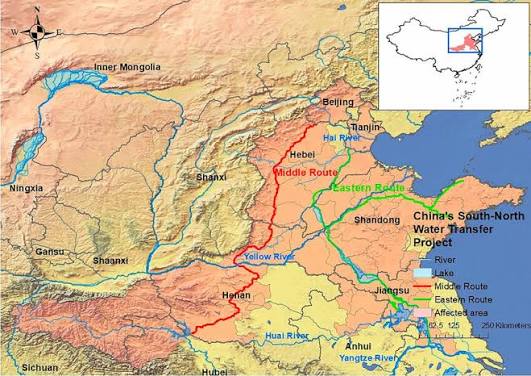
Water scarcity has long shaped the development of northern China. Rapid urbanization, industrial growth, and agricultural demand have placed immense pressure on limited local water resources, threatening economic stability and environmental sustainability. The South–North Water Transfer Project (Middle Route) is one of the most ambitious water infrastructure projects ever undertaken to address this imbalance. Its ongoing extension to additional northern provinces represents a new chapter in the effort to secure long-term water supply for millions of people.
This vast project is not simply about moving water from south to north. It is a demonstration of large-scale systems engineering, combining hydrology, structural engineering, geotechnics, environmental management, and digital monitoring into a single, highly coordinated network.
The Purpose of the Middle Route Expansion
The Middle Route of the South–North Water Transfer Project carries water from central China northward through a gravity-fed canal system spanning hundreds of kilometers. The expansion aims to extend this infrastructure deeper into water-stressed northern regions, increasing supply reliability for major cities, industrial zones, and agricultural areas.
Key objectives of the expansion include:
- Alleviating chronic water shortages in northern provinces
- Supporting population growth and urban development
- Reducing over-extraction of groundwater
- Improving water quality and ecological stability
Unlike short-term water management measures, the Middle Route extension is designed as a century-scale infrastructure system, intended to operate reliably across generations.
Scale and Complexity of the Infrastructure
The Middle Route extension involves a vast network of interconnected components, including:
- Long-distance open canals
- Covered aqueducts and pipelines
- Tunnels through mountains and urban areas
- Pumping stations and control structures
- Water treatment and distribution nodes
Much of the system relies on gravity flow, which minimizes energy consumption but requires extraordinary precision in alignment, slope control, and structural continuity.
Major Engineering and Construction Challenges
1. Maintaining Gravity Flow Over Long Distances
One of the defining engineering challenges of the Middle Route is maintaining continuous gravity-driven water flow across varied terrain. Even small errors in elevation or slope can disrupt flow efficiency or cause operational instability.
Engineers must:
- Control canal gradients with centimeter-level accuracy
- Design transitions between open canals, tunnels, and pipelines
- Manage energy dissipation where elevation changes occur
This requires extensive surveying, precision construction, and constant verification throughout the build process.
2. Crossing Diverse Terrain and Geological Conditions
As the infrastructure extends northward, it crosses:
- Plains with soft or compressible soils
- River valleys requiring large aqueducts
- Mountainous regions requiring long tunnels
- Urban areas with dense underground utilities
Each terrain type demands tailored engineering solutions. Tunnels must account for variable rock strength and groundwater inflow, while canals in soft soil regions require ground reinforcement to prevent settlement and cracking.
3. Seismic and Structural Safety
Northern China includes regions with seismic risk, making earthquake resilience a critical design requirement. Canals, aqueducts, and tunnels must remain operational or safely recoverable after seismic events.
Engineers address this through:
- Flexible structural joints
- Reinforced concrete sections with controlled cracking behavior
- Redundant load paths in critical structures
Designing for seismic resilience ensures long-term system reliability and public safety.
4. Protecting Water Quality Over Long Distances
Transporting clean water over hundreds of kilometers presents unique water quality challenges. Contamination risks arise from:
- Surface runoff entering open canals
- Agricultural or industrial activities near the route
- Sediment accumulation and biological growth
Engineering solutions focus on isolation, monitoring, and controlled flow conditions to preserve water quality from source to destination.
Innovative Engineering Solutions
1. High-Precision Canal Engineering
The Middle Route extension uses advanced canal lining systems designed to:
- Minimize leakage
- Resist temperature-induced cracking
- Reduce maintenance requirements
High-performance concrete and joint sealing technologies ensure durability under long-term exposure to water, temperature variation, and environmental conditions.
2. Large-Scale Aqueduct and Bridge Structures
Where the route crosses rivers, highways, and valleys, engineers construct massive aqueducts that function like bridges carrying water instead of traffic. These structures must:
- Support the weight of water and structural materials
- Resist wind, temperature changes, and seismic forces
- Maintain watertight integrity under dynamic conditions
Designs often incorporate continuous spans and prestressed concrete to improve strength and reduce cracking.
3. Advanced Tunneling Techniques
In mountainous and urban areas, tunnels are used to maintain alignment and protect water quality. Tunnel construction employs:
- Precision excavation methods
- Waterproof lining systems
- Drainage and pressure relief mechanisms
Tunnels are designed to operate under constant hydraulic pressure while allowing inspection and maintenance access.
4. Smart Monitoring and Control Systems
Digital technology plays a crucial role in operating the Middle Route extension. Sensors and automated systems monitor:
- Water levels and flow rates
- Structural movement and deformation
- Leakage and seepage
- Water quality indicators
This data enables real-time control, rapid response to anomalies, and predictive maintenance, reducing risk and improving efficiency.
Core Engineering Principles Behind the Project
1. Systems Engineering
The Middle Route extension is a textbook example of systems engineering. Each component — canal, tunnel, aqueduct, control gate — must function both independently and as part of a unified network.
Design decisions are evaluated not just for local performance, but for their impact on the entire system’s reliability, efficiency, and safety.
2. Hydraulic Continuity and Energy Management
Water movement is governed by hydraulic principles. Engineers carefully manage:
- Flow velocity to prevent erosion or sedimentation
- Energy dissipation at drops and transitions
- Pressure control in enclosed sections
Maintaining hydraulic stability is essential for protecting infrastructure and ensuring consistent delivery.
3. Structural Durability and Redundancy
Given the project’s intended lifespan, structures are designed for durability under constant load and exposure. Redundancy is built into critical sections so that localized damage does not compromise overall operation.
4. Risk Management and Resilience
From seismic events to extreme weather, the system is designed to withstand uncertainty. Risk assessments guide design choices, material selection, and monitoring strategies, ensuring resilience over decades of operation.
Environmental and Ecological Considerations
Large-scale water transfer has significant environmental implications. Engineers and planners integrate ecological protection measures such as:
- Buffer zones along canals
- Controlled flow regimes to minimize ecological disruption
- Measures to prevent invasive species transfer
- Landscape restoration along construction corridors
The extension aims not only to supply water, but to do so in a way that minimizes long-term environmental impact.
Social and Economic Impact
The Middle Route extension delivers benefits far beyond engineering achievement:
- Reliable drinking water for major cities
- Reduced groundwater depletion and land subsidence
- Support for industrial and agricultural productivity
- Improved regional economic balance
For northern provinces, water security becomes a foundation for sustainable development rather than a limiting factor.
Construction Management at a National Scale
Coordinating construction across multiple provinces requires:
- Standardized technical specifications
- Centralized quality control systems
- Strict safety and environmental oversight
- Coordination with local governments and communities
This level of coordination represents one of the largest infrastructure management efforts ever undertaken.
Looking Ahead: A Long-Term Water Strategy
The extension of the South–North Water Transfer Project’s Middle Route is not a short-term solution, but a strategic investment in China’s long-term water security. As climate variability and demand pressures increase, the system provides flexibility and resilience that localized solutions cannot achieve alone.
Future enhancements may include:
- Expanded smart monitoring capabilities
- Adaptive flow management strategies
- Integration with regional water recycling systems
Conclusion: Engineering Water for the Future
The South–North Water Transfer Project (Middle Route) extension stands as one of the most complex and impactful civil engineering endeavors in the world. It combines precision construction, advanced hydraulic engineering, digital monitoring, and systems-level thinking to solve one of humanity’s most fundamental challenges: access to reliable water.
By extending this infrastructure into northern provinces, engineers are not just moving water — they are shaping economic stability, environmental resilience, and social well-being for generations to come. The project demonstrates how thoughtful, large-scale engineering can address scarcity, balance regional development, and secure a sustainable future.
No responses yet