Slope stability analysis is a critical aspect of geotechnical engineering that ensures the safety of natural slopes and man-made earth structures such as embankments, cut slopes, earth dams, and landfill covers. Slope failures can lead to loss of life, property damage, and severe environmental consequences. To prevent such failures, civil engineers rely on analytical methods to assess whether a slope is stable under given loading and environmental conditions.
Among the most widely used approaches are limit equilibrium methods (LEM). This article explains the theory behind slope stability, introduces major limit equilibrium methods, and demonstrates how engineers apply them in practical problem-solving.
1. What Is Slope Stability?
Slope stability refers to the ability of a soil or rock slope to resist sliding or failure under the influence of gravity and external forces. Failure occurs when the driving forces exceed the resisting forces along a potential slip surface.
The stability of a slope is expressed in terms of the factor of safety (FOS):FOS=Driving forcesResisting forces
- FOS>1: stable slope
- FOS=1: limiting equilibrium
- FOS<1: failure condition
Design typically requires a minimum FOS between 1.3 and 1.5, depending on slope type and risk level.
2. Causes of Slope Failure
Slope failures may result from:
- Increase in slope angle or height
- Reduction in soil shear strength
- Rise in groundwater table
- Heavy rainfall or seepage
- Earthquakes
- Excavation at slope toe
- Additional surcharge loads
Understanding these causes helps engineers identify critical loading scenarios for analysis.
3. Shear Strength of Soil in Slope Stability
Slope stability analysis relies on the Mohr–Coulomb failure criterion:τ=c+σ′tanϕ
Where:
- τ = shear strength
- c = cohesion
- σ′ = effective normal stress
- ϕ = angle of internal friction
Changes in pore water pressure reduce effective stress and thus decrease shear strength, making slopes more susceptible to failure.
4. Concept of Limit Equilibrium
In limit equilibrium analysis:
- The soil mass above a potential failure surface is assumed to be on the verge of sliding
- Overall force and/or moment equilibrium is satisfied
- Stress–strain relationships are not explicitly considered
The method determines whether resisting forces are sufficient to counteract driving forces.
5. Types of Slip Surfaces
Common assumed failure surfaces include:
- Circular slip surfaces (typical for homogeneous soil slopes)
- Non-circular slip surfaces (layered soils, rock slopes)
- Planar slip surfaces (rock slopes and embankments)
Limit equilibrium methods evaluate multiple potential slip surfaces to find the critical one with the lowest FOS.
6. Method of Slices
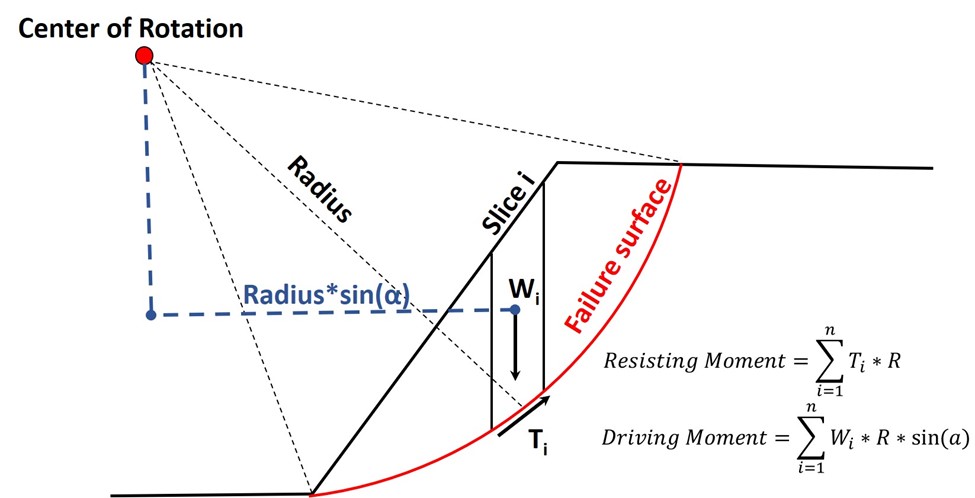
Most LEM techniques use the method of slices, where the potential sliding mass is divided into vertical slices.
For each slice:
- Weight is calculated
- Forces acting on the slice are identified
- Inter-slice forces may be neglected or approximated
The overall equilibrium of all slices is then evaluated.
7. Common Limit Equilibrium Methods
1. Ordinary Method of Slices (Fellenius Method)
Assumptions:
- Inter-slice forces are neglected
- Moment equilibrium is satisfied
Advantages:
- Simple and quick
Limitations:
- Conservative
- Less accurate for complex slopes
2. Bishop’s Simplified Method
Assumptions:
- Inter-slice shear forces neglected
- Normal forces included
- Moment equilibrium satisfied
Advantages:
- High accuracy for circular slip surfaces
- Widely used in practice
Limitations:
- Requires iterative solution
3. Janbu’s Method
Assumptions:
- Force equilibrium satisfied
- Applicable to non-circular surfaces
Advantages:
- Suitable for layered soils
Limitations:
- Less accurate without correction factors
4. Spencer’s Method
Assumptions:
- Both force and moment equilibrium satisfied
- Inter-slice forces included
Advantages:
- Highly accurate
- Applicable to all slip surfaces
Limitations:
- Computationally intensive
8. Factor of Safety Expression (Bishop’s Method)
For a slice:FOS=∑[Wsinα]∑[c′b+(W−ub)tanϕ′]
Where:
- b = slice width
- W = slice weight
- u = pore water pressure
- α = inclination of slice base
The equation is solved iteratively to obtain the final FOS.
9. Worked Example (Conceptual)
Given:
- Homogeneous soil slope
- Known c, ϕ, and unit weight
- Circular slip surface assumed
Steps:
- Divide sliding mass into slices
- Compute weight of each slice
- Calculate normal and shear forces
- Apply Bishop’s equation
- Iterate until FOS converges
The minimum FOS corresponds to the critical slip surface.
10. Effect of Groundwater on Slope Stability
Groundwater significantly influences stability by:
- Increasing pore water pressure
- Reducing effective stress
- Adding seepage forces
Engineers model groundwater conditions using:
- Phreatic surface assumptions
- Seepage analysis
- Drainage improvement measures
11. Seismic Slope Stability
Earthquake effects are included using:
- Pseudo-static analysis
- Horizontal seismic coefficient kh
Fseismic=khW
This additional force reduces the factor of safety and must be considered in seismic regions.
12. Practical Applications
Slope stability analysis is used in:
- Highway and railway cut slopes
- Embankments and levees
- Earth dams
- Open-pit mines
- Landslide risk assessment
Limit equilibrium methods are implemented in most commercial geotechnical software, making theoretical understanding essential.
13. Limitations of Limit Equilibrium Methods
- Do not model stress–strain behavior
- Assume predefined failure surfaces
- Sensitive to soil parameter selection
For complex problems, LEM is complemented by finite element or finite difference methods.
Conclusion
Limit equilibrium methods provide civil engineers with practical and reliable tools to assess slope stability. By understanding the underlying assumptions, equations, and applications of methods such as Fellenius, Bishop, Janbu, and Spencer, engineers can evaluate potential slope failures and design effective stabilization measures. Despite their simplifications, these methods remain the cornerstone of slope stability analysis in both academic study and engineering practice.
No responses yet