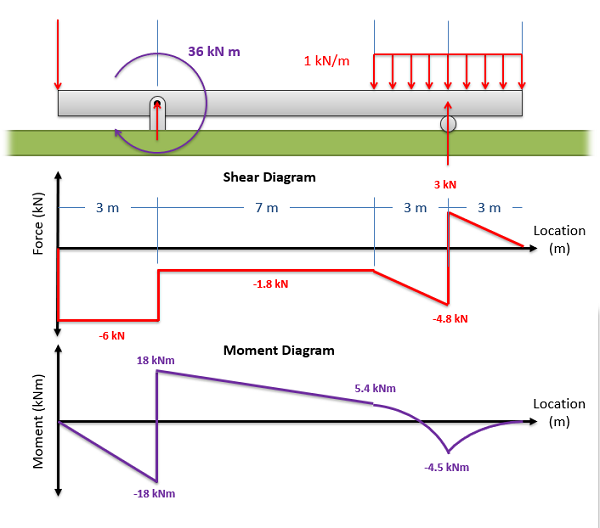
Shear force and bending moment diagrams are among the most important analytical tools in civil and structural engineering. They provide a graphical representation of how internal forces and moments vary along the length of a structural member subjected to external loads. Every beam design—whether in steel, reinforced concrete, or timber—depends on accurate shear force and bending moment analysis.
This guide explains the theory behind shear force and bending moment diagrams and presents a clear, systematic procedure for constructing them, enabling civil engineering students and practicing engineers to solve beam problems confidently and correctly.
1. Why Shear Force and Bending Moment Diagrams Matter
When loads act on a beam, internal forces develop to maintain equilibrium. These internal forces govern:
- Shear failure
- Flexural failure
- Crack formation in concrete
- Deflection and serviceability
Shear force diagrams (SFDs) and bending moment diagrams (BMDs) allow engineers to:
- Locate maximum shear and bending moment
- Identify critical design sections
- Size beams and reinforcement safely
- Verify structural stability
2. Fundamental Definitions
Shear Force
Shear force at a section is the algebraic sum of all vertical forces acting on one side of the section.
Positive shear force convention:
- Left side upward force or
- Right side downward force
Bending Moment
Bending moment at a section is the algebraic sum of moments about that section caused by forces on one side.
Positive bending moment:
- Causes sagging (concave upward)
- Negative bending moment:
- Causes hogging (concave downward)
Understanding sign conventions is critical for correctly plotting diagrams.
3. Relationship Between Load, Shear Force, and Bending Moment
These relationships form the mathematical foundation of SFDs and BMDs:dxdV=−w(x) dxdM=V(x)
Where:
- w(x) = load intensity
- V(x) = shear force
- M(x) = bending moment
Key implications:
- Slope of SFD = negative load
- Slope of BMD = shear force
- Maximum bending moment occurs where shear force is zero
4. Types of Beams Commonly Analyzed
- Simply supported beams
- Cantilever beams
- Overhanging beams
- Fixed beams (introductory level)
This guide focuses on statically determinate beams, where equilibrium equations are sufficient.
5. Step-by-Step Procedure for Drawing SFD and BMD
Step 1: Draw the Beam and Loading Diagram
Clearly show:
- Beam length
- Support conditions
- All loads (point loads, UDLs, moments)
This diagram forms the basis of all calculations.
Step 2: Calculate Support Reactions
Apply equilibrium equations:∑Fy=0 ∑M=0
Correct reaction calculation is essential—errors here affect the entire diagram.
Step 3: Divide the Beam into Sections
Identify:
- Points of applied loads
- Changes in load intensity
- Supports
These points define where shear and moment equations change.
Step 4: Calculate Shear Force at Key Points
Start from one end and move systematically:
- Immediately to the right of each load
- Just before and after supports
Plot shear force values accurately.
Step 5: Draw the Shear Force Diagram
Rules:
- Point loads cause vertical jumps
- Uniformly distributed loads cause sloped lines
- No load → constant shear force
Ensure sign conventions are followed.
Step 6: Calculate Bending Moment at Key Points
Use:
- Moment equilibrium equations
- Area under SFD
M=∫Vdx
Key points include:
- Supports
- Locations where shear = 0
- Load application points
Step 7: Draw the Bending Moment Diagram
Rules:
- Point loads → change slope
- UDLs → parabolic curves
- No load → straight lines
Mark maximum and minimum moments clearly.
6. Worked Example (Conceptual)
Given:
- Simply supported beam
- Span = L
- Uniformly distributed load w over entire length
Support Reactions:
RA=RB=2wL
Shear Force Equation:
At distance x from left support:V(x)=2wL−wx
Shear force becomes zero at:x=2L
Bending Moment Equation:
M(x)=2wLx−2wx2
Maximum bending moment:Mmax=8wL2
Occurs at midspan where shear force is zero.
7. Important Rules Engineers Must Remember
- Maximum bending moment occurs where shear force crosses zero
- Area under SFD = change in bending moment
- Concentrated moments cause jumps in BMD but not SFD
- BMD must return to zero at simple supports
- Diagrams must satisfy equilibrium and continuity
8. Common Mistakes Students Make
- Incorrect sign convention
- Forgetting reaction forces
- Misplacing zero shear location
- Drawing incorrect diagram shapes
- Ignoring applied moments
Avoiding these errors significantly improves accuracy.
9. Application in Design
Shear force and bending moment diagrams are used to:
- Design beam cross-sections
- Determine reinforcement layout
- Check shear capacity
- Calculate deflections
- Perform finite element modeling
They form the basis of structural safety checks in design codes.
10. Importance in Exams and Professional Practice
These diagrams are:
- Frequently tested in university exams
- Core topics in FE, GATE, and PE exams
- Fundamental to software verification and hand checks
Mastery ensures both academic success and professional competence.
Conclusion
Shear force and bending moment diagrams translate external loads into internal force behavior within beams. By following a systematic step-by-step approach—drawing the loading diagram, calculating reactions, analyzing shear force, and integrating to find bending moments—civil engineers can confidently analyze and design safe structures. These diagrams are not merely academic exercises; they are essential tools for real-world engineering decision-making.
No responses yet