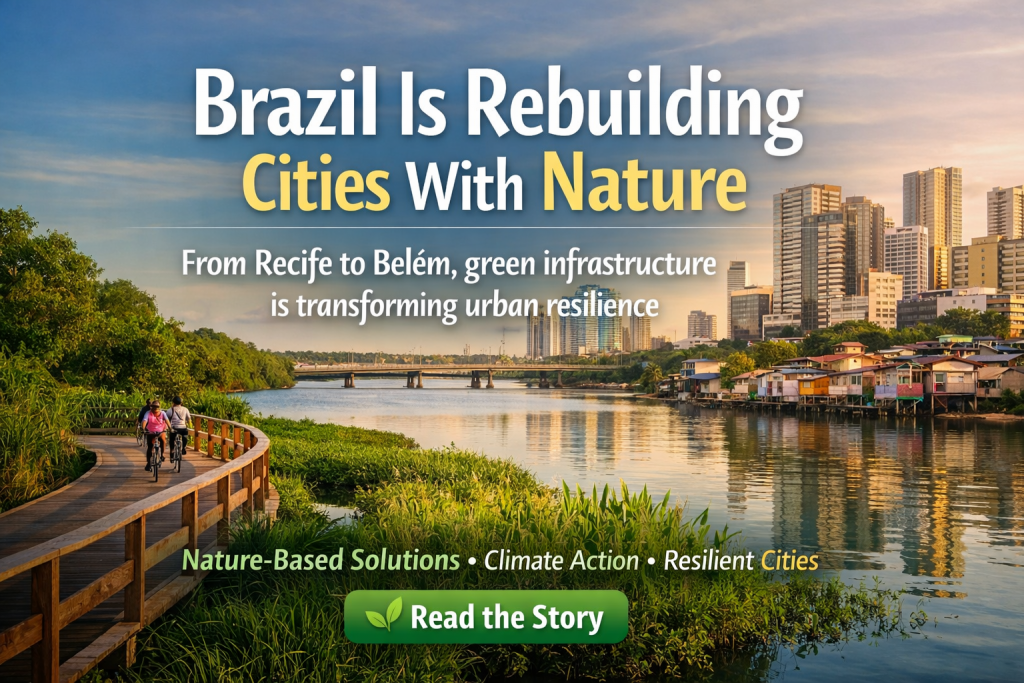
In many cities, infrastructure is synonymous with steel, asphalt, and concrete. In Brazil, however, a different model is taking shape—one where mangroves, rivers, forests, and people are treated as essential components of urban systems. From the coastal city of Recife to the Amazonian metropolis of Belém, Brazilian cities are adopting nature-based and low-carbon solutions that strengthen resilience while improving daily life for residents.
Supported by the Global Environment Facility (GEF) and the United Nations Environment Programme (UNEP), these initiatives show how cities can confront climate change, pollution, and inequality simultaneously—by working with nature rather than against it.
Recife: Designing with Water, Not Fighting It
Recife’s geography makes it both beautiful and vulnerable. Built across three islands at the confluence of the Beberibe and Capibaribe rivers, the city sits on a low-lying floodplain just before the rivers reach the Atlantic Ocean. Seasonal flooding, inadequate sanitation, polluted waterways, and a shortage of safe public spaces have long shaped life for residents—particularly those living along riverbanks.
Instead of relying solely on hard engineering solutions, Recife has begun integrating nature into its urban fabric. One flagship intervention is a filtering garden installed in a public park. This green infrastructure uses plants, soil, and natural filtration processes to treat polluted runoff before it reaches the river. The result is cleaner water, reduced flood risk, and a revitalized public space.
Beyond its environmental benefits, the project has transformed how people use the area. The renewed park has become a social hub—an extension of residents’ homes in neighborhoods where private outdoor space is scarce. Safer lighting, walkable paths, and improved design have also made riverfront areas more accessible to women, children, and the elderly, reversing years of neglect and avoidance.
Crucially, the filtering garden is part of a broader, integrated approach. Pedestrian bridges, riverfront walkways, waste reduction measures, and sustainable mobility options have been layered together to reduce emissions, improve water quality, and connect communities more effectively. This kind of coordinated planning demonstrates that climate adaptation, pollution control, and social inclusion can—and should—be addressed together.
Integrated Planning as Climate Strategy
Urban areas are where climate change, biodiversity loss, and pollution intersect most sharply. As UNEP officials emphasize, cities cannot afford single-purpose solutions. Every intervention must respond to multiple challenges while also improving livelihoods.
This philosophy underpins Brazil’s CITinova I and II initiatives, led by the Ministry of Science, Technology and Innovation with support from the GEF and UNEP. Together, these programs combine $35 million in GEF grants with nearly $380 million in co-financing, fostering collaboration across federal, metropolitan, and municipal governments. Their aim is not only to test innovative solutions locally, but also to influence national policy and scale successful models across the country.
Belém: Climate Action Beyond City Borders
In the Amazon region, the stakes are even higher. Belém and its surrounding metropolitan area are expanding rapidly due to mining, agriculture, and service-sector growth. Neighboring municipalities such as Ananindeua and Marituba have effectively become extensions of the city, intensifying commuter traffic, emissions, and pressure on fragile ecosystems.
Here, climate challenges do not respect administrative boundaries—making metropolitan-scale governance essential.
A GEF-funded initiative in Belém is piloting a low-emission street in the city center, addressing emissions from transportation, buildings, and waste simultaneously. At the same time, the project is creating a mosaic of protected areas that connect conservation efforts across municipal lines. This integrated approach strengthens resilience to flooding, urban heat, and biodiversity loss—while setting a precedent for coordinated climate action in fast-growing regions.
Linking Urban Resilience to Local Livelihoods
What sets these projects apart is their focus on people as much as infrastructure. In Belém, urban sustainability is being tied to a growing bioeconomy—one that values renewable resources, circular production, and local knowledge.
On Combú Island, for example, agroforestry systems are being strengthened to support sustainable food production while conserving forest ecosystems. Local businesses, including artisanal ice cream makers and chocolate producers, are receiving support to build low-carbon value chains that keep economic benefits within communities.
By aligning environmental protection with income generation, these initiatives help ensure that sustainability is not perceived as a constraint, but as a pathway to economic opportunity.
Scaling Local Success to National Impact
The success of pilot projects in Recife and Belém is already inspiring further investments. Recife, for instance, is exploring additional riverfront public spaces, new piers, and expanded sustainable transport links—all grounded in the same inclusive, nature-based principles.
This momentum is particularly significant given Brazil’s climate commitments. The country has pledged to cut greenhouse gas emissions by 59–67 percent by 2035, and its National Mitigation Plan explicitly recognizes cities as central to achieving these targets. Urban energy transitions, cleaner transport, and resilient infrastructure are no longer optional—they are essential.
With Brazil set to host COP30, attention is increasingly focused on how urban solutions can drive national and global climate outcomes. As Brazilian leaders have noted, it is impossible to address environmental challenges without addressing cities, where most people live and most emissions are generated.
A Model for Cities Worldwide
These efforts are part of the GEF’s broader Sustainable Cities Program, now in its third phase and supporting more than 90 cities across 33 countries. Through platforms such as UrbanShift and the Global Platform for Sustainable Cities, lessons from Brazil are being shared globally—helping cities rethink how they plan, govern, and invest.
The message from Recife and Belém is clear: resilient cities are not built solely with concrete barriers and drainage systems. They are built by restoring ecosystems, integrating governance, empowering communities, and designing urban spaces that serve both people and the planet.
As climate risks accelerate and urban populations grow, Brazil’s experience offers a powerful reminder that the most effective infrastructure solutions may already be rooted in the natural world beneath our feet.
No responses yet