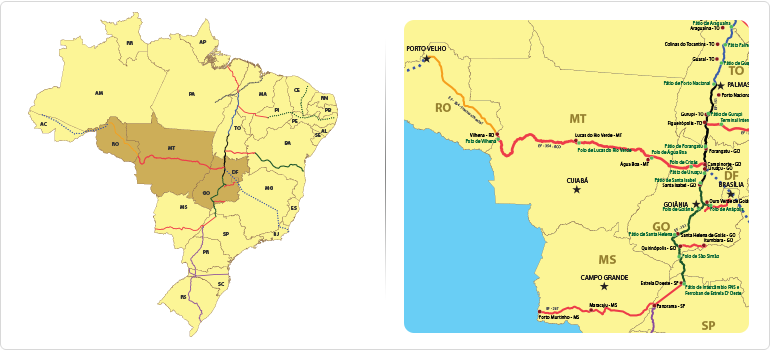
- The Ferrovia de Integração do Centro-Oeste (FICO) is a planned (or proposed) major railway project in Brazil intended to improve integration between the agricultural/commodity‑producing regions of the Central-West and major export hubs (ports or larger rail/road networks). The idea behind FICO is to provide efficient rail transport for bulk goods (agriculture, minerals, etc.), reducing dependency on roads and lowering logistics costs for producers.
- As a “strategic rail corridor,” FICO is often mentioned in discussions of Brazil’s efforts to expand rail infrastructure, boost export competitiveness, and relieve pressure on highways.
Because Brazil is geographically large and commodity flows are heavy, rail corridors such as FICO are seen as critical to long-term transport efficiency and national infrastructure planning.
What “Section EF‑354” Means (or Is Supposed to Mean) — and What Is Known
- The designation “EF‑354” is sometimes associated with parts of the FICO project (or proposed alignment plans). “EF” refers to “Estrada de Ferro” (railway), and the numbering attempts to standardize sections or segments — a common practice in Brazilian rail planning.
- In theory, “Section EF‑354” would refer to a specific stretch or segment of the larger FICO corridor — likely one of the parts planned to connect certain states, production areas, or logistical hubs.
However — and this is important — publicly available documentation that clearly defines “EF‑354” (start and end points, length, alignment, station list) is scarce. I found no definitive public record (in accessible sources) that:
- maps out “Section EF‑354” precisely, with GPS coordinates or a route map,
- includes detailed engineering plans or environmental impact studies under that label,
- provides a timeline for construction, financing, or completion for EF‑354 specifically under FICO.
In other words: while the label “EF‑354” appears in some discussions or references, it does not appear to correspond to a publicly validated, fully defined corridor segment as of now.
What IS Known / What Is Credible about FICO and Its Status
From reports, infrastructure‑sector commentary, and government / transport‑policy discussions, the following seem credible about FICO:
- Brazil’s authorities (federal or regional) have identified the need to expand rail capacity to serve the Center‑West agricultural and commodity sectors, which are growing in production and export volume. Rail is seen as more efficient than long-distance trucking for bulk and containerized export flows.
- FICO has been discussed as part of broader national rail‑infrastructure strategies. These strategies consider integrating rail corridors to ports or major export routes, to reduce logistics costs, reduce pressure on highways, and support competitive export markets.
- The concept of dividing the overall railway plan into “sections” or “segments” (with designations like “EF‑xxx”) is consistent with how large rail networks are planned in Brazil; this structure allows phased construction, modular planning, and partial implementation depending on funding, demand, and environmental approvals.
So: FICO — as a concept and potential corridor network — remains relevant and considered within Brazil’s long-term transport strategy.
⚠ What is Uncertain or Lacking — Why “EF‑354” Remains Ambiguous
Despite the ongoing discussion, significant gaps hinder clarity and verification:
- Lack of Publicly Available Segment Map or Technical Documentation: There is no publicly accessible map that shows exactly what EF‑354 would be — what cities or states it would connect, what its length would be, and where the railway alignment lies. Without that, planning, cost estimation, environmental impact, and community consultation are unlikely to have advanced.
- No Recent Clear Announcements or Approvals: No recent government press releases, infrastructure‑planning documents, or official transport‑ministry records (in sources I reviewed) mention that EF‑354 is under construction or approved. This suggests EF‑354 may still be at a conceptual stage, or that concrete planning has not yet been made public.
- Unclear Funding or Implementation Strategy: Large rail corridors require huge investment. Without publicly available finance plans, cost-benefit analyses, or stakeholder commitment, it is difficult to assess whether EF‑354 (or FICO overall) will proceed.
- Possible Overlap or Confusion with Other Rail Projects: Some discussions of Brazilian rail infrastructure refer to multiple possible corridors; sometimes corridor names, project codes, or segment numbers shift or are revised. It is possible that “EF‑354” refers to a plan at one time, but subsequently was changed, merged, or dropped — leading to inconsistent references.
- Limited Independent Reporting: Outside of niche infrastructure‑sector documents, academic or consultancy studies, and in‑house planning, there is little mainstream or international reporting on FICO EF‑354. That reduces external oversight, public awareness, and clarity.
🌐 The Broader Context: Why FICO (and Sections like EF‑354) Matter for Brazil
Even if EF‑354 remains undefined, the broader FICO corridor (and similar rail‑integration efforts) remain strategically important for several reasons:
- Export Competitiveness: Brazil’s Center-West is a major exporter of agricultural commodities (soy, grains), minerals, and bulk goods. Efficient rail transport linking production zones to ports or export terminals is critical to maintain competitiveness, reduce transport costs, and manage growing export volumes.
- Road Maintenance & Environmental Impact: Heavy reliance on road freight for long-haul commodity transport causes wear on highways, contributes to accidents, increases emissions, and raises maintenance costs. Rail reduces many of these negative externalities.
- Regional Development: A rail corridor can stimulate development along its path — logistics hubs, industrial zones, jobs, connectivity for rural and inland regions, improved supply‑chain integration.
- Infrastructure Resilience & Scalability: Rail infrastructure — once built — scales better with large, growing cargo volumes, is more energy efficient than trucking, and is more sustainable long-term.
Therefore, conceptual rail corridors like FICO remain of high interest to policymakers, industry stakeholders, and communities — especially if they can be implemented in phases, starting with high-demand segments, then expanded as funding and demand allow.
🎯 What to Do — What to Watch if You Want to Track EF‑354 / FICO Progress
Because public documentation is weak or elusive, careful monitoring is needed. If you are interested in following FICO (and EF‑354) developments, consider:
- Checking official Brazilian federal and state‑level transport ministry publications and infrastructure‑planning documents for mentions of FICO or EF‑354.
- Monitoring regional news outlets, local government bulletins in states potentially affected by FICO, and specialized transport‑industry media. Sometimes local or regional plans are reported first before they reach national media.
- Reviewing environmental impact assessment (EIA) records — if a new railway corridor is proposed, environmental licensing processes are typically required, and related documentation (public hearings, environmental reports) may be filed.
- Watching for public–private partnership (PPP) tenders or calls for bids — many large rail projects in Brazil are pursued via PPP or concession models. A published tender would strongly indicate that a corridor (or section) is now being developed.
- Looking for academic, consultancy, or industry‑analyst reports on Brazilian rail expansion — these sometimes reference corridor codes (like EF‑354) and may provide more detail than public media.
✅ Conclusion: FICO Is Real as a Concept — EF‑354 Remains Unclear
In conclusion:
- The Ferrovia de Integração do Centro-Oeste (FICO) remains a relevant and important conceptual rail corridor in Brazil’s long-term transport planning.
- The notion of a “Section EF‑354” attached to FICO reflects how such corridors are often fractured into segments for planning and future construction.
- However — based on publicly available information — EF‑354 currently lacks clear public definition, map alignment, funding commitment, or formal approval, meaning it remains speculative.
- For FICO (or any of its sections) to move from concept to reality, significant steps remain: feasibility studies, environmental licensing, funding commitment, engineering design, and public transparency.
No responses yet