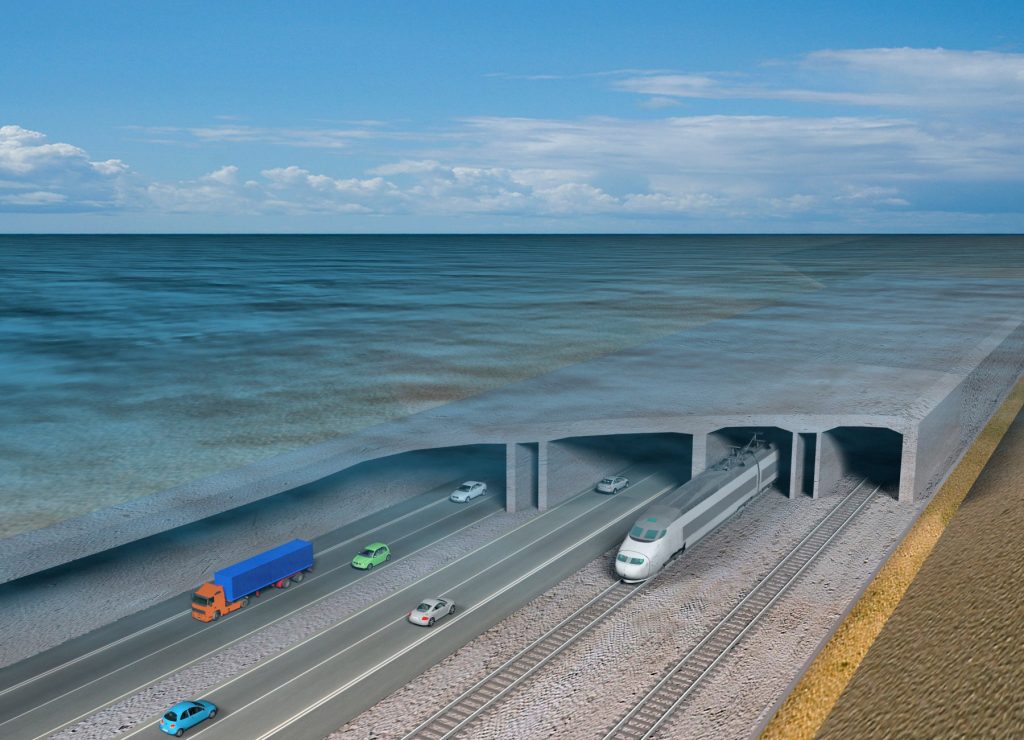
The Fehmarn Belt Fixed Link is a landmark infrastructure project designed to permanently connect the Danish island of Lolland with the German island of Fehmarn across the 18-kilometer Fehmarn Belt in the Baltic Sea. Once completed, it will become the world’s longest combined road and rail immersed tunnel, serving as a transformative link between Scandinavia and continental Europe. The project represents a pinnacle of modern civil and structural engineering, combining innovative underwater construction techniques, sustainable design practices, and complex transport integration.
1. Project Vision and Strategic Significance
The Fehmarn Belt Fixed Link aims to replace the existing ferry connection with a continuous, high-capacity transport corridor. The objectives of the project include:
- Dramatically reducing travel times between Denmark and Germany, with anticipated reductions of around 1 hour for rail traffic and up to 50 minutes for vehicles.
- Facilitating freight movement across the European North-South corridor, improving logistics efficiency and economic connectivity.
- Integrating multimodal transport by accommodating both dual railway tracks and a four-lane motorway in the same tunnel structure.
- Stimulating regional development by improving accessibility for Lolland and surrounding areas, boosting tourism, and encouraging industrial and commercial investment.
The link is a key component of the Scandinavian-Mediterranean TEN-T Corridor, ensuring seamless connections from Scandinavia to Central Europe and beyond.
2. Civil Engineering and Structural Concepts
2.1. Immersed Tunnel Design
Unlike conventional bored tunnels, the Fehmarn Belt Fixed Link is an immersed tunnel, constructed from prefabricated tunnel elements that are floated to site, submerged, and precisely positioned on a prepared seabed trench. This method offers several engineering advantages:
- Precision alignment: Each tunnel element is aligned using GPS, sonar, and custom positioning systems.
- Controlled prefabrication: Structural quality and watertightness are ensured in onshore construction yards before elements are placed underwater.
- Rapid installation: Elements are connected sequentially, allowing for controlled assembly in a marine environment.
The tunnel will consist of 79 individual elements, each 217 meters long, forming a continuous conduit for rail and road traffic. Its design accounts for dynamic marine loads, thermal expansion, and long-term durability in a saline environment.
2.2. Foundation and Trench Engineering
Before immersion, a trench is dredged along the seabed to create a stable foundation for the tunnel elements. Civil engineering considerations include:
- Seabed stabilization to prevent settlement or tilting of tunnel segments.
- Seismic and hydrodynamic load analysis to ensure the tunnel withstands storm surges, strong currents, and wave forces.
- Protective backfill and armor layers to safeguard against erosion, shipping impacts, and scouring.
Advanced geotechnical surveys inform trench design, seabed preparation, and backfill composition, balancing structural integrity with minimal environmental disturbance.
2.3. Structural Mechanics of Tunnel Elements
Each concrete tunnel element functions as a self-supporting shell capable of resisting:
- Longitudinal and transverse bending moments
- Hydrostatic pressure from the surrounding water column
- Traffic loads from high-speed trains and heavy trucks
Segment joints are designed to be watertight and flexible, accommodating minor settlement or thermal expansion without compromising structural safety. Reinforced concrete is extensively used, with specialized admixtures to resist chloride penetration and marine corrosion.
3. Road and Rail Integration
One of the defining features of the Fehmarn Belt Fixed Link is its dual-function design, carrying both:
- A four-lane motorway with emergency lanes and ventilation systems for safe operation.
- Two electrified railway tracks designed for high-speed trains traveling up to 200 km/h.
This integration required meticulous engineering:
- Structural load balancing to accommodate heavy, concentrated rail loads alongside distributed vehicular traffic.
- Vibration isolation systems to minimize interference between high-speed rail operations and the road deck.
- Safety and evacuation planning, including cross-passages for emergencies, smoke extraction, and fire-resistant materials.
The combined design demonstrates sophisticated coordination between civil, mechanical, and transportation engineering disciplines.
4. Tunnel Construction and Installation Challenges
Building the Fehmarn Belt Tunnel involves unique technical and logistical challenges:
4.1. Marine and Environmental Constraints
- Sensitive marine ecosystem protection: Construction schedules and dredging operations are planned to minimize disruption to fish spawning grounds and water quality.
- Sediment management: Dredged materials are carefully handled and deposited to prevent environmental contamination.
- Storm and tidal variations: Engineering teams must maintain precise control during immersion operations despite changing sea conditions.
4.2. Precision Assembly and Logistics
- Transportation of prefabricated elements: Each 217-meter-long tunnel segment must be floated, maneuvered, and submerged with millimeter accuracy.
- Sealing and joining segments underwater: Advanced gaskets, hydraulic presses, and grouting are used to ensure watertight connections.
- Safety monitoring: Continuous structural health monitoring ensures alignment, stress, and deformation remain within design tolerances during construction.
4.3. Coordination Across Disciplines
The project requires integration of multiple engineering disciplines:
- Civil engineering for trenching, foundations, and structural design.
- Structural engineering for load-bearing tunnel shells and joint mechanics.
- Transportation engineering for dual rail-road design.
- Mechanical and electrical engineering for ventilation, drainage, and safety systems.
- Environmental engineering to mitigate impacts on the Baltic Sea ecosystem.
5. Architectural and Safety Considerations
While immersed tunnels are primarily functional, architectural and safety elements are crucial:
- Interior layout: Adequate lane widths, clear signage, lighting, and emergency exits ensure user comfort and safety.
- Fire and ventilation design: Advanced HVAC systems maintain air quality, manage smoke in emergencies, and support evacuation.
- Monitoring and control systems: Sensors and automated monitoring detect traffic incidents, water ingress, or structural anomalies in real time.
These systems integrate seamlessly into the structural tunnel envelope without compromising its load-bearing capacity.
6. Economic and Regional Impacts
The Fehmarn Belt Fixed Link has transformative potential for transport, commerce, and tourism:
- Reduced travel times for both passengers and freight enhances trade efficiency between Scandinavia and Germany.
- Strengthened regional connectivity encourages economic development in southern Denmark and northern Germany, with spillover benefits for Lolland and Fehmarn.
- Modal shift from ferries to high-capacity rail and road reduces congestion and emissions, aligning with European sustainability goals.
- Integration into continental logistics corridors facilitates faster, more reliable north-south freight movement across Europe.
The link not only improves physical connectivity but also promotes economic resilience and cross-border collaboration.
7. Project Timeline and Status
The project is structured around phased implementation:
- Onshore preparation: Manufacturing of prefabricated tunnel elements and construction of immersion basins.
- Seabed trench excavation: Stabilization and leveling of the marine foundation.
- Immersion and placement: Sequential submersion and connection of each tunnel segment.
- Rail and road fitting: Installation of tracks, road surface, safety systems, and support infrastructure.
The completion of the Fehmarn Belt Fixed Link will mark a world milestone in tunnel engineering, representing the longest immersed tunnel for combined road and rail traffic globally.
8. Conclusion
The Fehmarn Belt Fixed Link embodies the forefront of modern civil engineering, combining immersed tunnel technology, dual-function transport design, and resilient construction methods. It addresses both technical challenges—ranging from marine trenching to high-speed rail integration—and socio-economic goals, such as regional connectivity, economic development, and sustainable transport. By linking Scandinavia and central Europe through a single, world-class infrastructure asset, it sets a benchmark for future cross-border megaprojects and demonstrates the power of engineering to transform geography into opportunity.
No responses yet