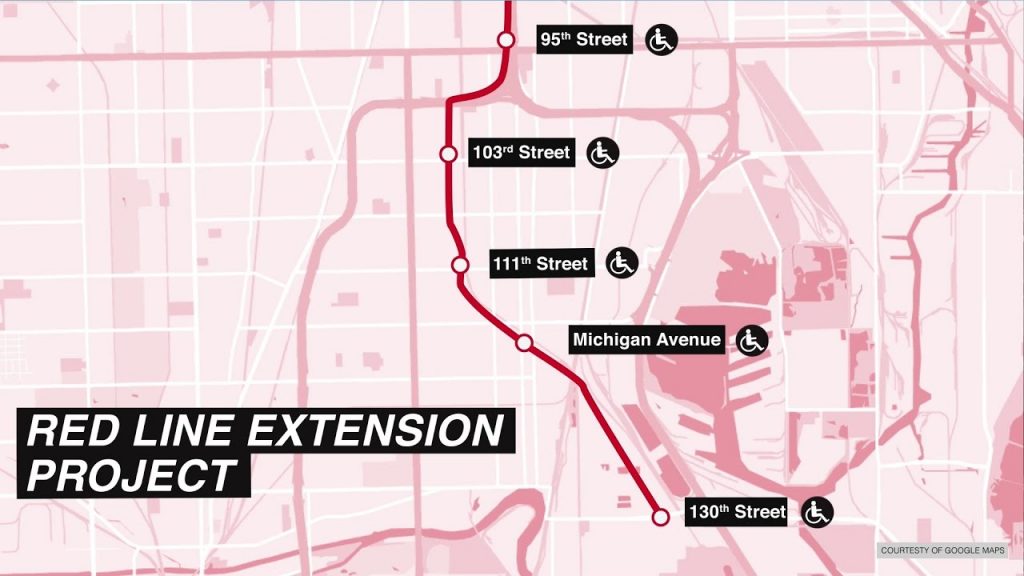
The Chicago Red Line Extension (RLE) is among the most important and transformative transit infrastructure projects underway in Chicago. It aims to extend the existing rail rapid-transit service by 5.6 miles from its current terminus at 95th Street down to 130th Street on the city’s Far South Side. Below is a detailed breakdown of what the project is, why it matters, how it will be built, what benefits are expected — and what challenges lie ahead.
1. What is the Red Line Extension? Project Scope & Purpose
- The RLE will extend the heavy-rail line of the Chicago Transit Authority (CTA) by approximately 5.6 miles on the Far South Side: from the current 95th Street terminus to a new southern terminus near 130th Street. transit.dot.gov+2Urbanize Chicago+2
- The project includes four new stations, at roughly:
- 103rd Street / Eggleston Avenue
- 111th Street / Eggleston Avenue
- Michigan Avenue near 116th Street
- 130th Street (near the Bishop Ford Freeway / Altgeld Gardens area) Urbanize Chicago+2Walsh Group+2
- It also involves construction of a new rail yard and maintenance facility near 120th Street, necessary to support the additional rolling stock and maintain system operations. transit.dot.gov+2transit.dot.gov+2
- To support multimodal transit, each new station will include bus, pedestrian, bicycle, and “park-and-ride” facilities, offering connectivity for commuters beyond just rail passengers. metro-magazine.com+1
- The RLE aims to provide improved transit access to some of Chicago’s most underserved and underinvested neighborhoods — communities with high poverty rates, significant unemployment, and long commute times compared with citywide averages. transit.dot.gov+1
- The rationale for the extension includes: reducing commute times, improving access to jobs, education, and services; catalyzing economic development along the South Side corridor; and providing equitable transit access for historically neglected areas. transit.dot.gov+1
In short: the RLE is not merely a technical extension — it’s a project with social equity, economic opportunity, and long-term city planning ambitions.
2. Technical Details: How the Extension Is Designed
The RLE’s design and construction plan reflect modern standards for public transit, accessibility, and future demand. Key technical features:
- Length & Track Layout: 5.6 miles of new track, extending from 95th Street to 130th Street. transit.dot.gov+1
- Station Design: Four new fully accessible stations, complying with Americans with Disabilities Act (ADA) standards; each station will provide multimodal access (bus, bike, pedestrian, parking). Walsh Group+2metro-magazine.com+2
- Elevation / Alignment: The extension will run on elevated tracks from 95th Street to approximately 119th Street; beyond that point to 130th Street the alignment transitions to ground level. Chicago Sun-Times+1
- Support Infrastructure: A new rail yard and maintenance shop around 120th Street to house and service additional rail cars. transit.dot.gov+1
- Rolling Stock: The project plan includes procurement of additional rail cars required to support extended operations and increased ridership. transit.dot.gov+1
This configuration is intended not only to extend service but also to ensure that the extension integrates smoothly with the existing network, while allowing for future scalability and high service reliability.
3. Timeline, Funding, and Project Development Status
Project History & Planning
- The “Locally Preferred Alternative” (LPA) was first adopted by the CTA Board in January 2018; the extension was incorporated into the region’s long-range transportation plan later that year. transit.dot.gov+1
- Environmental review and impact assessments were carried out; the final environmental review was completed with a Record of Decision from the federal authority in 2022. transit.dot.gov+1
Recent Milestones
- In 2024, CTA awarded the design-and-build contract to a consortium led by VINCI Construction Grands Projets (in partnership with local firm Walsh Construction Company). That contract covers the extension of the line, building the elevated guideway, and construction of the four new stations. Walsh Group+1
- The contract reportedly has a value of roughly USD 2.78 billion. VINCI+1
- Preparatory works are scheduled to begin in 2025, with full construction mobilization expected by early 2026. durbin.senate.gov+2Chicago Sun-Times+2
- The agency has secured a major federal funding agreement, reportedly among the largest infrastructure grants in CTA’s history — enabling the project to proceed into construction. durbin.senate.gov+1
Projected Opening and Operations
- The target opening year for revenue service is 2030. Urbanize Chicago+2Walsh Group+2
- Initial estimates (from earlier project documentation) suggested that service could start around 2029; later revisions place the full commissioning date slightly later, reflecting updated timelines. transit.dot.gov+1
4. Expected Benefits: Transport Equity, Economic and Social Impact
The Red Line Extension is widely viewed not only as a transit project, but as a catalyst for broader social and economic changes. Its expected benefits include:
Improved Mobility & Reduced Commutes
- The extension will drastically cut travel times for residents of the Far South Side: a trip from the 130th Street area to downtown Chicago (the Loop) will become significantly faster compared to existing bus-based trips. According to the CTA, the extension could cut commute times by up to 30 minutes compared to current options. CBS News+2Urbanize Chicago+2
- More reliable, 24-hours-per-day, 7-days-per-week service is planned — increasing accessibility for workers with non-standard shifts, students, and others who rely on public transit.
Economic Development & Investment Stimulus
- The expansion is expected to stimulate development around the new stations. The city has adopted a “Transit-Supportive Development Plan” for the corridor, aiming to encourage mixed-use, affordable housing, retail and commercial spaces, public spaces, and better transportation access for residents. Urbanize Chicago+1
- The construction phase itself will create many jobs. Estimates suggest thousands of construction-related jobs, plus indirect jobs from resulting economic activity, new businesses, and infrastructure improvements. chicagoconstructionnews.com+1
- For residents, improved access to jobs, education, health services, and amenities across the city — reducing inequalities tied to poor connectivity.
Transit Equity and Social Inclusion
- Many communities along the extension corridor have historically lacked high-quality rapid transit access. By extending the Red Line into those neighborhoods, the CTA aims to correct decades of transit inequity in Chicago. Walsh Group+2transit.dot.gov+2
- Multi-modal station design (bus, bike, park-and-ride) enhances mobility for people with different transit needs and promotes inclusive access.
5. Challenges, Costs, and Considerations
No major transit project is without hurdles — and the RLE has several important challenges and trade-offs to consider:
- Cost: The capital cost is substantial. Estimates vary, but the overall project cost is in the multi-billion-dollar range. One recent budget figure puts it at US$ 3.7–3.8 billion (year-of-expenditure dollars) when fully loaded with financing charges. transit.dot.gov+1
- Financing and Local Match: While a large portion comes from federal grant funding, the project relies on local matching funds. This raises questions about budget pressure on local government and long-term financial commitments. Urbanize Chicago+1
- Complex Construction: The mixture of elevated track, ground-level segments, station builds, a new yard and maintenance facility — all in built urban and suburban environments — means the project will face logistical, engineering, and community-impact challenges during construction.
- Equity & Social Impact Implementation: While the project aims to support underserved areas, successful realization depends on careful planning of transit-oriented development (housing, affordable living, local business opportunities), and on ensuring the benefits reach long-term residents rather than triggering displacement or gentrification. The adoption of a “Transit-Supportive Development Plan” by the city is promising, but execution will require careful and inclusive policies. Urbanize Chicago+1
- Timeline Risks: Although the target opening date is 2030, large infrastructure projects are often subject to delays — from funding, regulatory hurdles, supply-chain issues, or unexpected community/environmental complications.
6. Why the Red Line Extension Matters — Ultimately
The Red Line Extension is far more than just new tracks and stations. It represents:
- A long overdue correction of transit inequality in Chicago: connecting neighborhoods that have long lacked reliable rapid transit.
- An investment in inclusive economic growth, bringing infrastructure, jobs, mobility and opportunity to marginalized areas.
- A model for transit-oriented redevelopment, combining rail, housing, commerce, and accessibility under a coordinated city plan.
- A commitment to modern, sustainable public transport, reducing reliance on cars, encouraging public transit use, and integrating multimodal connectivity (bus, bike, walk, car-park) to meet diverse needs.
If successful — in construction, implementation, and follow-through in urban planning — the RLE could transform the Far South Side, improve quality of life for many Chicagoans, and serve as an example for equitable transit expansion in major cities worldwide.
No responses yet