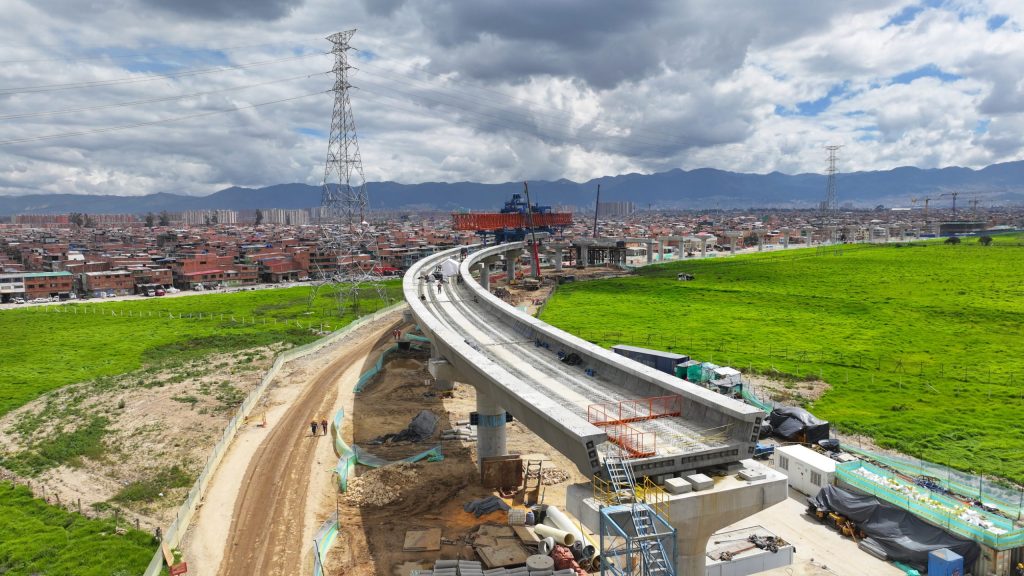
The Bogotá Metro Line 1—officially known as the Primera Línea del Metro de Bogotá (PLMB)—is one of the most significant urban infrastructure projects in Colombia’s modern history. After decades of planning, political debate, and multiple technical studies, Bogotá is finally moving forward with its first mass-transit metro line. Unlike many major systems built underground, the city opted for an entirely elevated metro for its inaugural route, shaping not only how people move but how Bogotá itself will evolve in the decades ahead.
1. An Overview of Line 1: Scope, Route, and Vision
Line 1 is designed as a 24-kilometer elevated metro corridor stretching from the southwest of Bogotá in the locality of Bosa, across densely populated and heavily congested areas such as Kennedy and Puente Aranda, and terminating in Chapinero at the intersection of Calle 72 and Avenida Caracas.
Key characteristics
- 100% elevated via a continuous viaduct
- 16 elevated stations
- A large maintenance yard and operations control center in Bosa
- Integration with existing transport, notably TransMilenio, Bogotá’s BRT (Bus Rapid Transit) system
- Bicycle-friendly access with thousands of new bike-parking spaces
- Connection to major urban corridors such as the Avenida Villavicencio, Primero de Mayo, NQS, and Caracas
The vision behind Line 1 is to create a high-capacity transit backbone capable of reducing travel times, improving urban connectivity, and reshaping mobility culture in a city historically dominated by buses.
2. Why an Elevated Metro? Technical and Urban Logic Behind the Choice
While underground metros are common in dense world capitals, Bogotá’s decision for an elevated system was driven by several factors:
2.1 Geotechnical considerations
Bogotá sits on a plateau with complex clay soils, high water saturation, and seismic activity. Tunneling would:
- Increase construction risk
- Extend timelines
- Drive up costs significantly
An elevated structure avoids these complications and enables a faster, more predictable build.
2.2 Construction speed and cost
Elevated viaducts can be assembled more rapidly using prefabricated beams, pillars, and standardized station modules. This method:
- Minimizes disruptions to existing traffic
- Keeps costs lower than a deep tunnel system
- Allows visible, incremental progress appreciated by the public
2.3 Urban presence and visibility
An elevated metro becomes a visual symbol of modernization. Although this requires careful integration into the urban fabric, it also provides:
- A sense of progress and transparency
- Opportunities for urban renewal under the viaduct (parks, bike lanes, plazas)
The elevated model is widely used in Asia and rapidly expanding Latin American cities for similar reasons.
3. Station Design and Passenger Experience
The 16 stations of Line 1 have been categorized into several types depending on their architectural configuration and surrounding environment.
3.1 “Special” stations
These include:
- Access buildings positioned at street level
- Pedestrian bridges connecting the access building to the elevated platform
- Multi-level circulation areas to handle high passenger flows
They act as major transfer points or are located in areas with significant urban density.
3.2 Standard elevated stations
These are simpler and consist of:
- A mezzanine level
- A central island platform above
- Elevators, escalators, and ramps
- Integrated bicycle parking areas
3.3 Accessibility as a core design element
Bogotá’s Metro will be fully accessible, offering:
- Step-free access across all stations
- Tactile paving for visually impaired passengers
- Bicycle storage and pedestrian-friendly public spaces
This marks an important milestone in a city where many transport infrastructures lack universal accessibility.
4. System Technology: Automation, Control, and Modern Efficiency
Bogotá’s Line 1 will use driverless automated trains (GoA4 automation), similar to advanced systems in cities like Copenhagen, Dubai, and Vancouver.
4.1 Communication-Based Train Control (CBTC)
The system employs CBTC, which enables:
- Real-time communication between trains and control centers
- Shorter time intervals between trains (headways)
- High capacity, reliability, and safe automated braking
4.2 Train characteristics
Each train will be approximately:
- 135 meters long
- Capable of transporting ~1,800 passengers
- Running at commercial speeds around 42–43 km/h
4.3 System capacity
With automation and efficient scheduling, the system is planned to handle:
- Up to 72,000 passengers per hour per direction
- Over 1 million passengers per day at peak capacity
This level of capacity surpasses what Bogotá’s bus-based system can currently offer, even at maximum operational stress.
5. Benefits of the Metro: Mobility, Sustainability, and Equity
Line 1 is much more than a transport project; it is a catalyst for long-term urban transformation. Its impacts can be grouped into several key categories:
5.1 Mobility Benefits
Reduced travel times
Current bus journeys along corridors such as Avenida Caracas often exceed 90 minutes during rush hours. With Line 1, the same route may take under 30 minutes, dramatically improving daily life for commuters.
Greater reliability
Unlike road-based transit, the elevated metro is:
- Unaffected by traffic
- Protected from weather disruptions
- Easier to schedule precisely
This reliability forms the backbone of effective public transit systems worldwide.
5.2 Environmental Benefits
Line 1 is fully electric, which means:
- Zero tailpipe emissions
- Reduced noise pollution
- Decreased dependence on diesel buses
Bogotá, a city frequently struggling with air quality issues, is expected to benefit significantly from this transition. Additionally, the project includes new bike lanes and 9,000+ bicycle parking spaces, promoting non-motorized travel.
5.3 Social and Equity Benefits
One of the most transformative aspects of Line 1 is its impact on social equity. The corridor passes through areas with:
- High population density
- Low access to high-quality public transport
- Significant travel times to employment hubs
Better mobility translates into better access to:
- Education
- Jobs
- Healthcare
- Urban opportunities
This helps bridge socioeconomic gaps that have persisted for decades.
5.4 Urban Development and Economic Growth
Large metro investments typically stimulate:
- Neighborhood revitalization
- Increased land value
- Development of commercial areas
- Job creation
- Improved public space
The areas beneath and around the viaduct are expected to be transformed into:
- Linear parks
- Cycling corridors
- Community plazas
- New retail and cultural spaces
Far from being merely a structural footprint, the viaduct becomes a platform for public space innovation.
6. Construction Progress and Timeline
As of late 2025, the Bogotá Metro Line 1 has reached significant milestones:
6.1 Completed progress
- Over 9 kilometers of viaduct installed
- More than 55% overall project completion
- Arrival of the first train expected soon for initial tests
6.2 Projected timeline
- Civil works completion: mid-to-late 2027
- System testing and commissioning: late 2027–2028
- Opening of commercial operation: planned for 2028
The construction process has been closely monitored due to its complexity and the public importance of the project.
7. Challenges and Risks: What Bogotá Must Carefully Manage
Despite the progress, the project faces challenges typical of mega-infrastructure endeavors:
7.1 Urban integration challenges
An elevated metro can create concerns such as:
- Visual impact
- Noise considerations
- Shading of public spaces
- Effects on property owners
Proper architectural design, sound barriers, and active public-space enhancement will be essential.
7.2 Intermodal coordination
The metro’s success depends on seamless integration with:
- TransMilenio
- Feeder buses
- Pedestrian networks
- Bicycle infrastructure
Without careful planning, passengers may face inefficiencies or bottlenecks.
7.3 Cultural adaptation
Bogotá must build a new mobility culture that respects:
- Train safety norms
- Accessibility principles
- Cleanliness and maintenance
- Multimodal travel habits
Education campaigns will be vital to ensure a smooth transition.
8. Why Line 1 Matters: A Historical Turning Point for Bogotá
The construction of Line 1 represents more than a transportation upgrade; it marks a fundamental shift in how Bogotá envisions its future.
A symbolic transformation
After more than 70 years of proposals, cancellations, and political debates, the metro has finally become a reality.
A step toward sustainability
Electric rail transit is crucial for reducing emissions and building a greener mobility system.
A social equalizer
By dramatically improving access to opportunities for millions, the metro advances social justice and urban equity.
A model for future expansion
Line 1 sets the foundation for:
- Future metro lines
- Regional rail systems
- A fully integrated, multimodal transit network
Bogotá is finally joining the ranks of global cities that rely on modern rail for mobility and urban cohesion.
Conclusion
The Bogotá Metro Line 1 is far more than a transportation project—it is a transformative piece of urban infrastructure that promises to reshape mobility, equity, and environmental sustainability in Colombia’s capital. With its 24-kilometer elevated route, 16 modern stations, automated trains, and capacity exceeding one million passengers daily, it will become the backbone of Bogotá’s future transport system.
If construction continues on schedule, by 2028 Bogotá will experience a transportation revolution that has been anticipated for generations. Line 1 represents not only engineering progress but also hope: hope for faster commutes, cleaner air, more accessible neighborhoods, and a more integrated and equitable city.
No responses yet