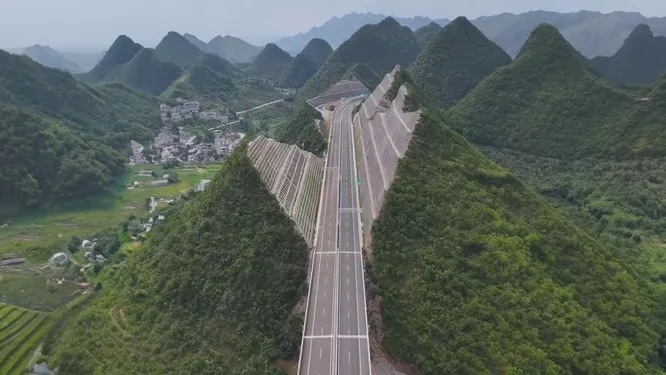
In 2025, the world witnessed the unveiling of one of the most ambitious feats of modern engineering: the Huajiang Grand Canyon Bridge in Guizhou Province, China. Standing an astonishing 625 meters above the Huajiang Canyon, this record-breaking bridge is now the highest in the world. To put this in perspective, its deck soars higher than many of the tallest skyscrapers, including the iconic Shanghai Tower. Yet, the bridge is more than a record-holder—it is a remarkable testament to human ingenuity, precision engineering, and the power of infrastructure to reshape a region.
The Need for Huajiang Bridge
Guizhou Province, often called the “Switzerland of China,” is a land of dramatic peaks, winding valleys, and breathtaking scenery. While its beauty attracts tourists, the terrain poses significant challenges for transportation. Historically, residents and travelers had to navigate long, winding mountain roads, often taking hours to traverse what might otherwise be a short distance.
This difficulty in connectivity was a major reason for China’s investment in infrastructure across the province. Since the 1990s, Guizhou has seen the opening of airports, high-speed rail lines, and expressways, all designed to improve access and integrate the region with China’s broader economic network. Yet, even with these advances, the province’s mountainous landscape made travel slow and complex, especially in areas like Huajiang Canyon.
The Huajiang Bridge is part of the S57 Liuzhi–Anlong Expressway, a 152-kilometer highway cutting through the heart of Guizhou’s mountains. Before the bridge, crossing the canyon could take up to two hours. With its completion, that journey has been reduced to just two minutes. The bridge, therefore, is not just a structure but a transformative connector for communities and commerce.
Designing a Giant: The Engineering Challenge
Building a bridge 625 meters above a canyon floor is no ordinary engineering project. Engineers faced steep, unstable terrain, extreme wind conditions, and the challenge of spanning a canyon nearly 1.5 kilometers wide. The location was chosen after extensive geological surveys up to 10 kilometers upstream and downstream, evaluating soil stability, seismic activity, and optimal alignment for the bridge towers.
Two primary design options were considered: cable-stayed bridges and suspension bridges. For long spans in mountainous terrain, suspension bridges are generally more practical, as their cables can be anchored into hard rock to provide incredible stability. Ultimately, the Huajiang Bridge was designed as a steel truss suspension bridge, combining structural resilience with engineering elegance.
The bridge’s steel framework comprises 93 truss sections weighing a total of 22,000 tons—nearly three times the weight of the Eiffel Tower. Each section had to be precisely manufactured and positioned, as any misalignment could compromise safety, given the dizzying height above the canyon floor.
Innovative Construction Techniques
Transporting and installing massive steel trusses over a canyon hundreds of meters deep required ingenuity. Conventional cranes were impractical for this scale. Instead, engineers deployed a cable-crane system, essentially an overhead monorail that delivers steel sections to their designated positions with precision. Sections were placed starting from the center and built outward to maintain balance and reduce stress on the support towers.
In addition, the Chinese BeiDou Navigation Satellite System was used for pinpoint accuracy, ensuring each girder aligned perfectly with the design specifications. The bridge towers themselves are asymmetrical—the north tower is 262 meters tall, while the south tower is 205 meters—reflecting the uneven terrain and the need for tailored cable anchoring.
Wind posed another formidable challenge. The canyon creates unpredictable gusts, sometimes intensified by the Venturi effect, where air speeds up when funneled through narrow passages. Engineers tested wind impacts using scaled-down models in wind tunnels and a Doppler LiDAR system that created a three-dimensional map of wind currents by analyzing reflected laser signals from airborne moisture particles.
The construction also accounted for seismic activity and other geological factors, ensuring the bridge would endure not only extreme heights and wind but also potential natural events. Once operational, continuous monitoring systems, including fiber-optic sensors embedded in the main cables, track tension and structural integrity in real time.
A Record-Breaking Marvel
The Huajiang Bridge stretches 2,890 meters, with a main span of 1,420 meters, creating an unbroken roadway across a dramatic canyon. Its deck height of 625 meters surpasses any other bridge in the world. From the canyon floor, the bridge’s steel trusses appear almost impossibly suspended, a testament to precision engineering and human daring.
The bridge also highlights China’s broader commitment to infrastructure development. Guizhou Province alone now hosts tens of thousands of bridges, many designed to overcome the same rugged terrain challenges, and the country leads the world in both high-speed rail and high-altitude bridge construction.
More Than a Bridge: Tourism and Economic Impact
Huajiang Bridge is not just a conduit for vehicles; it is an emerging tourist destination and cultural landmark. Its design includes amenities for visitors, including a glass elevator rising 800 meters to a café built within one of the towers. Beneath the deck, a glass walkway offers daring tourists breathtaking views of the canyon below, while an artificial waterfall stretches across the structure, creating a dramatic visual spectacle.
Adventure seekers can also experience bungee jumping and base jumping from the bridge, while plans are underway for professional extreme sports events and recreational facilities in the surrounding canyon. By combining functional infrastructure with tourism and recreation, the bridge stimulates local economies and attracts visitors from across the globe.
Beyond entertainment, the bridge symbolizes China’s commitment to regional development and poverty alleviation. By improving connectivity and access, it opens new economic opportunities for remote areas, allowing trade, tourism, and cultural exchange to flourish in regions that were previously isolated.
Engineering Insights and Legacy
The Huajiang Grand Canyon Bridge demonstrates several key lessons in modern civil engineering:
- Precision Matters: Accurate surveying, satellite navigation, and pre-assembly modeling were critical in ensuring the safety and functionality of a bridge spanning nearly three kilometers.
- Innovation Overcomes Limitations: Traditional equipment often cannot meet extreme challenges. Innovative construction techniques, such as cable-crane systems, allowed workers to install massive components with minimal risk.
- Adaptation to Natural Forces: Asymmetrical towers, advanced wind studies, and ongoing monitoring ensure the bridge can withstand the unpredictable conditions of a canyon environment.
- Integration with Community and Economy: Infrastructure projects can serve multiple purposes, from transportation and commerce to tourism and recreation, multiplying their societal impact.
Huajiang Bridge represents the culmination of decades of experience in high-altitude bridge construction in China. Its successful completion underscores not only technical achievement but also the broader vision of connecting communities, fostering development, and showcasing engineering excellence to the world.
Conclusion: A Symbol of Ambition
The Huajiang Grand Canyon Bridge is more than a record-breaking structure. It is a monument to human ambition, blending engineering mastery with cultural and economic vision. From the dizzying heights of its deck to the meticulous placement of its steel trusses, it illustrates the extraordinary lengths to which engineers will go to overcome nature’s challenges.
More than just a bridge, it is a gateway: connecting communities, enabling commerce, attracting tourism, and inspiring generations of engineers worldwide. In a land where mountains dominate the landscape, Huajiang Bridge reminds us that human innovation can rise above even the steepest obstacles—literally and figuratively.
No responses yet