How do you organize the construction of an 18-kilometre tunnel beneath the Baltic Sea when every major structural element weighs more than 73,000 tonnes?
The answer involves far more than engineering calculations and heavy machinery.
Before a single tunnel element can be installed, thousands of workers, enormous quantities of building materials, specialized ships, manufacturing facilities, and international contractors must be coordinated.
Every stage depends on another.
Concrete production must match factory schedules. Reinforcement steel must arrive before casting begins. Completed tunnel elements must be prepared for transportation. Specialized marine vessels must be available, and the seabed foundation must be ready before installation can proceed.
If one critical operation falls behind schedule, the consequences can extend across the entire project.
This is the extraordinary logistical challenge behind the Fehmarnbelt Tunnel, an approximately 18-kilometre immersed road and railway tunnel connecting Denmark and Germany.
The project is intended to become the world’s longest immersed tunnel, providing a permanent connection beneath one of Europe’s important maritime corridors.
But while much of the attention focuses on the enormous concrete elements being lowered into the sea, another engineering achievement is taking place behind the scenes.
The construction team has effectively created an enormous industrial supply chain dedicated to manufacturing and installing an underwater tunnel.
Understanding this system reveals why construction logistics, procurement, scheduling, and project management are just as important to megaproject success as structural engineering.
1. Why Megaproject Logistics Are So Complex
Construction logistics involves planning, coordinating, transporting, storing, and delivering the people, materials, equipment, and information required to complete a project.
On a small construction site, this might involve scheduling concrete deliveries, arranging cranes, managing storage areas, and coordinating subcontractors.
On a megaproject, the same principles operate at a dramatically larger scale.
The Fehmarnbelt Tunnel requires 79 standard concrete tunnel elements and ten smaller special elements.
Each standard element measures approximately 217 metres long and weighs more than 73,000 tonnes.
These structures must be manufactured, inspected, prepared for flotation, transported to sea, and installed within a precisely excavated trench.
At the same time, contractors must construct tunnel portals in Denmark and Germany, manage marine operations, and prepare the infrastructure needed for future motorway and railway systems.
This creates multiple interconnected construction operations.
A delay in concrete production can affect element availability.
A delay in preparing the seabed can affect immersion.
Problems with marine equipment can leave finished elements waiting for installation.
For this reason, megaproject logistics must be understood as a complete system rather than a collection of independent deliveries.
2. Building a Factory Specifically for One Tunnel
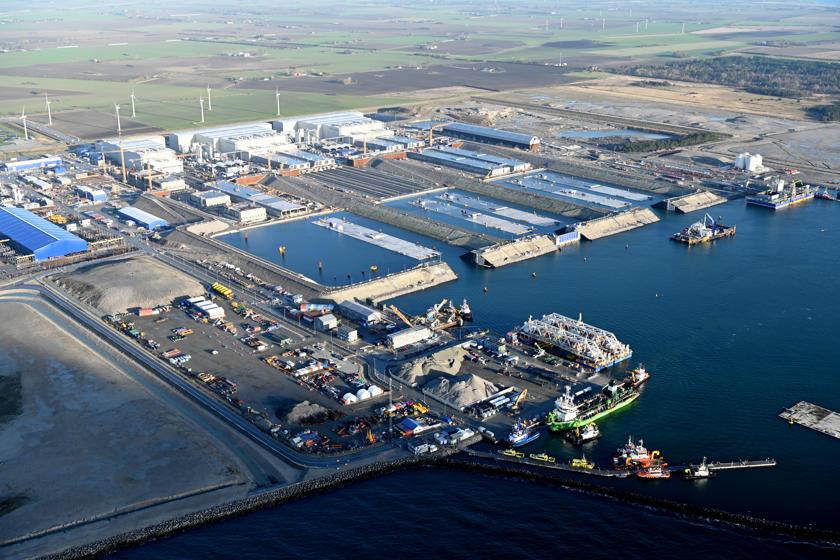
One of the project’s most important logistical decisions was to manufacture the tunnel elements in a dedicated factory near Rødbyhavn on the Danish island of Lolland.
The construction site covers an area equivalent to approximately 300 football pitches.
It includes three major production halls, concrete batching plants, reinforcement facilities, storage areas, work harbours, and supporting infrastructure.
More than 2,000 people from over 40 countries work at the construction site.
Why manufacture the elements near the installation location?
Imagine producing 217-metre-long concrete elements at a conventional factory hundreds of kilometres inland.
Transporting them by road or rail would be practically impossible because of their enormous size and weight.
Even transporting them across long maritime distances would introduce substantial logistical challenges.
The Fehmarnbelt project addresses this by positioning the factory close to the shoreline.
Completed elements can be moved from the manufacturing facility through dedicated basins and into the work harbour.
From there, tugboats and specialized immersion equipment transport them to their designated positions in the Baltic Sea.
This arrangement reduces the need for long-distance transportation of completed elements.
It also allows the manufacturing operation to connect directly with marine installation activities.
The factory is therefore not simply where the concrete is produced.
Its location is a central part of the project’s entire construction strategy.
3. The Work Harbours: The Project’s Supply Chain Gateways
One of the most impressive logistical features of the project is its reliance on purpose-built work harbours.
These facilities allow large quantities of materials to be delivered directly by ship.
The project has work harbours on both the Danish and German sides of the Fehmarnbelt.
The Danish work harbour began operating in the summer of 2022.
The German work harbour began operating in July 2023.
Together, they provide important connections between international material suppliers and the construction sites.
Why use ships instead of trucks?
Major infrastructure projects consume enormous quantities of cement, aggregates, reinforcement steel, and other construction materials.
Transporting these materials exclusively by road would require a very large number of heavy vehicle journeys.
This could create congestion, increase pressure on local roads, and complicate delivery scheduling.
Ships offer substantial carrying capacity, making them suitable for transporting bulk construction materials.
According to the project developer, the Danish work harbour receives approximately one cargo vessel every three days.
Around 65,000 tonnes of stone, cement, sand, gravel, and steel are handled there each week.
The German harbour receives approximately two cargo vessels per week.
These figures illustrate the enormous scale of the supply chain required to support construction.
From harbour to production line
Once materials arrive, they must be unloaded and transferred to their designated storage or production locations.
Cement may be stored in silos.
Aggregates are directed toward concrete production facilities.
Reinforcement steel is transferred for fabrication and assembly.
Each delivery must arrive in the correct quantity, at the correct time, and in a condition suitable for use.
This requires coordination between suppliers, shipping companies, harbour operators, material-handling teams, and construction managers.
Efficient logistics prevent the factory from running out of essential inputs while avoiding excessive accumulation of materials.
4. Managing Concrete Production on an Industrial Scale
Concrete production is one of the most demanding logistical activities at the Fehmarnbelt factory.
The facility includes two large batching plants capable of producing more than 600 cubic metres of concrete per hour combined.
This production capacity supports the casting of the enormous reinforced-concrete segments.
A typical standard tunnel element consists of nine individual segments.
Producing these segments requires a carefully coordinated sequence involving reinforcement, formwork, concrete placement, curing, and movement through the factory.
The challenge of continuous supply
Large concrete pours cannot be treated like ordinary deliveries.
Concrete begins changing chemically and physically after mixing.
Its workability, setting behaviour, and temperature develop over time.
Consequently, concrete must be produced and delivered according to a controlled schedule.
If production stops unexpectedly, the interruption can affect the quality and continuity of a casting operation.
For this reason, batching plant reliability, equipment availability, workforce planning, and quality control are essential.
The construction team must also coordinate maintenance to reduce the likelihood of unexpected breakdowns during critical operations.
Production bottlenecks
Consider a simplified example.
Suppose a casting operation requires 3,300 cubic metres of concrete and the effective average supply rate is 150 cubic metres per hour.
The theoretical supply time would be:
3,300 ÷ 150 = 22 hours.
This is only a hypothetical production calculation, not an actual Fehmarnbelt casting schedule.
Real production times depend on placement rates, workability requirements, equipment capacity, inspections, interruptions, and construction sequencing.
The example demonstrates why even small changes in productivity can significantly affect large casting operations.
5. Coordinating Reinforcement, Formwork, and Production Lines
Concrete is only one component of the tunnel elements.
The factory must also manufacture and install enormous quantities of steel reinforcement.
A dedicated panel factory covering approximately 25,000 square metres produces reinforcement assemblies for the tunnel elements.
Automated equipment helps fabricate large reinforcement mats.
These assemblies are subsequently moved to the production halls and incorporated into the structural reinforcement system.
Why production sequencing matters
Reinforcement must be available before formwork can be closed and concrete placement can begin.
Formwork must be ready before casting.
Concrete must develop sufficient strength before particular movement and handling operations can proceed.
This creates a sequence of dependent activities.
Construction managers must therefore coordinate manufacturing stages to avoid congestion or inactivity.
If one production operation is slower than the others, it can become a bottleneck.
For example, increasing concrete production capacity would not necessarily improve overall output if reinforcement assembly remained the limiting activity.
The same principle applies to many construction projects.
Increasing the capacity of one operation does not automatically accelerate the entire programme.
Productivity improves when the complete sequence is balanced.
6. The Logistics of Moving a 73,500-Tonne Structure
Once a standard tunnel element has been manufactured, transporting it presents an entirely different challenge.
The element must move from the factory into the marine construction environment.
Temporary steel bulkheads are installed to close its ends and keep the internal compartments watertight.
Additional ballast systems are prepared to control flotation and stability.
For the first element, approximately 4,500 tonnes of ballast concrete were added before immersion.
This increased its weight for the controlled lowering operation.
A journey measured in kilometres, but planned in extraordinary detail
The first tunnel element left the work harbour on May 4, 2026.
Its initial journey to the immersion location covered just over two kilometres.
Five tugboats and specialized equipment were used to transport the structure.
Although the distance was relatively short, the operation required detailed planning.
A structure hundreds of metres long cannot manoeuvre like a conventional ship.
Wind, currents, towing forces, vessel movements, and available water depth must all be considered.
Marine traffic must also be coordinated around the operation.
The objective is not speed.
It is maintaining sufficient control over the element to deliver it safely to the correct installation position.
7. The Specialized Marine Fleet
The Fehmarnbelt project uses a fleet of vessels designed or adapted for specific construction tasks.
Each vessel performs a different role within the underwater installation sequence.
MAYA — Preparing the foundation
MAYA is a multipurpose pontoon used to place and level the gravel bedding on which the tunnel elements rest.
The foundation must be prepared to the specified geometry before an element can be installed.
IVY 1 and IVY 2 — Transport and immersion
IVY consists of specialized immersion pontoons designed to support and lower the massive tunnel elements.
For a standard element, the two pontoons support opposite ends of the structure.
For the shorter special elements, the pontoons can be coupled together to provide joint support.
NP460 — Placing surrounding materials
The spreader pontoon NP460 places stone and gravel around the installed tunnel elements.
These materials help secure and support the structure within the trench.
WISMAR — Protective covering
WISMAR places a protective stone layer above the installed elements.
This helps protect the tunnel according to its engineered backfilling design.
Why specialized equipment matters
Each vessel performs work that must be coordinated with the activities before and after it.
For example, immersion cannot proceed until the required foundation preparation is complete.
Likewise, protection and backfilling operations follow the installation and connection of an element.
This makes vessel availability a critical scheduling consideration.
A delay involving one specialized vessel may affect several subsequent construction activities.
8. How Marine Operations Are Scheduled
Marine construction depends on conditions that contractors cannot fully control.
Weather, currents, visibility, and sea conditions can influence the safety and feasibility of operations.
For an immersed tunnel, these factors are especially important during transportation and lowering.
The project team must therefore identify appropriate operational conditions and coordinate the availability of vessels, crews, surveyors, and installation specialists.
The importance of installation windows
Unlike many land-based construction activities, some marine operations cannot simply continue under all weather conditions.
Contractors may need to postpone a critical operation until suitable conditions are available.
This introduces uncertainty into the construction schedule.
Project planners must consider possible weather delays and develop contingency arrangements.
They must also ensure that the element, marine equipment, and supporting construction activities are ready when a suitable installation opportunity arises.
The objective is to avoid losing valuable operating windows because of preventable logistical problems.
9. How Delays Can Affect the Entire Megaproject
The Fehmarnbelt project provides a real example of how specialized equipment can influence the critical path of a major construction programme.
In February 2026, project owner Sund & Bælt reported that construction was approximately two years behind the earlier schedule.
The company identified challenges with the specialized immersion vessel as an important reason for the delay.
These challenges affected the timing of tunnel element installation.
The consequences extended beyond marine construction.
Sund & Bælt cancelled two procurement procedures related to railway track and overhead electrical systems, and tolling facilities.
The reason was that the later tunnel completion date changed when those systems would be needed.
Understanding the critical path
In construction scheduling, the critical path is the sequence of activities that determines the project’s earliest achievable completion date.
If an activity on the critical path is delayed and the delay cannot be recovered, the project’s completion date may move.
The Fehmarnbelt example illustrates this principle.
Tunnel element immersion is a central activity because many subsequent operations depend on the structural tunnel being available.
Installing railway equipment too early could create unnecessary contractual or financial exposure.
Therefore, the project owner adjusted procurement timing to better match the revised construction programme.
This demonstrates an important management lesson:
A successful project schedule is not simply a list of dates. It is a coordinated system of dependencies, resources, risks, and commercial decisions.
10. Managing Thousands of Workers From Around the World
Infrastructure megaprojects depend on people as much as machinery.
The Fehmarnbelt construction site employs more than 2,000 workers from over 40 countries.
Coordinating such an international workforce creates logistical and management requirements.
Workers need accommodation, transportation, welfare facilities, safety training, communication systems, and access to the construction areas.
The project includes an accommodation complex with more than 1,300 residential units.
Completed in 2023, the facility includes supporting services such as shopping, sports, and recreational amenities.
Why workforce logistics affect productivity
A shortage of accommodation or poor transport arrangements can reduce the availability of workers.
Similarly, unclear communication between international teams can increase the risk of errors.
Construction managers must coordinate different trades, subcontractors, and specialist teams while maintaining common safety standards.
The workforce also changes as the project progresses.
Marine construction requires different skills from concrete manufacturing.
Later phases will involve railway, electrical, ventilation, and other technical installation specialists.
Planning these transitions is an important part of project delivery.
11. Environmental Logistics: Managing Millions of Cubic Metres of Material
The Fehmarnbelt Tunnel required the excavation of approximately 15 million cubic metres of material from the seabed.
Managing this volume creates a major logistical challenge.
Dredged material must be removed, transported, and placed according to the project’s engineering and environmental requirements.
Rather than treating all excavated material as waste, the project has reused significant quantities to create new land and coastal areas near Rødbyhavn.
These areas are intended to support nature and recreational uses.
Why material reuse matters
On a megaproject, disposal is not simply an environmental question.
It is also a transportation and cost issue.
Moving millions of cubic metres of excavated material over long distances would require substantial resources.
Reusing suitable material close to the excavation area can reduce the need for alternative disposal arrangements.
However, reclamation must still be designed and managed carefully.
Engineers must consider material suitability, settlement, coastal stability, environmental effects, and construction sequencing.
Environmental monitoring also forms part of the marine works.
The project has used underwater monitoring equipment, including autonomous survey technology, to assess suspended sediment in the surrounding water.
This helps provide information about the effects of construction activities.
12. Construction on Two Sides of an International Border
The Fehmarnbelt Tunnel is not simply a Danish construction project.
It is a cross-border infrastructure connection involving Denmark and Germany.
Tunnel portals are being constructed on both sides of the waterway.
These portals will connect the immersed tunnel with the motorway and railway infrastructure on land.
The Danish portal connects to the future crossing near Rødbyhavn.
The German portal is located near Puttgarden.
Construction activities must align with national requirements, technical specifications, and the future operation of an international transportation link.
The challenge of project interfaces
An interface occurs where different parts of a project must connect or coordinate.
Examples include the connection between the immersed tunnel and a portal, or between tunnel infrastructure and the railway network.
Interface management becomes especially important when different contractors or authorities are responsible for different components.
A technically successful tunnel element cannot deliver a functioning transportation connection if the adjoining infrastructure is incomplete or incompatible.
Engineers and project managers must therefore coordinate design information, construction sequencing, testing requirements, and handover arrangements across the entire project.
13. Digital Systems and Supply Chain Resilience
Modern megaprojects rely heavily on digital information systems.
Construction teams use digital tools for scheduling, procurement, engineering coordination, document management, material tracking, and communication.
These systems improve visibility across complex operations, but they also create dependencies.
In October 2026, the Fehmarnbelt project’s main contractor, Femern Link Contractors, experienced a cyberattack affecting its IT systems.
The incident temporarily disrupted construction activities.
Work subsequently resumed in several areas while investigations and recovery efforts continued.
The event highlights a growing challenge in construction management: digital resilience.
Why cybersecurity matters to construction
When project information systems are unavailable, teams may struggle to access essential data or coordinate activities.
The effects can extend into procurement, production planning, logistics, and workforce management.
For major infrastructure projects, information security is therefore not solely an IT concern.
It can directly influence construction continuity.
Project organizations need appropriate access controls, backup arrangements, incident-response procedures, and operational contingency plans.
The Fehmarnbelt incident demonstrates how an unexpected disruption outside traditional engineering disciplines can affect physical construction work.
14. Construction Progress and the Remaining Logistics Challenge
The first Fehmarnbelt Tunnel element was successfully immersed in May 2026.
Further installations followed in June, August, and September.
By September 28, four standard elements had been installed, representing almost 900 metres of the planned 18-kilometre crossing.
The next major operation was the immersion of the first special element.
This element is smaller in length but has a more complex geometry because it contains an additional basement level for technical installations.
In September 2026, the specialized IVY immersion equipment completed an important load test in preparation for handling the special element.
Meanwhile, construction of the tunnel portals and other supporting infrastructure continued.
As of early November 2026, the project remained under construction, with substantial manufacturing, immersion, backfilling, technical installation, and testing activities still to be completed.
The continuing logistical challenge is coordinating these activities without allowing avoidable bottlenecks to develop.
15. What Construction Professionals Can Learn From Fehmarnbelt
The Fehmarnbelt Tunnel provides valuable lessons for engineers, project managers, contractors, and construction students.
Plan logistics during design
The factory location, work harbours, transport routes, and marine equipment were essential to making the chosen construction method practical.
Logistics should therefore influence design decisions from the beginning.
Identify critical equipment early
Specialized vessels can become major programme constraints.
Their design, testing, commissioning, maintenance, and availability require careful risk management.
Coordinate procurement with construction progress
Ordering and installing systems too early can create unnecessary costs.
Procurement schedules should reflect realistic construction dependencies.
Treat material flow as part of production
A large factory cannot operate efficiently without reliable cement, aggregate, steel, and equipment deliveries.
Build resilience into project systems
Weather delays, equipment problems, workforce constraints, and digital disruptions can all affect productivity.
Contingency planning is essential.
Manage interfaces carefully
Successful completion requires coordination between manufacturing, marine installation, land infrastructure, and technical systems.
These lessons apply far beyond underwater tunnels.
They are relevant to large bridges, railways, airports, ports, industrial facilities, and major urban developments.
Conclusion: The Invisible Engineering Behind a Megaproject
The Fehmarnbelt Tunnel is an extraordinary structural engineering achievement, but its construction also demonstrates the immense importance of logistics.
To build the crossing, contractors have established a purpose-built factory, developed dedicated work harbours, coordinated international material supplies, deployed specialized marine vessels, and organized thousands of workers.
Every concrete tunnel element passes through a complex sequence of manufacturing, inspection, transportation, immersion, and protection.
The system must operate across land and sea, under changing weather conditions, while maintaining strict engineering and safety requirements.
The project also demonstrates how unexpected disruptions can influence an entire construction programme.
Specialized equipment delays can affect procurement.
Material shortages can interrupt manufacturing.
Marine weather can delay installation.
Digital incidents can disrupt otherwise well-organized construction operations.
The challenge for project managers is to coordinate these interdependent activities into one functioning system.
For civil engineering students, Fehmarnbelt provides a powerful example of how construction methods and project logistics influence engineering decisions.
For industry professionals, it illustrates the importance of supply chain management, critical-path scheduling, risk assessment, and coordination.
And for engineering enthusiasts, it reveals the enormous amount of work happening behind the spectacular images of tunnel elements being lowered into the Baltic Sea.
The Fehmarnbelt Tunnel is not just an 18-kilometre underwater structure. It is the product of an industrial and logistical operation stretching across factories, ports, vessels, suppliers, and construction teams.
That is what makes it one of Europe’s most fascinating megaprojects.
Explore More Engineering With VCE Build
At VCE Build, we explore how the world’s most ambitious infrastructure projects are designed, constructed, and delivered.
Watch our YouTube channel for engineering documentaries, construction explanations, and megaproject analysis.
For deeper technical learning, join VCE Build on Patreon.
Members can explore illustrated engineering case studies, construction tutorials, project planning resources, and professional infrastructure analysis.
Interested in engineering research, technical content development, construction education, or infrastructure-related project support? Explore VCE Build’s professional services through our website.
VCE Build — Understand the Engineering. Learn the Construction. Explore the Megaprojects.
No responses yet