How do engineers construct a tunnel beneath a sea, river, or harbour without digging through the ground underneath it?
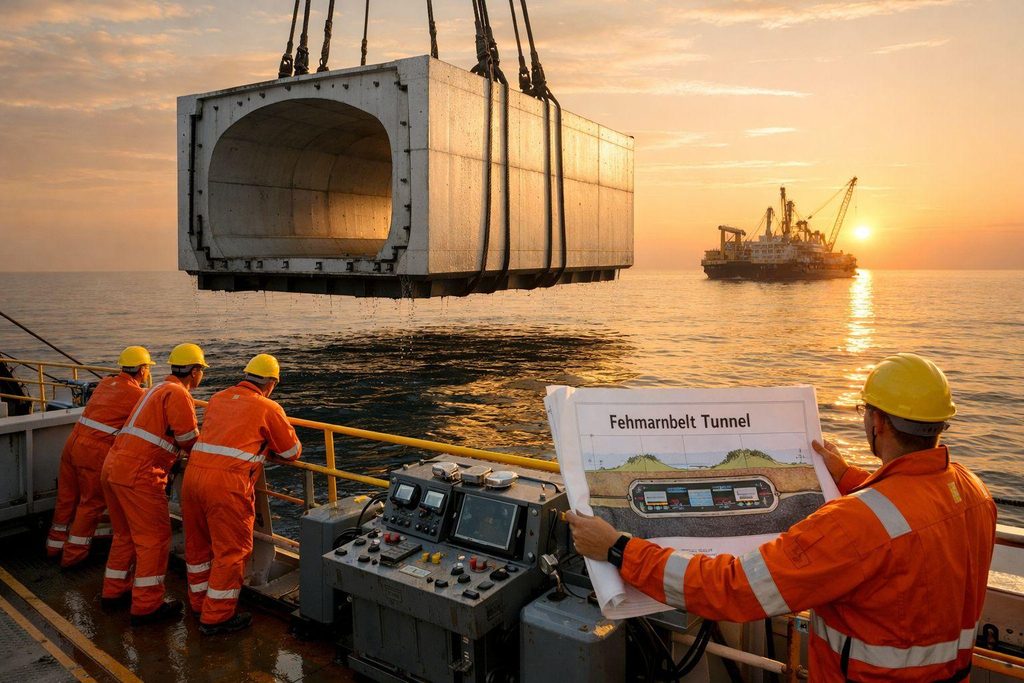
The answer is one of the most fascinating construction techniques in modern civil engineering: the immersed-tube tunnel.
Instead of excavating an underground passage using a massive tunnel-boring machine, engineers manufacture enormous tunnel sections on land, seal them, transport them across the water, and carefully lower them onto the seabed.
Once positioned, the sections are connected to form a continuous, watertight tunnel.
It sounds straightforward, but the engineering is extraordinarily complex.
Some tunnel sections weigh tens of thousands of tonnes. They must remain afloat during transportation, descend in a controlled manner, connect with extraordinary precision, and resist enormous forces from water, soil, and traffic throughout their operational life.
This construction method has been used on major infrastructure projects worldwide, including the Øresund Link between Denmark and Sweden and the Hong Kong–Zhuhai–Macao Bridge tunnel in China.
It is also the method being used to construct the approximately 18-kilometre Fehmarnbelt Tunnel between Denmark and Germany, which will become the world’s longest immersed road and railway tunnel when completed.
But how does immersed-tube construction actually work?
To understand this technology, we need to explore the engineering principles, construction methods, and challenges involved in building an underwater tunnel.
1. What Is an Immersed-Tube Tunnel?
An immersed-tube tunnel is an underwater passage constructed from prefabricated sections that are installed within a prepared trench beneath a waterway.
Unlike conventional bored tunnels, which are excavated through soil or rock, immersed tunnels are generally constructed in relatively shallow trenches.
Each section, known as a tunnel element, is manufactured separately.
The elements can be built from reinforced concrete, steel, or a combination of materials, depending on the design requirements.
After fabrication, they are transported to the installation location, lowered onto the prepared foundation, and connected underwater.
The finished tunnel is subsequently protected with backfill materials.
The result is a continuous structure capable of carrying vehicles, trains, or other transportation systems beneath a body of water.
Why use immersed-tube construction?
One major advantage is that much of the structural construction can take place outside the marine environment.
Manufacturing tunnel elements on land allows engineers to control concrete quality, reinforcement placement, dimensional accuracy, and production conditions.
Immersed tunnels can also follow relatively shallow alignments compared with some bored tunnels.
This is important because transportation tunnels require suitable approach gradients.
For railway tunnels, excessively steep gradients can restrict train operations and increase energy requirements.
A shallower tunnel alignment can reduce the length of approach structures in suitable circumstances.
However, immersed-tube construction is not appropriate for every project.
It requires suitable seabed conditions, space for marine construction, and careful management of environmental impacts.
Engineers must evaluate these factors before deciding whether an immersed tunnel is preferable to a bored tunnel or bridge.
2. Step One: Investigating the Seabed
Before engineers excavate anything, they must understand the ground beneath the water.
This begins with geotechnical and hydrographic investigations.
Geotechnical engineers collect information about seabed materials, soil strength, groundwater conditions, settlement characteristics, and potential geological hazards.
Investigations can include boreholes, soil sampling, laboratory testing, and geophysical surveys.
Hydrographic surveys establish the underwater topography.
These surveys identify water depths, seabed elevations, and features that could affect the tunnel alignment.
Engineers also investigate currents, tides, waves, shipping activity, and environmental conditions.
The collected information helps determine where the tunnel should be positioned and how its foundation should be designed.
Why soil conditions matter
An immersed tunnel does not simply rest on the seabed without preparation.
Its foundation must provide sufficiently uniform support.
If one section of the tunnel settles more than another, stresses may develop around the joints and structural connections.
Differential settlement is particularly important because a completed tunnel consists of multiple connected elements.
Even relatively small movements can affect joint performance and long-term durability.
Engineers therefore evaluate the expected settlement behaviour of the foundation soils and design the bedding accordingly.
For projects involving weak or compressible soils, ground improvement or other foundation measures may be necessary.
This illustrates an important principle of civil engineering: the performance of a structure depends not only on its concrete or steel but also on the ground supporting it.
3. Step Two: Excavating a Trench Underwater
Once the alignment has been established, construction begins with excavating a trench across the seabed.
This is typically accomplished using specialized dredging equipment.
Depending on the seabed conditions, contractors may employ backhoe dredgers, grab dredgers, trailing suction hopper dredgers, or other marine excavation systems.
These vessels remove sediment, sand, gravel, and other materials to create the required trench geometry.
The excavation must be deep enough to accommodate the tunnel elements, foundation bedding, and protective covering.
It must also be sufficiently wide to allow safe installation and placement of surrounding materials.
The Fehmarnbelt Tunnel example
The Fehmarnbelt Tunnel provides a remarkable example of the scale involved.
The project required an approximately 18-kilometre trench across the Baltic Sea.
The trench has an average depth of approximately 12 metres and an average width of around 100 metres.
Approximately 15 million cubic metres of seabed material were excavated.
To manage the enormous operation, specialized dredging vessels worked along the tunnel alignment.
Environmental monitoring was also necessary to control the effects of disturbed sediment.
Underwater excavation creates suspended particles that can spread through the surrounding water.
For that reason, marine construction requires monitoring systems and compliance with environmental restrictions.
Once the excavation is completed, engineers can begin preparing the tunnel foundation.
4. Step Three: Preparing the Tunnel Foundation
A tunnel element cannot simply be lowered into an excavated trench and expected to remain perfectly aligned.
It needs a properly prepared bearing surface.
Many immersed-tube tunnels use a gravel or sand foundation layer to establish the required support conditions.
The bedding material must be placed with carefully controlled thickness and elevation.
Specialized marine equipment is used to distribute the material along the trench.
Surveying and positioning systems verify the final geometry.
The purpose of the bedding is to provide reliable support beneath the massive structure.
Why foundation accuracy is critical
Imagine placing an enormous concrete tunnel section onto an uneven surface.
If the structure contacts the foundation at only a few locations, its weight may become concentrated in those areas.
This could create undesirable stresses or settlement.
A properly prepared foundation helps distribute loads and reduces the risk of excessive movement.
At the Fehmarnbelt Tunnel, a specialized vessel called Maya is used to prepare the gravel bedding.
The project also employs precise positioning systems to support the subsequent installation of tunnel elements.
However, the foundation is only one part of the process.
The next challenge is producing the enormous tunnel sections themselves.
5. Step Four: Manufacturing the Tunnel Elements
Immersed-tube tunnels rely on prefabrication.
Instead of building the underwater structure continuously in place, engineers manufacture individual tunnel sections within a controlled construction environment.
These elements may be produced in dry docks, casting basins, shipbuilding facilities, or purpose-built factories.
For reinforced-concrete elements, the process begins with assembling formwork and reinforcement.
The formwork determines the element’s dimensions and internal geometry.
Steel reinforcement is positioned to resist the forces that the concrete will experience during transportation, immersion, and long-term operation.
Concrete is then placed, compacted, cured, and inspected.
Quality control is especially important because repairing defects becomes considerably more difficult after installation underwater.
Why reinforced concrete?
Concrete performs well under compression, while embedded steel reinforcement provides additional tensile resistance and helps control cracking.
Together, the materials create structural systems capable of resisting complex loading conditions.
However, designing an immersed-tunnel element involves more than carrying traffic.
Engineers must consider different stages of its life.
During construction, the element may experience forces associated with lifting, movement, flotation, ballast, and immersion.
During operation, it must resist water pressure, soil loads, traffic loads, temperature effects, and possible ground movement.
These loading conditions are not identical.
Consequently, the temporary construction stages can be just as important as the final operating condition.
Manufacturing at the Fehmarnbelt Tunnel
The Fehmarnbelt Tunnel uses a purpose-built factory near Rødbyhavn in Denmark.
The project requires 79 standard tunnel elements, each approximately 217 metres long, plus ten special elements.
A standard element weighs approximately 73,000 tonnes.
Each standard element consists of nine concrete segments manufactured in a sequential production process.
This industrialized approach allows repeated elements to be constructed using standardized methods.
It also creates a predictable production system for an exceptionally large infrastructure project.
6. Step Five: Making a Massive Concrete Tunnel Float
At first glance, floating a concrete structure weighing tens of thousands of tonnes seems impossible.
Concrete is considerably denser than water.
Yet enormous concrete tunnel elements can float because of a fundamental principle of fluid mechanics: Archimedes’ principle.
This principle states that an object immersed in a fluid experiences an upward buoyant force equal to the weight of the fluid displaced.
The buoyant force can be expressed as:
F = ρ × g × V
Where:
- F = buoyant force, in newtons
- ρ = density of water, in kilograms per cubic metre
- g = gravitational acceleration, in metres per second squared
- V = volume of water displaced, in cubic metres
The important concept is that buoyancy depends on the amount of water displaced, not simply on the material from which the object is constructed.
A solid block of concrete usually sinks.
A large hollow concrete structure can float if its total weight is less than the weight of the water it displaces before becoming fully submerged.
This is similar to the principle that allows enormous steel ships to float.
Temporary bulkheads
Before transportation, engineers install watertight bulkheads at the ends of the tunnel element.
These temporary barriers prevent water from entering its internal compartments.
With the enclosed spaces kept dry, the element can provide sufficient displacement to remain afloat.
However, floating is only part of the challenge.
The structure must also remain stable.
Engineers calculate the centre of gravity, centre of buoyancy, and stability characteristics of the element.
Temporary ballast arrangements can be used to adjust its balance.
At Fehmarnbelt, the road tubes are heavier than the railway tubes, creating an uneven weight distribution.
Temporary water chambers help compensate for this difference during installation.
This ensures that the element can remain correctly oriented as it moves through the water.
7. Step Six: Transporting the Tunnel Element
After a tunnel element has passed the required inspections, it is moved to the marine construction area.
Depending on the project, transport may involve tugboats, barges, pontoons, or specialized immersion vessels.
The element must be carefully controlled throughout the journey.
Even when moving slowly, a structure hundreds of metres long responds to currents, wind, waves, and towing forces.
Engineers must evaluate these influences to prevent excessive movement or instability.
Marine operations are normally planned around suitable weather and sea conditions.
Positioning systems and surveying equipment are used to monitor the element throughout transportation.
Specialized marine equipment
For the Fehmarnbelt project, engineers developed a dedicated immersion system known as IVY.
The system uses specialized pontoons to support and lower the tunnel elements.
During the first immersion operation in May 2026, five tugboats transported the approximately 217-metre-long element toward the installation area.
This movement was only one stage of a much larger operation.
Once the element reached the correct location, engineers prepared it for controlled immersion.
8. Step Seven: Lowering the Element Into the Trench
The immersion stage requires an extraordinary degree of precision.
Engineers must lower a massive tunnel section from the water surface into its final underwater position.
The element is supported and controlled by specialized immersion equipment.
Its effective weight is adjusted through ballast systems, while lowering equipment regulates its descent and orientation.
As water is added to ballast tanks or other ballast arrangements are adjusted, the balance between weight and buoyant force changes.
When the element becomes sufficiently heavy, it can be lowered under controlled conditions.
Why not simply let it sink?
Allowing a tunnel element to descend freely would be extremely dangerous.
A structure weighing tens of thousands of tonnes could strike the foundation, rotate, or damage an adjoining tunnel element.
Instead, engineers maintain control of the descent.
The structure must be positioned vertically and horizontally while maintaining its designed orientation.
Surveying systems help track the element’s location.
Underwater cameras and remotely operated equipment may assist with monitoring.
At Fehmarnbelt, specialized equipment allows the large elements to be positioned with extremely tight tolerances.
The first tunnel element was successfully immersed in May 2026.
The lowering process took approximately 14 hours, after which the element was connected to the Danish tunnel portal.
For the construction team, this represented the successful completion of years of planning, fabrication, and engineering preparation.
9. Step Eight: Connecting the Tunnel Elements Underwater
Once an element reaches its correct position, engineers must connect it to the previously installed section.
This is one of the most important stages of the entire process.
An immersed tunnel must form a continuous watertight structure.
Any significant failure at a joint could allow water to enter the tunnel.
The connection therefore relies on carefully designed sealing systems.
How underwater tunnel joints work
In a typical immersed-tube connection, the new element is brought into contact with the previous one.
A rubber gasket provides an initial seal.
The space between the temporary bulkheads is then pumped dry.
As the pressure inside this intermediate space decreases, the surrounding water pressure pushes the new element toward the adjoining structure.
This compresses the gasket and helps establish the watertight connection.
This is a remarkable application of hydrostatic pressure.
The same water pressure that presents a major challenge to tunnel construction can also assist the sealing process.
After the connection has been verified, the construction team can remove the necessary temporary bulkheads and complete the internal structural connections.
Additional sealing and structural measures depend on the particular tunnel design.
Why joint movement matters
Tunnel elements are not completely immune to movement.
Temperature variations, settlement, concrete shrinkage, and other effects can introduce movement or deformation.
The joint system must be designed with these conditions in mind.
Engineers also evaluate the potential effects of long-term loading and foundation behaviour.
Successful joint engineering is therefore essential for both immediate watertightness and long-term durability.
10. Step Nine: Backfilling and Protecting the Tunnel
After an element has been connected, engineers place suitable materials around it.
Gravel, sand, and rock may be used to stabilize and protect the structure.
Backfilling helps fill the excavated trench and provide lateral support.
Protective layers above the tunnel can also reduce exposure to external hazards such as erosion or accidental mechanical damage, according to the site-specific design.
The placement of these materials must be carefully controlled.
Uneven backfilling can create undesirable loading conditions.
Engineers therefore use specialized equipment to distribute materials around the structure.
At Fehmarnbelt, the construction fleet includes equipment dedicated to placing gravel around the elements and laying protective stone layers above them.
Once completed, the immersed structure is buried beneath the waterway.
Although it may disappear from view, it remains a complex engineered structure carrying significant external loads.
11. How Do Immersed Tunnels Resist Water Pressure?
Water pressure increases with depth.
The approximate hydrostatic pressure created by a stationary water column can be calculated using:
P = ρ × g × h
Where:
- P = gauge water pressure, in pascals
- ρ = water density
- g = gravitational acceleration
- h = depth below the water surface
For example, at a depth of 20 metres in freshwater:
P = 1,000 × 9.81 × 20
P = 196,200 pascals
This is approximately 196 kilopascals of gauge pressure.
That is almost twice standard atmospheric pressure as an additional pressure acting at that depth.
Actual tunnel loading depends on the depth of each structural surface, groundwater conditions, soil pressures, and the geometry of the surrounding ground.
The example above illustrates hydrostatic pressure alone.
How engineers manage these forces
The reinforced-concrete structure must have sufficient capacity to resist the required combinations of loads.
Engineers assess bending moments, shear forces, axial forces, cracking, and long-term deformation.
The tunnel must also remain stable against uplift.
If the total upward forces exceed the resisting weight and other stabilizing effects, the structure could become unstable.
For this reason, the design considers the weight of the tunnel, backfill materials, groundwater pressures, and relevant safety factors.
Waterproofing is equally important.
Engineers use carefully designed concrete mixtures, crack-control reinforcement, engineered joints, and sealing systems to reduce the risk of leakage.
Long-term maintenance and monitoring are also essential.
An underwater tunnel is expected to function reliably for decades, so durability must be considered from the earliest design stages.
12. Immersed-Tube Tunnels vs Bored Tunnels
Both immersed and bored tunnels can provide effective underwater crossings.
However, the construction methods have different advantages and limitations.
Immersed-tube tunnels
Potential advantages:
- Much of the structural construction occurs in controlled conditions.
- Can provide relatively shallow crossing alignments.
- Suitable for wide cross-sections carrying multiple transport systems.
- Allows substantial prefabrication and quality control.
Potential disadvantages:
- Requires substantial marine construction operations.
- Disturbs the seabed during trench excavation.
- Requires carefully controlled underwater connections.
- Can affect shipping and marine activities during construction.
Bored tunnels
Bored tunnels are excavated beneath the ground using tunnel-boring machines or other underground excavation techniques.
Potential advantages:
- Can avoid continuous open-trench excavation across the waterway.
- May reduce direct disturbance to sensitive seabed areas.
- Can pass through deeper geological formations.
- May be preferable where marine excavation is impractical.
Potential disadvantages:
- May require longer or steeper approach alignments.
- Ground conditions can create significant excavation risks.
- Large tunnel-boring machines and underground support systems are expensive.
- Construction logistics, ground treatment, and emergency access can be complex.
Neither method is automatically superior.
The final decision depends on geology, water depth, environmental restrictions, transportation requirements, construction costs, and risk.
The Fehmarnbelt Tunnel illustrates how immersed-tube construction can be selected for a major international transportation corridor.
13. What Can Civil Engineering Students Learn From Immersed Tunnels?
Immersed-tube construction brings together several fundamental civil engineering disciplines.
Structural engineering: Engineers analyze reinforced-concrete elements subjected to changing loads throughout fabrication, flotation, immersion, and operation.
Geotechnical engineering: Ground investigations, foundation preparation, settlement analysis, and soil–structure interaction are critical.
Hydraulic and marine engineering: Buoyancy, stability, currents, hydrostatic pressure, and marine operations influence the construction process.
Construction engineering: Prefabrication, concrete quality control, specialized equipment, temporary works, and installation sequencing must be coordinated.
Transportation engineering: Road and railway geometry, gradients, operating speeds, emergency systems, and traffic capacity influence the overall design.
Project management: Complex interfaces between factories, marine contractors, engineering teams, and government authorities require detailed scheduling, risk management, and communication.
One particularly useful lesson is that temporary construction conditions can govern major design decisions.
A tunnel element must perform safely when it is being manufactured, when it is floating, when it is being lowered, and when it is finally buried.
These stages may impose very different structural and stability requirements.
Understanding those changing conditions is essential when designing large infrastructure.
Conclusion: Building a Tunnel Without Digging Through the Seabed
Immersed-tube tunnels demonstrate how engineers can combine simple physical principles with sophisticated construction technology.
At the centre of the method is an ingenious concept: build the tunnel in sections on land, float those sections into position, lower them into a prepared underwater trench, and connect them into a continuous structure.
But delivering that concept at full scale requires extraordinary engineering precision.
The foundation must be prepared accurately.
The concrete elements must be manufactured to demanding standards.
Buoyancy and stability must be carefully controlled.
Marine operations must achieve precise positioning.
And the completed tunnel must remain structurally stable and watertight throughout its intended service life.
The Fehmarnbelt Tunnel demonstrates these challenges on a remarkable scale.
With its approximately 18-kilometre alignment, massive concrete elements, specialized immersion equipment, and combined road and railway infrastructure, the project represents one of the most ambitious applications of immersed-tube construction.
For civil engineering students, it provides an excellent real-world application of fluid mechanics, structural design, geotechnical engineering, and construction management.
For engineers and construction professionals, it highlights the importance of multidisciplinary coordination and careful planning.
And for anyone fascinated by megaprojects, it demonstrates that some of the world’s most impressive tunnels are not excavated underground.
They are manufactured above ground and assembled beneath the water.
Explore More Engineering With VCE Build
At VCE Build, we explain the engineering, construction techniques, and technical decisions behind the world’s most extraordinary structures and megaprojects.
Explore our YouTube channel for engaging engineering explanations, infrastructure documentaries, and construction breakdowns.
For deeper technical knowledge, join VCE Build on Patreon.
Our members can access illustrated engineering case studies, downloadable learning resources, construction tutorials, and professional project analyses according to their membership tier.
VCE Build — Understand the Engineering. Learn the Construction. Explore the Megaprojects.
No responses yet