Japan is home to some of the world’s most advanced skyscrapers. Several of these are located in the world’s seismically active regions. Situated along the Pacific Ring of Fire, Japan experiences thousands of earthquakes every year, including some of the most powerful seismic events ever recorded. For example, in 2011, a magnitude 9.1 Earthquake was recorded in Tōhoku, Japan – It was named The Great Tōhoku earthquake. It killed more than 15000 people and displaced 130,000 more. Yet despite these constant geological threats, Japan has developed a global reputation for constructing skyscrapers that can withstand significant earthquakes while protecting lives and minimizing structural damage.
The ability of Japanese skyscrapers to survive powerful seismic events is not the result of a single technological breakthrough. Instead, it stems from decades of research, engineering innovation, strict building regulations, architectural evolution, and substantial economic investment. From sophisticated foundation systems to massive damping devices hidden within towers, Japan has transformed earthquake-resistant construction into a science.
This article explores how Japan builds earthquake-proof skyscrapers by examining the history, engineering principles, geography, economics, architecture, innovative construction methods, and foundation designs that make these remarkable structures possible.
The Historical Evolution of Earthquake-Resistant Construction in Japan
Japan’s relationship with earthquakes has shaped its architecture for centuries. Traditional Japanese buildings were often constructed using timber frames that could flex and absorb seismic movement. Unlike rigid masonry structures common in Europe, wooden temples and homes were designed with flexibility in mind.
One of the most famous examples is the Horyu-ji Temple near Nara, which has survived for more than 1,300 years despite numerous earthquakes. One of the many reasons why it has survived multiple earthquakes is because the way its central wooden column was designed. Known as a shinbashira, the central pillar allows the structure to sway independently and dissipate seismic energy due to its flexible, interlocking timber joinery. This allows the segment to slither and absorb the seismic shock. Also, its layered, independent floors act independently during a tremor. The temple’s deep, heavy eaves and broad , heavy roofs cause inertia. This generates forces during earthquakes that make the building sway rather than violently shake, preventing the structure from tipping over.
Modern earthquake engineering in Japan has accelerated after several devastating disasters. The Great Kanto Earthquake of 1923, which killed over 140,000 people and destroyed much of Tokyo and Yokohama, exposed the vulnerability of urban infrastructure. This catastrophe led to the first major seismic building regulations.
Because most of the causalities and destructions of this earthquake were caused by firestorms, several amendments to Japan’s Urban Building Law and its building codes were made to ensure these preventable factors were reduced. This led to several modern seismic standards.
Further advances followed the 1964 Niigata Earthquake, which revealed the dangers of soil liquefaction, and the 1995 Great Hanshin (Kobe) Earthquake, which caused extensive damage and resulted in over 6,000 deaths. The Kobe disaster became a turning point in Japanese engineering, leading to stricter building codes and the widespread adoption of advanced seismic technologies.
Today, Japan possesses some of the most rigorous earthquake-resistant construction standards in the world. Every major seismic event contributes new data, helping engineers continuously refine building practices and improve structural resilience.
Why Geography Makes Earthquake-Proof Design Essential
Japan’s geography is the primary reason why earthquake-resistant construction is such a national priority.
The country sits at the intersection of four major tectonic plates:
- Pacific Plate
- Philippine Sea Plate
- Eurasian Plate
- North American Plate
The constant interaction of these plates generates frequent seismic activity. Japan experiences approximately 1,500 earthquakes annually that are strong enough to be felt by people living there.
Major urban centers such as Tokyo, Osaka, Nagoya, and Yokohama are located in regions with significant seismic risk. Since these metropolitan areas contain millions of residents and some of the world’s most valuable real estate, constructing buildings capable of surviving earthquakes is not optional—it is a necessity.
Japan’s mountainous terrain also concentrates development into limited urban areas, forcing cities to build vertically. Skyscrapers therefore become essential components of urban growth, requiring highly advanced engineering solutions to coexist with seismic hazards.
Core Engineering Principles Behind Earthquake-Proof Skyscrapers
Earthquake-resistant skyscraper design relies on several fundamental engineering principles.
Flexibility Instead of Rigidity
One of the most important concepts in seismic engineering is that buildings should move rather than resist movement entirely.
Earthquakes generate horizontal and vertical forces that travel through the ground and into structures. If a building is too rigid, it will behave poorly during earthquakes because it will not be able to properly dissipate kinetic energy. While rigid buildings reduce large structural swaying, this excessive stiffness leads to massive internal stresses. As a result, the building will be more likely to experience brittle failures, cracking and eventual structural collapse.
Japanese skyscrapers, in seismically active zones must be designed to flex and sway safely. Engineers carefully calculate how much movement a building can tolerate and incorporate systems that allow controlled deformation without structural failure.
Energy Dissipation
Another key principle involves reducing the amount of seismic energy transmitted through the building.
Specialized devices known as dampers absorb and dissipate energy generated during an earthquake. These systems function similarly to shock absorbers in automobiles, reducing structural stress and limiting excessive movement.
Redundancy
Japanese structural design emphasizes redundancy. Critical structural elements are duplicated so that if one component fails, others can continue carrying loads.
This approach ensures that buildings maintain stability even during extreme seismic events.
Ductility
Materials used in earthquake-resistant construction must deform without breaking.
High-strength steel and reinforced concrete are designed to bend and absorb energy rather than fracture suddenly. This characteristic, known as ductility, provides additional protection against structural collapse.
Architecture Designed for Seismic Survival
Architects and engineers collaborate closely in Japan to ensure skyscrapers achieve both aesthetic and structural goals.
Modern Japanese skyscrapers often feature forms that reduce seismic vulnerability. Symmetrical floor plans, balanced mass distribution, and streamlined geometries help minimize torsional forces during earthquakes.
Architectural designs are frequently informed by advanced computer simulations that model how buildings will behave during seismic events. These simulations allow teams to identify weaknesses before construction begins.
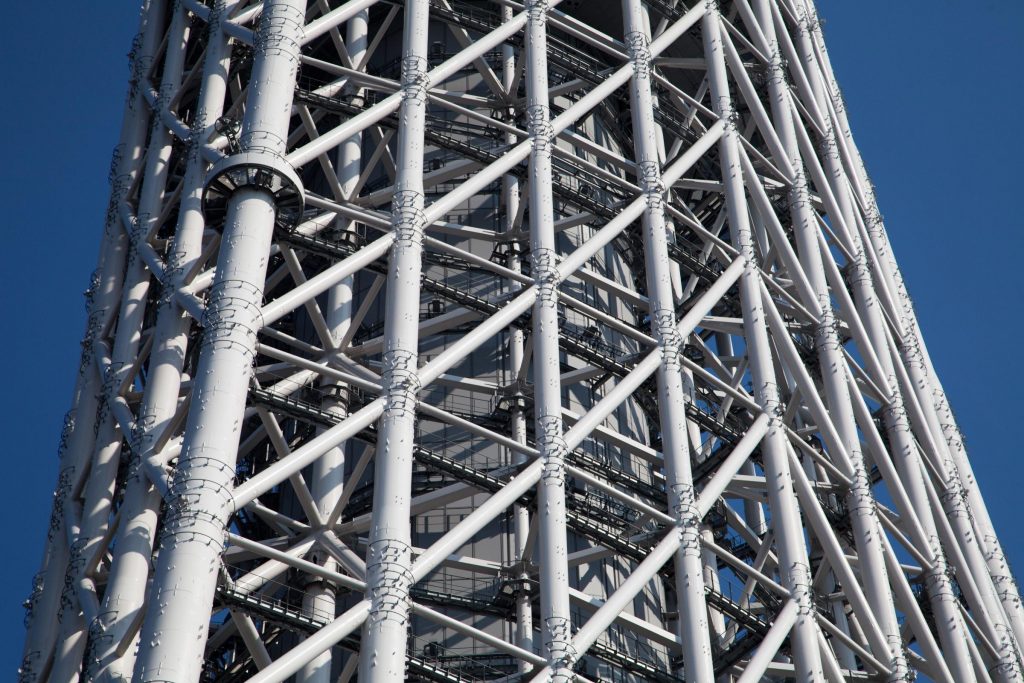
Many contemporary towers incorporate visible structural elements as architectural features. Mega-columns, diagonal bracing systems, and exposed steel frameworks often contribute both to aesthetics and earthquake resistance.
Tokyo Skytree, for example, incorporates traditional Japanese engineering concepts inspired by ancient pagodas while using state-of-the-art materials and technologies. Its central reinforced concrete core functions similarly to the ancient shinbashira, helping stabilize the structure during earthquakes.
Innovative Technologies Used in Japanese Skyscrapers
Japan has pioneered several innovative methods that significantly improve seismic performance.
Base Isolation Systems
Base isolation is among the most effective earthquake-resistant technologies available today.
Instead of attaching a building directly to its foundation, engineers place flexible bearings between the structure and the ground. These bearings may consist of:
- Rubber layers
- Steel plates
- Lead-core bearings
- Sliding mechanisms
When an earthquake occurs, the ground moves while the building remains relatively stable.
Base isolation can reduce seismic forces transmitted into a structure by up to 80%, making it particularly effective for hospitals, government facilities, and high-value commercial buildings.
Tuned Mass Dampers
Many Japanese skyscrapers contain enormous tuned mass dampers near their upper levels.
A tuned mass damper is a massive weight suspended within the building. During an earthquake, the weight moves in the opposite direction of the building’s motion, counteracting sway and improving stability.
Some dampers weigh hundreds of tons and are carefully calibrated to match the building’s natural frequency.
Active and Semi-Active Control Systems
Japan has also developed intelligent seismic technologies that respond in real time.
Sensors throughout a building continuously monitor vibrations. Computerized systems analyze incoming seismic waves and adjust dampers accordingly, optimizing performance during an earthquake.
These systems represent one of the most advanced applications of structural engineering in the world.
Oil Dampers and Viscous Dampers
Oil-filled dampers absorb energy through fluid resistance.
As a building moves, hydraulic pistons force fluid through narrow chambers, converting seismic energy into heat. This process reduces structural motion and protects critical components from damage.
Many modern skyscrapers in Tokyo rely heavily on viscous damping systems to achieve superior seismic performance.
Foundation Design: The Hidden Hero of Earthquake Resistance
While attention often focuses on visible structural systems, foundation design plays an equally critical role in earthquake resilience.
Deep Pile Foundations
Many Japanese skyscrapers are supported by deep pile foundations extending dozens of meters into stable soil or bedrock.
These piles transfer building loads past weaker surface soils and provide greater resistance to seismic forces.
Depending on site conditions, engineers may use:
- Reinforced concrete piles
- Steel pipe piles
- Composite pile systems
Addressing Soil Liquefaction
Liquefaction occurs when saturated soils temporarily lose strength during seismic shaking, behaving like a liquid.
The 1964 Niigata Earthquake demonstrated the destructive potential of liquefaction when entire buildings tilted or sank into the ground.
Modern Japanese engineers employ several methods to mitigate this risk:
- Soil compaction
- Deep soil mixing
- Gravel drains
- Ground improvement techniques
- Chemical stabilization
These methods strengthen soils before construction begins.
Raft Foundations
Large skyscrapers often use raft foundations, which distribute loads across extensive areas.
Combined with deep piles, raft systems improve overall stability while reducing differential settlement during seismic events.
Foundation Monitoring Systems
Many high-rise buildings incorporate sensors within their foundations to monitor movement, stress, and soil behavior over time.
This continuous monitoring allows engineers to assess structural health and respond proactively if issues emerge.
The Economics of Building Earthquake-Proof Skyscrapers
Constructing earthquake-resistant skyscrapers requires substantial investment.
Advanced seismic technologies, specialized materials, extensive testing, and rigorous quality control all increase construction costs.
In some cases, seismic protection systems may add 5% to 20% to a project’s total budget. However, Japanese developers view these expenditures as essential rather than optional.
The economic benefits include:
- Reduced repair costs after earthquakes
- Lower insurance risks
- Improved occupant safety
- Enhanced property values
- Business continuity after disasters
For a country that regularly experiences major seismic events, the long-term economic advantages far outweigh the initial investment.
Government regulations also reinforce this approach by requiring strict compliance with seismic standards. Developers who meet or exceed these requirements gain greater confidence from investors, tenants, and insurers.
The Role of Building Codes and Regulations
Japan’s building regulations are among the most comprehensive in the world.
Current codes require structures to satisfy multiple performance objectives:
Level 1 Earthquakes
Buildings must remain fully operational during moderate earthquakes with little or no damage.
Level 2 Earthquakes
Structures must avoid collapse during severe earthquakes, even if repairs become necessary afterward.
Engineers conduct extensive analyses using advanced computer models, physical testing, and wind tunnel studies before receiving approval.
Regulatory oversight ensures that every skyscraper meets stringent safety standards before construction begins.
Real-World Success Stories
The effectiveness of Japan’s earthquake engineering is demonstrated by real-world events.
During the 2011 Tohoku Earthquake, one of the strongest earthquakes ever recorded, many modern skyscrapers in Tokyo experienced significant swaying but remained structurally intact.
Occupants reported movement lasting several minutes, yet widespread high-rise collapses did not occur.
Similarly, numerous skyscrapers survived recent seismic events with minimal structural damage thanks to advanced engineering systems.
These successes validate decades of research and investment in earthquake-resistant design.
The Future of Earthquake-Proof Construction
Japan continues to push the boundaries of seismic engineering.
Emerging technologies include:
- AI-driven structural monitoring
- Smart materials that adapt to stress
- Advanced carbon-fiber reinforcement
- Next-generation damping systems
- Real-time earthquake response networks
Researchers are also exploring biomimicry, drawing inspiration from nature to develop structures that respond more effectively to seismic forces.
As urban populations grow and climate-related hazards increase, Japan’s innovations are influencing construction practices worldwide.
Countries including the United States, Chile, New Zealand, Taiwan, and Turkey increasingly adopt Japanese seismic technologies and design philosophies.
Conclusion
Japan’s earthquake-proof skyscrapers represent one of humanity’s greatest engineering achievements. Built in one of the world’s most seismically active regions, these structures combine centuries of architectural wisdom with cutting-edge technology to protect millions of people.
Their success stems from a comprehensive approach that integrates geography, engineering, architecture, economics, foundation design, strict regulations, and continuous innovation. Through flexible structural systems, base isolation technologies, advanced dampers, deep foundations, and rigorous building standards, Japanese engineers have transformed seismic resilience into a cornerstone of modern urban development.
As cities worldwide confront increasing risks from natural disasters, Japan’s methods offer a powerful model for creating safer, more resilient skyscrapers capable of withstanding the forces of nature while supporting sustainable urban growth.
No responses yet