In the late 1920s, New York City became the stage for one of the most extraordinary competitions in architectural history. The battle wasn’t fought with weapons or armies, but with steel, concrete, engineering ingenuity, and relentless ambition. Corporations, developers, and wealthy industrialists competed to reshape the Manhattan skyline, each hoping to leave behind a monument that would define an era.
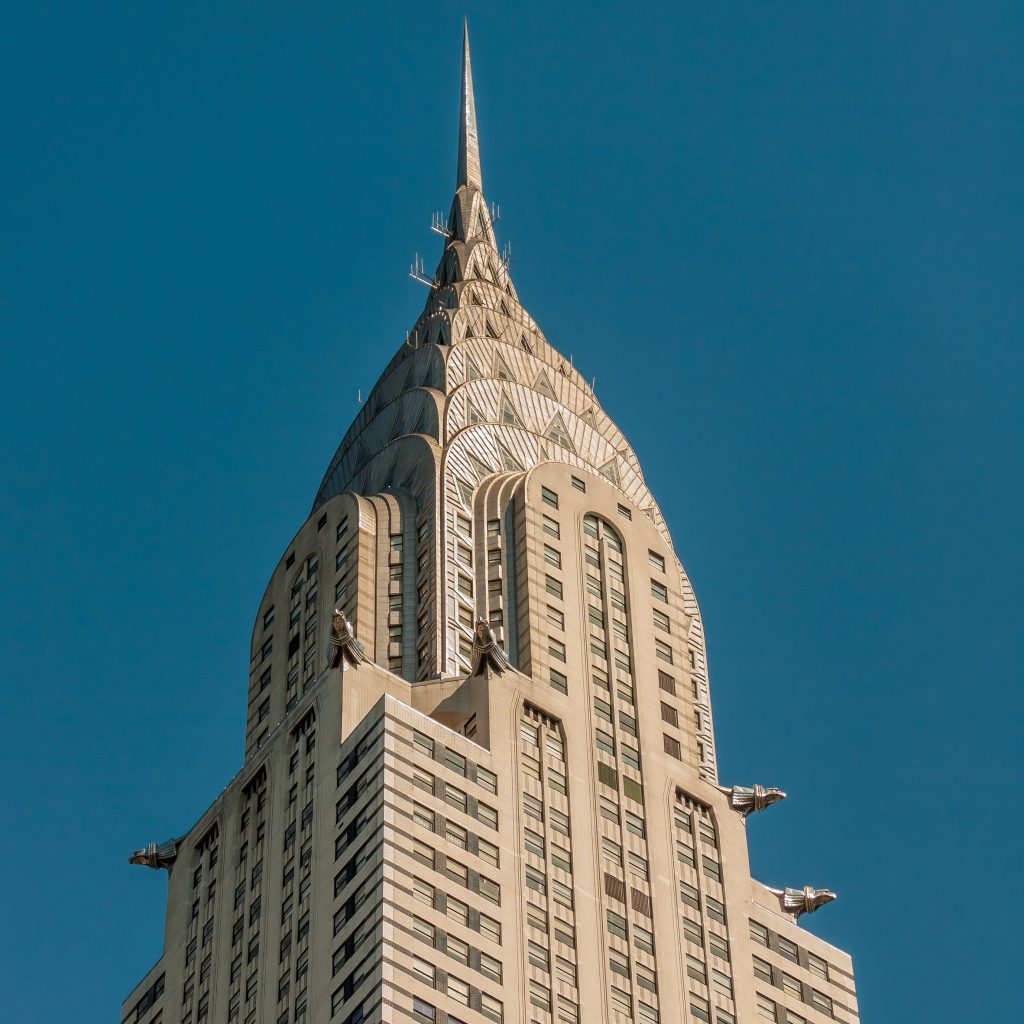
At the center of this race stood a building that would become one of the most beloved landmarks in the world: the Chrysler Building.
Today, its gleaming stainless-steel crown and elegant Art Deco design make it one of the most recognizable skyscrapers ever constructed. Yet the Chrysler Building was never intended to be merely beautiful. It was conceived as a symbol of power, a statement of corporate prestige, and a monument to one man’s vision.
Nearly a century after its completion, the building remains an enduring symbol of innovation, ambition, and the belief that there were no limits to what America could achieve.
The City That Reached for the Sky
Before skyscrapers transformed Manhattan, New York faced a simple problem: there was nowhere left to expand.
As immigration surged, industries flourished, and land values soared during the late nineteenth century, the city was forced to look upward. Fortunately, technological innovations made vertical growth possible.
The development of steel-frame construction revolutionized architecture. Unlike traditional masonry buildings, which relied on thick load-bearing walls, steel skeletons could support enormous weight while remaining relatively lightweight. Suddenly, buildings could rise far higher than ever before.
Another critical breakthrough came with the invention of the modern elevator. When Elisha Otis demonstrated his revolutionary safety elevator in 1854, he solved one of urban architecture’s greatest challenges. No longer were upper floors inconvenient or inaccessible. Instead, they became the most desirable locations in a building.
By the early twentieth century, developers understood that height translated into prestige, visibility, and profit. Skyscrapers became powerful business tools, and the skyline itself evolved into a form of advertising.
Then came the Roaring Twenties.
Wall Street boomed. Jazz clubs flourished. Automobiles transformed American life. Wealth flowed freely, and New York entered an unprecedented era of optimism and speculation.
No industry better represented this new age than the automobile business.
And no businessman embodied its spirit more than Walter P. Chrysler.
Walter Chrysler’s Monument
Unlike many industrial titans of his era, Walter Chrysler did not come from wealth or privilege.
Born in Kansas in 1875, he began his career as a railroad mechanic. He understood machinery from the ground up, spending years working directly with engines and tools before entering corporate leadership.
His technical expertise and business instincts helped him rise rapidly through the automotive industry. After helping revive Buick, he founded the Chrysler Corporation in 1925. Within a few years, Chrysler had become one of the largest automobile manufacturers in the world.
But financial success was not enough.
Like many industrialists of the 1920s, Chrysler understood the power of public image. Headquarters buildings were becoming symbols of corporate strength, and companies increasingly viewed architecture as a form of branding.
For Walter Chrysler, the project became deeply personal.
Rather than constructing a building solely for his corporation, he financed much of the project himself, intending it to become a lasting family legacy. The Chrysler Building would serve as both a headquarters and a monument.
To bring his vision to life, he hired architect William Van Alen.
The Art Deco Revolution
William Van Alen was unlike many architects of his generation.
Influenced by European modernism and trained in the Beaux-Arts tradition, Van Alen believed architecture should celebrate speed, technology, and the machine age.
His design embraced the emerging Art Deco movement, which rejected the heavy ornamentation of previous eras in favor of geometric forms, metallic surfaces, symmetry, and modern elegance.
The Chrysler Building became the ultimate expression of Art Deco architecture.
Automobile-inspired details appeared throughout the structure. The famous eagle gargoyles were modeled after Chrysler hood ornaments. Decorative elements echoed radiator caps and wheel designs. Every feature reinforced the identity of the automobile empire that inspired it.
Yet the building’s most remarkable feature was its crown.
Van Alen proposed covering the upper section in stainless steel, a daring and unconventional choice at the time. The reflective metal transformed the building into a beacon that shimmered across the Manhattan skyline.
Critics were divided.
Some praised the design as revolutionary.
Others considered it excessive.
No one ignored it.
The Secret Race for the World’s Tallest Building
As construction progressed, the Chrysler Building became involved in an intense rivalry with another skyscraper project: 40 Wall Street.
Both developers wanted the same title—the tallest building in the world.
Plans were revised repeatedly as each side attempted to outdo the other. Newspapers followed the competition closely, turning it into a public spectacle.
For months, it appeared that 40 Wall Street would claim victory.
Then William Van Alen unveiled one of the greatest architectural surprises in history.
Unknown to competitors, a massive stainless-steel spire had been secretly assembled inside the Chrysler Building. On October 23, 1929, workers raised the spire through the roof and completed its installation in just a few hours.
With a final height of 1,046 feet, the Chrysler Building became the tallest structure on Earth.
The victory stunned the world.
Unfortunately, it arrived at a tragic moment.
Only days later, the stock market crashed.
The Great Depression had begun.
Building the Impossible
Constructing the Chrysler Building required extraordinary engineering and coordination.
Workers completed approximately four floors per week—an astonishing pace for the era. Thousands of laborers, engineers, electricians, riveters, crane operators, and craftsmen worked together in carefully orchestrated sequences.
The building’s steel framework anchored deep into Manhattan’s bedrock, allowing it to withstand immense loads and powerful winds.
Construction, however, came with significant risks.
Ironworkers routinely balanced on narrow steel beams hundreds of feet above the streets below. Safety standards were minimal by modern standards, and accidents were common throughout skyscraper construction during this period.
Many workers were immigrants seeking economic opportunity, while others belonged to Native American Mohawk communities renowned for their fearlessness at great heights.
The Chrysler Building was not merely an engineering achievement.
It was a human achievement.
Thousands of workers left their mark on the structure, helping create one of the world’s most iconic buildings.
The Crown That Defines New York
Few architectural features are as recognizable as the Chrysler Building’s stainless-steel crown.
Clad in Nirosta steel, the crown resists corrosion while reflecting sunlight in constantly changing patterns. At sunrise it glows silver. At sunset it radiates gold. At night, illuminated windows transform it into a luminous beacon above Manhattan.
The crown’s layered arches and triangular windows create a sense of movement rarely seen in architecture.
Rather than appearing static, the building seems to surge upward, embodying the speed and optimism of the machine age.
Nearly a century later, it remains one of the most admired skyscraper crowns ever designed.
A Symbol Beyond Architecture
When the Chrysler Building opened in 1930, it arrived during one of the darkest economic periods in American history.
The optimism of the Roaring Twenties had vanished almost overnight. Businesses collapsed, banks failed, and unemployment soared.
Yet despite these challenges, the building endured.
Over time, it evolved from a corporate headquarters into a cultural icon.
Its distinctive silhouette appeared in countless films, television shows, advertisements, and photographs. From Spider-Man to Men in Black, the Chrysler Building became visual shorthand for New York itself.
Unlike many skyscrapers, it inspired genuine affection.
People didn’t simply recognize it.
They admired it.
The Legacy of the Chrysler Building
The Chrysler Building held the title of the world’s tallest building for less than a year before the Empire State Building surpassed it.
But history delivered a different verdict.
While taller buildings have come and gone, few have captured the public imagination in the same way.
Architects frequently describe it as the most beautiful skyscraper ever built. Historians regard it as the pinnacle of Art Deco design. Visitors continue to stop and stare nearly a century after its completion.
The building represents far more than steel, glass, and stone.
It embodies human ambition.
It reflects a generation determined to leave its mark on the world.
And every morning, as sunlight strikes its stainless-steel crown, the Chrysler Building continues to remind New York—and the world—of a remarkable era when reaching for the sky seemed limitless.
No responses yet