Infrastructure has always shaped civilizations.
Roads built empires. Canals powered industrial revolutions. Railways stitched nations together. And in the 21st century, major transportation megaprojects continue to redefine how economies function and how regions develop.
Austria’s Koralm Railway, known as the Koralmbahn, is one of those transformative projects.
Stretching approximately 130 kilometers between Graz and Klagenfurt, this new high-speed railway is far more than a transportation upgrade. It is a case study in modern civil engineering, regional economic planning, and sustainable mobility. By reducing travel times from nearly three hours to just 41 to 45 minutes, the project demonstrates how infrastructure can alter geography itself—not physically, but functionally.
With an investment of around €5.9 billion, the railway includes some of Europe’s most sophisticated rail engineering, highlighted by the 33-kilometer Koralm Tunnel, one of the world’s longest railway tunnels.
Yet its significance extends beyond engineering achievement.
The Koralm Railway illustrates how strategic infrastructure can unlock productivity, improve freight efficiency, strengthen regional integration, and support broader European transport goals.
Understanding why this project matters requires looking not only at what was built, but what problems it solves.
Why Southern Austria Needed a New Railway
Before the Koralm Railway, travel between Graz and Klagenfurt was surprisingly inefficient.
Despite being major urban centers in southern Austria, the two cities were separated by mountainous terrain and aging rail alignments that forced indirect routing. Existing routes followed topography rather than overcoming it, resulting in long travel times and operational limitations.
Rail journeys often took around three hours.
For passengers, that meant poor competitiveness with road transport.
For freight operators, it meant inefficiency.
For regional economies, it meant a structural bottleneck.
Transportation bottlenecks impose costs that are often invisible.
They reduce labor mobility.
They limit business interaction.
They increase logistics costs.
They constrain growth.
In many ways, the Koralm Railway was conceived not simply to shorten a journey, but to remove a long-standing economic barrier.
What Is the Koralm Railway?
The Koralmbahn is a newly built double-track electrified high-speed railway designed for speeds up to 250 kilometers per hour.
It forms part of Austria’s New Southern Railway and serves both passenger and freight traffic.
Its major features include:
130 kilometers of new rail infrastructure
Operating speeds up to 250 km/h
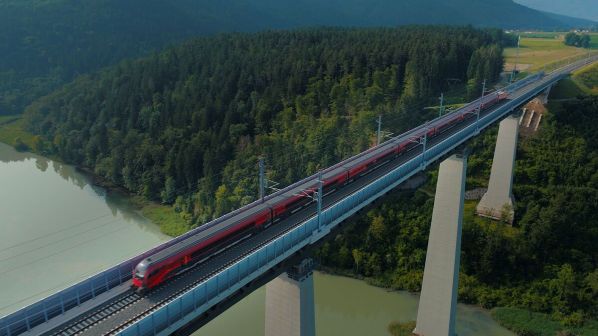
More than 100 bridges
Approximately 50 kilometers of tunnels
Advanced signaling and rail control systems
The 33-kilometer Koralm Tunnel
Travel times reduced to roughly 41–45 minutes
While these specifications are impressive on their own, what makes the project remarkable is how all these components function together as a single integrated system.
This is not simply faster track.
It is an entirely new mobility corridor.
The Engineering Importance of the Koralm Tunnel
At the center of the project lies the Koralm Tunnel.
At nearly 33 kilometers in length, it is Austria’s longest railway tunnel and among the longest rail tunnels globally.
Its engineering significance is enormous.
Rather than forcing trains over mountainous terrain, the tunnel allows them to pass beneath it through a low-gradient base alignment.
That matters because steep gradients are problematic for railways, especially freight.
Lower gradients improve:
Energy efficiency
Train speeds
Freight hauling capability
Operational reliability
Maintenance efficiency
This is why base tunnels are often considered transformative infrastructure.
They do not merely improve routes.
They redefine them.
Engineering Challenges
Constructing a tunnel of this scale required solving multiple technical problems:
Geological instability
Water ingress
Rock pressure management
Tunnel ventilation
Emergency evacuation design
High-speed pressure dynamics
Long-term maintenance planning
The tunnel consists of twin single-track tubes connected by safety cross passages.
This design improves operational resilience and emergency safety.
It also reflects the increasingly sophisticated standards required in modern high-speed rail infrastructure.
Travel Time Compression and Regional Integration
Perhaps the most dramatic outcome of the project is time compression.
Reducing a journey from nearly three hours to around 41 minutes changes far more than transportation.
It changes regional behavior.
Transportation economists often note that when travel times fall below key thresholds—particularly around one hour—separate cities can begin functioning as one economic region.
This may happen between Graz and Klagenfurt.
Potential Effects Include:
Expanded commuter markets
Integrated labor pools
Greater business interaction
Increased university collaboration
Broader housing options
Improved regional specialization
Some planners describe the line as helping create a functional urban region of roughly 1.1 million people spanning Styria and Carinthia.
If realized, that would represent one of the project’s most significant long-term impacts.
The Role of High-Speed Rail in Economic Development
Rail infrastructure is often discussed primarily in terms of transportation.
But its economic role is equally important.
Efficient transport networks affect:
Productivity
Investment patterns
Labor mobility
Supply chains
Regional competitiveness
High-speed rail can reduce economic “distance,” even when physical distance remains unchanged.
That reduction can stimulate growth.
The Koralm Railway offers a clear example.
Faster connectivity may encourage:
Business relocation
Innovation clustering
Tourism growth
Commercial development near stations
Regional economic diversification
In this sense, the railway functions not merely as transport infrastructure, but as development infrastructure.
Freight: The Often Overlooked Story
Passenger travel dominates public attention.
Freight may be the deeper story.
The Koralm Railway is designed for mixed traffic, and freight benefits could be substantial.
Lower gradients and improved alignment allow:
Heavier freight trains
More reliable scheduling
Reduced operating costs
Improved intermodal connections
Greater corridor capacity
Freight rail efficiency has broad economic implications.
It affects trade costs.
Industrial competitiveness.
Port connectivity.
Supply chain resilience.
And this links directly to the railway’s wider European significance.
A Strategic Link in the Baltic-Adriatic Corridor
The Koralm Railway is part of the Baltic-Adriatic Corridor, one of Europe’s major transnational transport corridors.
This corridor connects regions stretching from Central Europe to the Adriatic.
Its significance lies in improving both passenger mobility and freight flows across national borders.
For Austria, this strengthens links toward:
Vienna
Italy
Slovenia
Adriatic ports such as Trieste and Venice
For Europe, it improves a strategic north-south transport axis.
That matters increasingly in an era focused on logistics resilience and sustainable freight movement.
The project therefore operates at multiple scales:
Regional.
National.
Continental.
Few infrastructure projects do all three.
Bridge Engineering and System Integration
While the Koralm Tunnel attracts most attention, the line’s bridges are equally significant.
More than 100 bridges form part of the corridor.
These structures support:
High-speed alignment continuity
Terrain crossing
Environmental integration
Dynamic load performance
Long-term durability
High-speed rail depends on precision.
Track geometry.
Bridge behavior.
Tunnel aerodynamics.
Power supply.
Signaling.
Everything interacts.
Modern railways are systems engineering as much as civil engineering.
The Koralm Railway illustrates this integration exceptionally well.
Sustainability and Modal Shift
Another major lesson from the project concerns sustainability.
Rail is one of the most energy-efficient modes of transport.
High-quality rail infrastructure can shift passengers and freight from road to rail.
That can reduce:
Carbon emissions
Road congestion
Heavy truck traffic
Transport energy intensity
Environmental impacts
Especially in sensitive Alpine environments, these benefits matter.
The project demonstrates how transportation infrastructure can support environmental goals through system design rather than policy alone.
Safety in Long High-Speed Tunnels
Long railway tunnels present unique safety challenges.
Particularly those used for high-speed operations.
Critical issues include:
Emergency evacuation
Fire safety
Ventilation
Maintenance access
Operational monitoring
Pressure-wave effects
Passenger safety systems
The Koralm Tunnel incorporates advanced safety design through:
Twin-tube configuration
Regular cross passages
Monitoring systems
Emergency response provisions
These features reflect how contemporary infrastructure increasingly integrates safety as a core engineering discipline rather than an afterthought.
Why Megaprojects Take Decades
Large infrastructure projects often attract criticism for long timelines.
But projects like this reveal why.
Complex megaproject delivery involves:
Geological investigation
Environmental approvals
Funding coordination
Land acquisition
Construction staging
Systems integration
Testing and certification
Infrastructure at this scale is inherently slow because complexity demands it.
Especially when tunneling through mountains.
Understanding this helps explain why transformative infrastructure often requires generational thinking.
And why long-term planning matters.
Lessons for Civil Engineering and Infrastructure Planning
The Koralm Railway offers several broader lessons.
1. Infrastructure Can Reshape Geography
Not physically.
Functionally.
Reducing travel times can transform how regions operate.
2. Bottlenecks Matter
Removing a single major constraint can generate outsized economic benefits.
3. Megaprojects Are Multidimensional
This project is simultaneously:
Transportation infrastructure
Freight infrastructure
Economic development policy
Climate infrastructure
European corridor strategy
4. Systems Thinking Matters
Modern infrastructure succeeds through integration, not isolated components.
5. Long-Term Investments Can Produce Generational Returns
Large projects may take decades.
But their impacts may last much longer.
Austria’s Broader Rail Transformation
The Koralm Railway is also part of a wider pattern.
Austria has invested heavily in major rail modernization, including:
The Semmering Base Tunnel
The Brenner Base Tunnel
Southern corridor upgrades
Together, these projects reflect a long-term strategy centered on:
Rail competitiveness
Freight efficiency
European connectivity
Sustainable transport
Rather than treating rail as legacy infrastructure, Austria is treating it as future infrastructure.
That distinction is important.
And increasingly relevant globally.
A Model for 21st-Century Infrastructure
What makes the Koralm Railway educationally valuable is not simply its scale.
It is how many infrastructure themes it brings together.
Engineering.
Economics.
Mobility.
Sustainability.
Regional planning.
Systems design.
Few projects illustrate so many principles in one case study.
For students of civil engineering, transportation planning, or infrastructure economics, it offers a remarkable real-world example of how major projects can transform societies.
Conclusion
The Koralm Railway is much more than a high-speed rail line between Graz and Klagenfurt.
It is a lesson in what infrastructure can accomplish.
It shows how tunnels can overcome geography.
How rail can strengthen economies.
How freight corridors can shape regions.
How transportation systems can support sustainability.
And how engineering vision can produce lasting transformation.
For southern Austria, the project compresses distance and expands opportunity.
For Europe, it strengthens a strategic transport corridor.
For infrastructure observers, it stands as one of the most significant rail megaprojects of modern times.
And perhaps most importantly, it reminds us that well-designed infrastructure does not simply move people.
It changes what is possible.
No responses yet