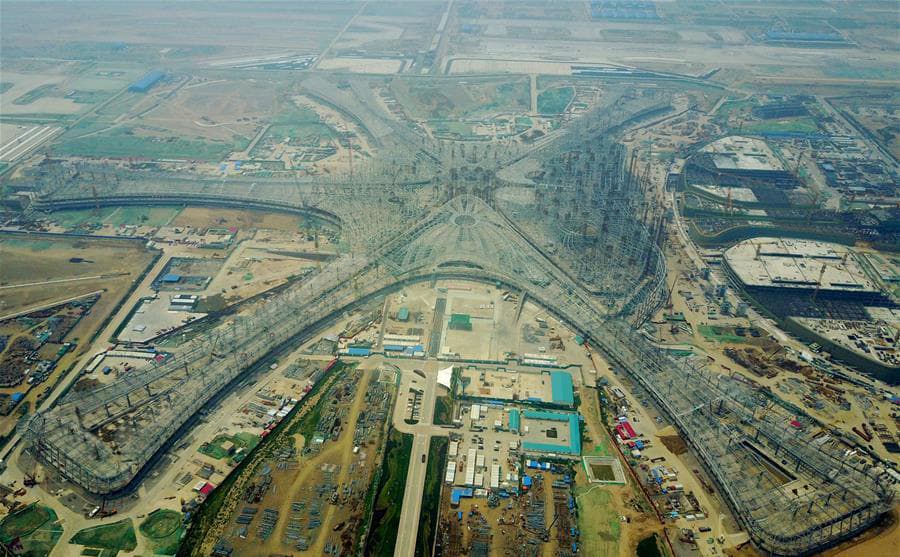
Beijing Daxing International Airport stands as one of the most ambitious infrastructure projects ever undertaken in the field of aviation. Designed to relieve pressure on Beijing’s original airport while supporting China’s long-term economic and transportation goals, Daxing was conceived not merely as an airport, but as a next-generation global aviation hub. The ongoing expansion — including a new terminal and additional runways — aims to raise its capacity to 100 million passengers per year, placing it among the largest and most complex airports in the world.
Behind its futuristic appearance lies a story of immense construction challenges, innovative engineering solutions, and fundamental engineering principles applied at an unprecedented scale. This article explores how engineers transformed a bold vision into a functioning, expandable megastructure.
The Need for Expansion
Air travel demand in China has grown rapidly over the past two decades, driven by population growth, urbanization, rising incomes, and global connectivity. Beijing, as a political and economic center, experiences especially intense air traffic demand. Even before the opening of Daxing Airport, projections showed that a single major airport would be insufficient to serve the region’s long-term needs.
Daxing was therefore planned from the outset with future expansion in mind. The current expansion phase focuses on enlarging terminal capacity and increasing runway numbers to accommodate rising passenger volumes and aircraft movements without compromising safety, efficiency, or passenger experience.
Terminal Expansion: Building at an Extraordinary Scale
Architectural and Structural Complexity
One of the defining features of Beijing Daxing International Airport is its vast terminal building, characterized by a radial layout that minimizes walking distances while maintaining enormous interior spaces. Expanding such a structure presents significant structural engineering challenges.
The terminal roof spans hundreds of meters with minimal internal supports, requiring careful control of structural loads. Engineers had to ensure that the roof could safely resist:
- Dead loads from its own weight
- Live loads from maintenance and equipment
- Environmental loads such as wind, snow, temperature changes, and seismic activity
To achieve this, a complex steel space-frame system was used. This system distributes forces efficiently through interconnected members, allowing large open spaces below while maintaining structural stability. Precision in fabrication and installation was critical, as even small deviations could compound across such a large structure.
Managing Human Movement at Scale
Designing a terminal for 100 million passengers per year is as much a logistical challenge as a structural one. Engineers and planners had to account for:
- Passenger circulation during peak travel periods
- Efficient security screening and immigration processing
- Short transfer distances between gates
- Clear wayfinding in a massive interior space
Advanced modeling techniques were used to simulate passenger flows and identify potential congestion points long before construction. This allowed designers to adjust layouts, corridor widths, and vertical circulation systems to ensure smooth movement even during peak demand.
Runway Expansion: Engineering for Safety and Efficiency
The Importance of Additional Runways
Increasing passenger capacity is not possible without increasing aircraft movement capacity. Additional runways are essential to allow more takeoffs and landings while maintaining strict safety margins. Daxing’s expansion plan includes multiple new runways arranged to allow simultaneous operations under various wind and weather conditions.
Geotechnical Challenges
Constructing runways over large areas requires careful consideration of ground conditions. Engineers must ensure that the soil beneath the runways can support heavy aircraft loads repeatedly over decades without excessive settlement or deformation.
This involves:
- Deep soil investigation and testing
- Ground improvement techniques where soil conditions are weak
- Carefully layered pavement systems that distribute loads evenly
Runway pavements are engineered as multi-layer systems, typically consisting of prepared subgrade, base layers, and high-strength surface materials. Each layer plays a role in durability, drainage, and load distribution.
Integrating Underground Transportation Systems
One of the most innovative aspects of Beijing Daxing International Airport is the integration of multiple transportation systems directly beneath the terminal. High-speed rail, intercity rail, subway lines, and road transport all converge in a single underground hub.
Structural and Vibration Control Challenges
Placing rail infrastructure beneath a massive terminal introduces complex engineering problems. Trains generate vibration and dynamic loads that can affect both structural integrity and passenger comfort above.
To address this, engineers implemented advanced vibration isolation systems, including:
- Structural separation between rail and terminal foundations
- Damping materials that absorb and dissipate vibration energy
- Carefully designed structural joints that allow movement without damage
These measures ensure that high-speed trains can operate safely without affecting airport operations above.
Digital Engineering and Construction Innovation
Building Information Modeling (BIM)
Digital tools played a central role in managing the complexity of the Daxing expansion. Building Information Modeling allowed engineers, architects, and contractors to work within a shared digital environment.
Through BIM, teams could:
- Detect clashes between structural, mechanical, and electrical systems
- Coordinate construction sequencing
- Optimize material usage
- Improve accuracy and reduce costly rework
This level of digital coordination is essential on projects where thousands of components must fit together precisely.
Precision Surveying and Monitoring
Given the enormous scale of the project, traditional surveying methods alone were insufficient. Advanced positioning and monitoring technologies were used to ensure that structural elements were placed accurately and that settlement or deformation could be detected early.
Continuous monitoring systems allow engineers to track structural performance over time, ensuring safety both during construction and throughout the airport’s operational life.
Fire Safety and Emergency Engineering
Large terminals with open spaces and underground connections pose unique fire safety challenges. Conventional prescriptive fire codes are often inadequate for structures of this complexity.
Instead, a performance-based fire engineering approach was used. This involves:
- Simulating fire and smoke scenarios
- Designing smoke control systems tailored to the building’s geometry
- Ensuring safe evacuation routes under worst-case conditions
By analyzing how fire and smoke would behave in real scenarios, engineers could design systems that provide higher safety levels than standard solutions.
Core Engineering Principles at Work
Several fundamental engineering principles underpin the success of the Daxing expansion:
Load Path Continuity
All forces acting on the structure must be transferred safely to the ground. Engineers ensured continuous and redundant load paths so that if one element fails, others can redistribute forces without catastrophic collapse.
Redundancy and Resilience
Critical systems were designed with redundancy, meaning multiple components can perform the same function. This enhances resilience against failure, damage, or extreme events.
Systems Integration
Rather than designing each element in isolation, engineers adopted a systems approach. Structural, mechanical, transportation, energy, and safety systems were designed to function together as a unified whole.
Sustainability and Long-Term Performance
While the scale of the airport is impressive, sustainability was also a major consideration. Large infrastructure projects have long operational lifespans, making energy efficiency and resource management essential.
Key sustainability strategies include:
- Energy-efficient heating and cooling systems
- Use of natural daylight to reduce lighting demand
- Water management systems that collect and reuse rainwater
- Durable materials designed for long service life
These measures reduce operating costs, environmental impact, and long-term maintenance demands.
Looking Toward the Future
The expansion of Beijing Daxing International Airport is not just about accommodating more passengers — it represents a shift in how large infrastructure projects are conceived and delivered. Through advanced digital tools, integrated design, innovative construction methods, and sound engineering principles, the project demonstrates how modern engineering can handle complexity at an unprecedented scale.
As global air travel continues to grow, Daxing serves as a benchmark for future airports worldwide. Its expansion illustrates how careful planning, engineering innovation, and systems thinking can transform massive challenges into functional, resilient, and forward-looking infrastructure.
No responses yet