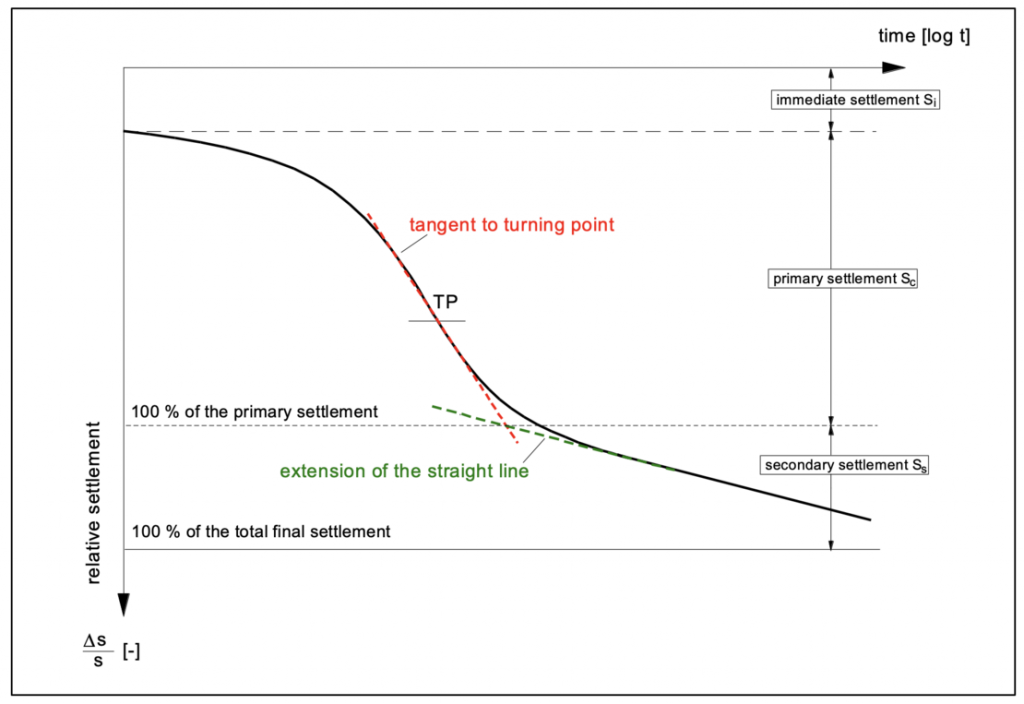
Settlement is one of the most critical serviceability concerns in geotechnical engineering. Even when a foundation is safe against bearing capacity failure, excessive settlement can cause structural damage, cracking, tilting, and functional problems. In fine-grained soils such as clays, settlement occurs gradually over time due to the expulsion of pore water under sustained loading—a process known as consolidation.
This article explains Terzaghi’s consolidation theory, its governing equations, and how civil engineers use it to predict settlement and rate of settlement in real engineering projects.
1. What Is Consolidation?
Consolidation is the time-dependent reduction in volume of a saturated soil due to the drainage of pore water under constant load.
Key characteristics:
- Occurs primarily in clay and silty clay
- Controlled by soil permeability
- Results in long-term settlement
Consolidation is different from:
- Immediate settlement (elastic deformation)
- Secondary settlement (creep)
2. Why Consolidation Analysis Is Important
Consolidation analysis helps engineers:
- Predict total settlement
- Estimate time required for settlement
- Design foundations and embankments
- Decide on ground improvement methods
- Prevent structural distress
Structures such as buildings, embankments, and earth dams are particularly sensitive to consolidation settlement.
3. Components of Settlement
Total settlement (S) consists of three components:S=Si+Sc+Ss
Where:
- Si = immediate settlement
- Sc = primary consolidation settlement
- Ss = secondary compression settlement
Consolidation theory focuses primarily on primary consolidation settlement.
4. Terzaghi’s One-Dimensional Consolidation Theory
Karl Terzaghi developed the classical theory of consolidation based on several assumptions:
- Soil is fully saturated
- Compression occurs only in one direction
- Darcy’s law is valid
- Soil grains and water are incompressible
- Deformation is small
Despite simplifications, the theory provides reliable predictions for many practical problems.
5. Effective Stress Principle
Consolidation is governed by effective stress:σ′=σ−u
Where:
- σ′ = effective stress
- σ = total stress
- u = pore water pressure
When a load is applied:
- Total stress increases immediately
- Pore water pressure initially carries the load
- As drainage occurs, effective stress increases
- Soil compresses, causing settlement
6. Governing Differential Equation
Terzaghi derived the consolidation equation:∂t∂u=Cv∂z2∂2u
Where:
- u = excess pore water pressure
- t = time
- z = depth
- Cv = coefficient of consolidation
This equation relates rate of pore pressure dissipation to soil properties.
7. Degree of Consolidation
The degree of consolidation (U) represents the percentage of total consolidation completed at a given time:U=ScSt
Where:
- St = settlement at time t
- Sc = ultimate consolidation settlement
Engineers often design for a specific degree of consolidation (e.g., 90%).
8. Time Factor and Drainage Conditions
The time factor (Tv) is given by:Tv=Hd2Cvt
Where:
- Hd = drainage path length
Drainage Conditions:
- Double drainage: Hd=2H
- Single drainage: Hd=H
Double drainage significantly reduces consolidation time.
9. Calculation of Consolidation Settlement
Primary consolidation settlement is calculated as:Sc=1+e0CcHlog(σ0′σf′)
Where:
- Cc = compression index
- H = thickness of compressible layer
- e0 = initial void ratio
- σ0′ = initial effective stress
- σf′ = final effective stress
This equation is central to settlement prediction.
10. Laboratory Determination of Consolidation Parameters
Consolidation parameters are obtained using the oedometer (consolidation) test, which provides:
- Compression index (Cc)
- Recompression index (Cr)
- Coefficient of consolidation (Cv)
- Preconsolidation pressure
These parameters directly influence settlement estimates.
11. Normally Consolidated vs Overconsolidated Clays
Normally Consolidated Clay
- Current stress equals maximum past stress
- Exhibits large consolidation settlement
Overconsolidated Clay
- Has experienced higher past stress
- Smaller settlement for same load
Recognizing soil stress history is essential for accurate predictions.
12. Rate of Settlement Prediction
To find time for a given degree of consolidation:t=CvTvHd2
Engineers use charts or tables to determine Tv corresponding to desired U.
This helps predict whether settlement will occur:
- During construction
- Over years or decades
13. Practical Engineering Applications
Consolidation theory is applied in:
- Building foundation design
- Embankment construction on soft clay
- Land reclamation projects
- Preloading and surcharge design
- Vertical drain design
Accurate settlement prediction prevents long-term structural issues.
14. Limitations of Consolidation Theory
- Assumes one-dimensional deformation
- Neglects secondary compression
- Soil properties may vary with depth
- Laboratory conditions differ from field behavior
Engineers often apply observational methods and field monitoring to supplement calculations.
Conclusion
Consolidation theory provides civil engineers with a powerful framework for predicting settlement in saturated fine-grained soils. By applying Terzaghi’s theory, understanding effective stress changes, and using laboratory-derived parameters, engineers can estimate both the magnitude and rate of settlement with reasonable accuracy. Despite its limitations, consolidation theory remains a cornerstone of geotechnical engineering practice and education.
No responses yet