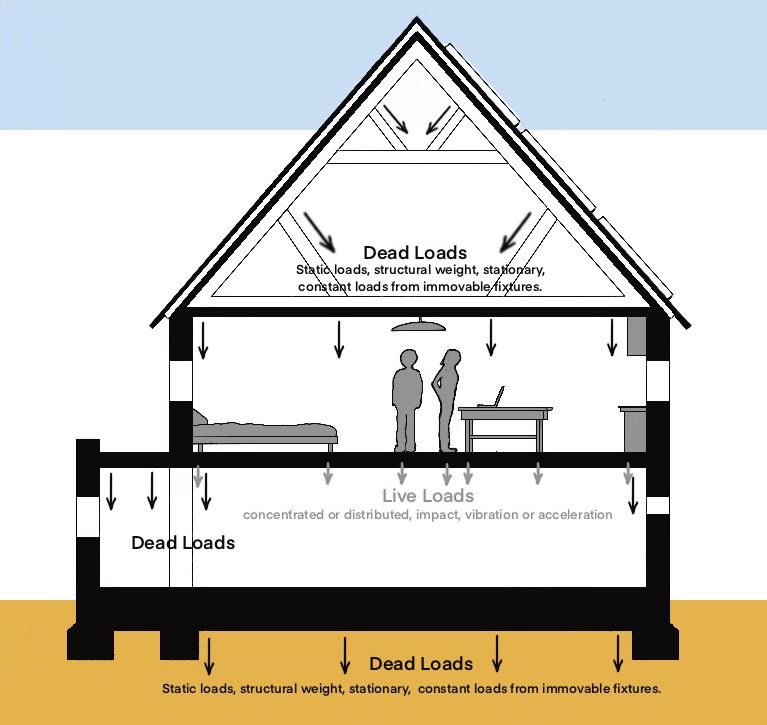
Structural design is fundamentally about ensuring safety under all possible loading conditions a structure may experience during its lifetime. Buildings and bridges are not subjected to a single load acting alone; instead, they experience multiple loads acting simultaneously or in different combinations. Structural load combinations provide a rational framework to account for these realities and ensure that structures remain safe, stable, and serviceable.
This article explains the types of structural loads, the concept of load combinations, and how civil engineers use them in analysis and design, with emphasis on dead, live, wind, and seismic loads.
1. Why Load Combinations Are Necessary
In real structures:
- Dead load is always present
- Live load varies with occupancy
- Wind and earthquake loads act intermittently
- Maximum values rarely occur simultaneously
Designing for each load separately would either be unsafe or overly conservative. Load combinations account for the probability and interaction of loads, ensuring structural safety without excessive cost.
2. Classification of Structural Loads
2.1 Dead Load (DL)
Dead load consists of permanent loads that remain constant throughout the life of the structure.
Examples include:
- Self-weight of beams, slabs, columns
- Walls and partitions
- Flooring, roofing materials
- Fixed equipment
Dead loads are calculated using:Dead Load=Volume×Unit Weight
Dead load estimation is relatively accurate compared to other loads.
2.2 Live Load (LL)
Live load represents transient loads due to occupancy and use.
Examples:
- People
- Furniture
- Vehicles
- Stored materials
Live loads vary with time and location and are specified by building codes based on occupancy type.
2.3 Wind Load (WL)
Wind load results from air pressure acting on the structure.
Characteristics:
- Acts horizontally and vertically
- Depends on wind speed, building height, shape, and exposure
- Causes lateral forces and overturning moments
Wind load is a critical design consideration for tall and slender structures.
2.4 Seismic Load (EL)
Seismic load arises from ground motion during earthquakes.
Key features:
- Inertial forces proportional to mass
- Acts horizontally and vertically
- Depends on seismic zone, soil conditions, and structural system
Unlike other loads, seismic loads are dynamic and reversible in nature.
3. Load Effects in Structures
Loads produce internal effects such as:
- Axial force
- Shear force
- Bending moment
- Torsion
Structural members must be designed to resist the worst combination of these effects, not individual loads.
4. Concept of Load Combination
A load combination is a specified set of loads acting together, each multiplied by a factor reflecting its likelihood and uncertainty.
General form:Design Load=∑(Load Factor×Load)
Load combinations are prescribed by design codes to ensure consistent safety levels.
5. Working Stress vs Limit State Design
Working Stress Design (WSD)
- Uses service-level loads
- Applies factor of safety to material strength
- Less commonly used today
Limit State Design (LSD)
- Uses factored loads
- Checks ultimate and serviceability limit states
- Most modern codes adopt LSD
Load combinations differ depending on the design philosophy used.
6. Load Combinations in Limit State Design
In limit state design, two primary limit states are considered:
6.1 Ultimate Limit State (ULS)
Ensures safety against:
- Collapse
- Overturning
- Structural failure
6.2 Serviceability Limit State (SLS)
Ensures acceptable:
- Deflections
- Cracking
- Vibrations
Each limit state uses different load combinations.
7. Typical Load Combinations (Conceptual)
Gravity Load Combination
1.5(DL+LL)
Used to design beams, slabs, and columns under vertical loads.
Dead + Wind Load Combination
1.2DL+1.5WL
Used for lateral load-resisting systems.
Dead + Seismic Load Combination
1.2DL+1.5EL
Critical for structures in seismic regions.
Reduced Live Load Combinations
Live load is often reduced when combined with wind or seismic loads because the probability of full live load occurring simultaneously is low.
8. Load Combination Logic for Wind and Seismic Loads
Wind and seismic loads:
- Rarely act simultaneously
- Act in opposite directions
- Are treated as exclusive events
Codes specify combinations such as:
- DL + LL + WL
- DL + EL
but generally do not combine full wind and full seismic effects together.
9. Directional Load Combinations
Lateral loads may act in:
- Positive or negative X-direction
- Positive or negative Y-direction
Engineers must check:
- Both directions
- Reversal of forces
This is especially important for seismic design.
10. Structural Design Applications
Beams and Slabs
- Governed by DL + LL combinations
- Checked for bending and shear
Columns
- Governed by axial load + bending
- Sensitive to load combinations involving lateral loads
Lateral Load-Resisting Systems
- Shear walls
- Braced frames
- Moment-resisting frames
These systems are primarily designed using wind and seismic load combinations.
11. Load Combinations in Seismic Design
Seismic design includes:
- Base shear calculation
- Distribution of lateral forces
- Load combinations with reduced live load
Vertical seismic effects may also be considered for critical structures.
12. Common Mistakes in Load Combination Analysis
- Ignoring reduced live load factors
- Applying wrong load factors
- Forgetting load reversals
- Combining incompatible loads
- Designing for service loads instead of factored loads
Avoiding these errors is crucial for safe design.
13. Role of Design Codes
Structural load combinations are specified in:
- National building codes
- International standards
Codes ensure:
- Uniform safety levels
- Consistency across designs
- Legal compliance
Engineers must always follow the governing design code for their project.
14. Importance in Exams and Professional Practice
Load combinations are:
- Frequently tested in structural engineering exams
- Central to software-based structural analysis
- Critical for peer review and design checks
Understanding the logic behind combinations is more important than memorizing equations.
Conclusion
Structural load combinations provide a systematic way to account for the simultaneous action of dead, live, wind, and seismic loads. By applying appropriate load factors and considering realistic loading scenarios, civil engineers can design structures that are both safe and economical. Mastery of load combinations is essential for understanding structural behavior, complying with design codes, and ensuring long-term performance of engineering structures.
No responses yet