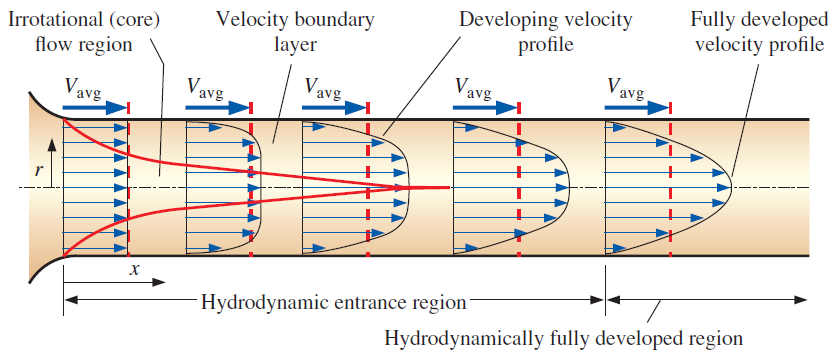
Fluid flow in pipes is a core topic in civil engineering, forming the foundation of water supply systems, sewer networks, irrigation canals, fire protection systems, and industrial pipelines. Engineers must predict how pressure, velocity, and elevation change along a pipeline to ensure adequate flow, prevent pipe failure, and optimize energy usage.
Two fundamental principles govern most pipe-flow problems: the Continuity Equation and Bernoulli’s Equation. This article explains these principles, their assumptions, and shows how civil engineers use them systematically to solve real engineering problems.
1. Importance of Pipe Flow Analysis in Civil Engineering
Pipe flow analysis is essential for:
- Designing water distribution systems
- Sizing pipes and pumps
- Estimating pressure losses
- Preventing cavitation and pipe bursts
- Ensuring adequate supply at consumer points
Accurate analysis ensures systems are safe, economical, and efficient.
2. Types of Flow in Pipes
Before applying equations, engineers classify flow:
Steady vs Unsteady Flow
- Steady flow: flow properties do not change with time
- Unsteady flow: flow properties vary with time
Uniform vs Non-Uniform Flow
- Uniform flow: velocity constant along pipe length
- Non-uniform flow: velocity varies with position
Most basic pipe-flow problems assume steady, incompressible, uniform flow.
3. Continuity Equation
The continuity equation is based on the conservation of mass.Q=AV=constant
Where:
- Q = discharge (m³/s)
- A = cross-sectional area (m²)
- V = velocity (m/s)
Application of Continuity Equation
If a pipe diameter changes:A1V1=A2V2
This shows that:
- Decreasing pipe area increases velocity
- Increasing area reduces velocity
This principle is fundamental in nozzle design, pipe transitions, and flow measurement devices.
4. Bernoulli’s Equation
Bernoulli’s equation expresses conservation of energy for flowing fluids.γp+2gV2+z=constant
Where:
- γp = pressure head
- 2gV2 = velocity head
- z = elevation head
Each term represents energy per unit weight of fluid.
5. Assumptions of Bernoulli’s Equation
Bernoulli’s equation applies under the following conditions:
- Steady flow
- Incompressible fluid
- Inviscid flow (no friction losses)
- Flow along a streamline
- No energy addition or loss
Real pipe flows violate some of these assumptions, requiring modifications.
6. Modified Bernoulli’s Equation for Real Pipe Flow
To account for real conditions, engineers include:
- Head loss (hLh_LhL)
- Pump head (hph_php)
- Turbine head (hth_tht)
γp1+2gV12+z1+hp=γp2+2gV22+z2+hL+ht
This equation forms the backbone of pipe network analysis.
7. Head Loss in Pipes
Major Head Loss (Friction Loss)
Given by the Darcy–Weisbach equation:hf=fDL2gV2
Where:
- f = friction factor
- L = pipe length
- D = pipe diameter
Minor Head Losses
Caused by:
- Bends
- Valves
- Sudden expansions or contractions
hm=K2gV2
Minor losses can be significant in short pipe systems.
8. Solving Pipe Flow Problems: Step-by-Step Approach
Step 1: Define the System
- Identify pipe sections
- Note elevations and diameters
- Mark pumps and fittings
Step 2: Apply Continuity Equation
- Determine velocities in different sections
- Ensure mass conservation
Step 3: Apply Bernoulli’s Equation
- Choose two points along the pipe
- Include head losses and pump heads
Step 4: Calculate Head Losses
- Compute friction loss using Darcy–Weisbach
- Add minor losses
Step 5: Solve for Unknowns
- Pressure
- Velocity
- Discharge
- Pump power
9. Conceptual Worked Example
Given:
- Horizontal pipe
- Diameter reduces from D1 to D2
- Known discharge Q
Solution Outline:
- Use continuity to find velocities
- Apply Bernoulli between sections
- Include head loss due to contraction
- Solve for pressure difference
This approach mirrors real design calculations.
10. Practical Engineering Applications
Bernoulli and continuity equations are used in:
- Water supply pipelines
- Firefighting systems
- Irrigation networks
- Venturi meters
- Pump selection and sizing
They are also embedded in hydraulic modeling software, making understanding the theory essential.
11. Limitations and Common Errors
Limitations
- Inaccurate for highly turbulent or compressible flow
- Assumes uniform velocity profile
- Sensitive to friction factor estimation
Common Mistakes
- Ignoring head losses
- Incorrect sign convention
- Misuse of continuity in branched systems
12. Importance in Exams and Professional Practice
This topic is:
- A core component of fluid mechanics courses
- Frequently tested in competitive exams (FE, GATE, PE)
- Essential for interpreting simulation results
A strong grasp ensures both academic and practical competence.
Conclusion
The continuity equation and Bernoulli’s equation form the theoretical foundation for analyzing fluid flow in pipes. By understanding their assumptions, limitations, and proper application, civil engineers can solve complex engineering problems involving pressure, velocity, and energy efficiently. These principles bridge theory and practice, enabling safe and economical hydraulic system design.
No responses yet